name: Introduction to Bitcoin & Stablecoin goal: An In-Depth Look at Bitcoin, Stablecoins, & the Sovereignty That Comes With Them objectives:
- Understanding the historical evolution of money and the primary pain points resulting from our current financial system.
- Developing a comprehensive understanding of Bitcoin, differentiating it from traditional fiat currencies.
- Examining the role of stablecoins, specifically Tether, in financial stability and as a bridge between Bitcoin and traditional fiat currencies.
- Identifying and debunking common misconceptions surrounding Bitcoin and stablecoins.
Have you ever wondered:
Why is my cost of living continuing to rise? Is inflation really good for me? What options are available to help me protect against inflation? How does Bitcoin or stablecoins fit into all this?
If you answered yes to any of these questions, you're in the right place.
Welcome to "Opting In To Change," where we delve beneath the surface of our monetary systems while looking at some available tools for creating positive change. As our world grapples with encroaching threats to freedoms and escalating human rights violations, this course attempts to offer a guiding light—an alternative system that restores control back into the hands of the individual.
If what you've just read has piqued your interest, we hope you'll join us on this educational journey.
What To Expect:
Beginner friendly Roughly 3 hours of self-paced content Interactive quizzes to test your knowledge Written by industry professionals Examples from across the globe and from all walks of life
Requirements: A passion for learning
This course has been sponsored by TETHER
Introduction
Course overview
2eaf5947-8180-540e-9418-c40bf04e07ce Welcome to the ECO104 course!
We live in a world where:
● A mere 20% of people reside in societies deemed "democratically free." Yet, even within this privileged fraction, human rights violations are increasingly commonplace— from frozen bank accounts to censorship. The remaining 80% find themselves grappling with the encroachment of authoritarian rule. Just two decades ago, nearly half of the world's population enjoyed the most basic freedoms.
● 1.4 billion adults worldwide remain unbanked, while countless others are restricted to limited banking services.
● By the end of 2022, nearly half the world faced double-digit inflation rates, eroding the value of hard-earned money. To put this in perspective, with an inflation rate of 10% over a decade, you would lose a staggering 65% of your purchasing power.
● And even without sustained periods of such inflation, the USD, arguably the strongest global currency, has witnessed a 96% loss of purchasing power over the last century.
These are some of the harsh truths of our global economic environment. Our financial systems fall woefully short of meeting the needs of the majority of the population. These systems perpetuate inequality, exclude many, and disempower billions of people globally.
If you find yourself burdened by the relentless pressures of rising prices or the lack of financial inclusion in our current system, if it's any consolation, know that you are not alone. These are the by-products of our present-day monetary system.
Despite our seemingly gloomy outlook, our focus with this course is not to fixate on the challenges of our present circumstances. Instead, we want to redirect our attention toward achieving liberation and financial empowerment.
That said, this course isn't solely for those facing rampant inflation or limited access to financial infrastructure or banking services. Whether you are already somewhat familiar with these issues or simply eager to expand your knowledge, this course is designed to benefit anyone looking to enhance their understanding and acquire the tools necessary to overcome these barriers and regain financial sovereignty.
With this in mind, our mission is to bring you up to the forefront of change in our current financial landscape, challenge the existing norms and offer alternative solutions. By delving into the history of money, demystifying Bitcoin, and exploring Tether and the world of stablecoins, we aim to inspire individuals to reimagine their financial future.
What to expect:
Module 1: The Price of Progress - A Closer Look at Our Financial System We begin our exploration by peering behind the curtains of our current financial system, where financial censorship, wealth inequality and inflation plague our daily lives. Through a brief history of money, we will look at how we found ourselves where we are, shedding light on some of the primary pain points we're all experiencing.
Module 2: Financial Liberation - An Introduction to Bitcoin This module will demystify Bitcoin, transcending the jargon to help you understand what differentiates Bitcoin from traditional fiat currencies. From how it works to how to use it, we guide you through the functionality and ways of interacting with Bitcoin.
Module 3: Stability Amidst Chaos - An Introduction to Tether & the World of Stablecoins In this module, we take a look under the hood of the leading stablecoin, Tether, exploring how this digital currency maintains its value and has the potential to give freedom to those facing an overbearing government, lack of financial services or rampant inflation.
Module 4: Overcoming Doubts - Debunking Common Misconceptions & Real-World Use Cases To finish, we will challenge the common misconceptions surrounding Bitcoin and stablecoins and offer real-world use cases of individuals who have already embraced and are benefiting from these technologies.
By the end of this course, you will not only have gained powerful knowledge and invaluable tools for navigating our complex financial landscape, but you will also better understand how Bitcoin and stablecoins, such as Tether, empower users by enabling them to opt into an alternative monetary system— one that prioritises the individual, giving anyone greater control of their financial situation. With this understanding, you will be better equipped to pursue financial freedom, personal empowerment, and liberation.
We are excited to have you join us on this journey into the depths of our monetary system.
The Price of Progress - A Closer Look at Our Financial System
An Introduction to Money
Money is a fascinating and essential part of our daily lives. We use it daily to buy groceries, pay bills, and make countless transactions. But what is money, really? At its core, money is simply a medium of exchange, a tool that allows us to trade goods and services with one another. It's an abstract concept we all take for granted, yet it's fundamental to our economic system.
But not all money is created equal. Some forms of money are better than others, depending on their ability to serve as a store of value, a medium of exchange, and a unit of account. Gold, for example, has been highly valued for thousands of years because of its durability and scarcity. On the other hand, paper money is only as valuable as the trust we place in the institutions that issue it.
In this module, we'll explore money's different functions and characteristics and what makes good money. Whether you're an average Joe, a business owner, an investor, or simply curious about the world of finance, our goal is to assist you in gaining a deeper understanding of this abstract yet essential concept that touches all our lives. So let's dive in…
What is money?
In its simplest form, money can be understood as the medium by which two parties agree to settle an exchange of a product, good or service.
Money allows us to swap our resources or services for a store of value, regardless of whether we have an immediate use for this stored value. This has allowed our civilisation to expand and grow much more efficiently than it otherwise would have if we had continued to rely on practices such as barter.
For the average person, money holds its value as there are only two methods to obtain money:
- We must expend time and energy in return for money (i.e. work, labour, services).
- We must trade goods or resources in return for money.
It is important to note that in the second point above, in order to obtain these goods and resources to trade, someone at some stage had to spend the time and energy to create them. We can thus deduce that we must expend time and energy to obtain money. Therefore:
Money = Time + Energy
By viewing money as a store of time and energy, metaphorically speaking, we can better understand that money is essentially a battery– a store of energy that can be used at a later date. With this analogy in mind, the evolution of money, in theory, is this constant search for the most efficient battery to store time and energy.
What makes great money?
As you read the introduction, you may have noticed three important terms: store of value, medium of exchange, and unit of account. Don't worry if you're unfamiliar with this lingo. These three functions are essential for money to provide value to its holder and are commonly referred to as the functions of money.
Let's take a look at each one:
- Store of Value: Money serves as a means of storing value for future use, enabling the holder to preserve their purchasing power over time. By doing so, it provides the holder with the ability to save and plan for the future. Gold serves as a prime example of such a store of value, as it has for centuries been able to purchase a decent suit with just one ounce.
- Medium of Exchange: For money to serve as a viable medium of exchange for goods and services, it must be easily exchanged. While any asset can technically be used as money, larger and immovable assets like houses are not practical for use as a medium of exchange.
- Unit of Account: Finally, money should function as a standard unit of measurement for the prices of goods and services. This means that items are priced and valued in terms of this money, allowing for easy comparison of the relative worth of different products and services.
When these three essential functions of money are met in their entirety, such money has the ability to meet the rigorous demands of trade. Without these functions, money is far less reliable and trustworthy, leading to insecurity and uncertainty in trade, which can have damaging effects on both a personal and national level.
With this in mind, when the money we use offers us a reliable means of storing value, an effective method of facilitating transactions, and a common measure of value, it enables us to save and build wealth, trade confidently and transact with ease. These functions together not only assist us in our capacity to trade and save but also lay the foundation for a stable and efficient economic system, fostering greater economic growth and prosperity for individuals and societies.
You're probably thinking, "Ok, I understand that for money to offer value, it must meet the functions of money laid out above, but how does it do that?"
Great question...
The concept of great money may seem complicated, but at its core, it is defined by certain essential characteristics that enable it to function as a reliable and effective store of value, medium of exchange, and unit of account. These elements are collectively known as the characteristics of money. By understanding the connections between the characteristics of money and its functions, we can develop a deeper understanding as to why certain money is preferable to others.
Characteristics of Money
Store of Value
For money to maintain its purchasing power over time, it must be:
Durable: When we talk about money being durable, we are referring to its ability to withstand the wear and tear of time and use. A durable store of value means that the money will retain its value over time, regardless of any physical or environmental factors that may cause it to deteriorate. For example, if you store your money in gold, it will retain its value and shine even if the coins it represents were to become obsolete. Durable money is important because it allows us to save our wealth over time without fear of losing its value.
Scarce: When money offers scarcity, we mean a limited available supply. This is important for a store of value because if there is too much of a particular currency, it can decrease in value. A scarce currency is more likely to hold its value over time, making it a reliable store of wealth. Think of it like a limited edition item - if there are only a few of them, they are more valuable and sought-after than if there were a limitless supply. Similarly, a scarce currency is more likely to hold its value and maintain its purchasing power, making it a better option for storing wealth.
Immutable: For money to offer immutability, it should be impervious to reversal or alteration once a transaction has been made. This is a crucial characteristic of a reliable store of value because it ensures that the value of the money is not subject to arbitrary changes or manipulations. For example, if you purchase something with cash, you cannot later change your mind and reverse the transaction. Similarly, with cryptocurrencies like Bitcoin, once a transaction has been recorded on the blockchain, it cannot be altered or reversed. This immutability provides a sense of security and reliability for both buyers and sellers in financial transactions.
Medium of Exchange
For money to be an effective intermediary for buying and selling goods and services, it must be:
Portable: When we talk about money being "portable," we mean that it is easy to carry and transport from one place to another. This is an important characteristic of a medium of exchange because it enables us to use money to buy and sell goods and services in different locations. For example, if you wanted to buy a coffee from a café, you could use your portable money (such as cash or a credit card) to pay, no matter where you are. In contrast, if you had to carry around large, heavy objects as a means of exchange, it would be much more difficult to use them in transactions.
Divisible: This is a critical characteristic of a good medium of exchange, which refers to the ability of money to be divided into smaller units to facilitate transactions of varying sizes. For example, making small purchases would be challenging if we only had large denominations of money. Divisibility allows us to make exact payments, regardless of the transaction size, making money more useful and practical in everyday life. Essentially, the more divisible a currency is, the more convenient it is for individuals to use and transact with.
Accepted: When we discuss acceptability, we are referring to whether there is widespread acceptance of a particular form of money. This means that people are willing to accept and use this form of money as a means of exchange for goods and services. If a currency is widely accepted, it becomes easier for people to engage in trade, as there is a common currency to buy and sell goods and services. The more widely accepted a currency is, the more valuable it becomes, as more people are willing to use it. Conversely, if a currency is not widely accepted, it loses its value, as people will hesitate to accept it as a means of exchange.
Unit of Account
For money to be used as a common measure of the value of goods and services, it must be:
Fungible: When money is said to be fungible, every unit of currency is interchangeable with any other unit. In simpler terms, it means that money is uniform and identical, regardless of where it came from or who owns it. For example, if you owe someone $10 and you give them a $10 bill, it doesn't matter if the bill came from your wallet or someone else's wallet. As long as it's a genuine $10 bill, it's considered to be of equal value. The concept of fungibility is important because it allows money to function effectively as a common unit of measurement, making transactions simpler and more efficient.
Conclusion
Money is a crucial and fascinating part of our daily lives. It serves as an intermediary, allowing us to trade goods and services with one another. However, not all money is created equal. Some forms of money are superior as a store of value, like gold coinage, while others may be more effective as a medium of exchange, the US dollar. However, when these functions are met in their entirety, it enables us to transact confidently and with ease, which not only assists us as individuals but fosters greater economic growth and prosperity for our economy.
In the upcoming modules, we'll explore two popular forms of money: Bitcoin and stablecoins. By examining them through the content discussed in this section, we'll explore how they fulfil the various functions of currency and how they can greatly benefit society.
From bartering to the invention of coins and paper currency, money has undergone a series of transformations to adapt to the ever-changing needs of society. As we move on to the next chapter, let's alter course, directing our attention toward the evolution of money.
An Examination of How We Got Here
From the days of bartering goods to the modern era of digital currencies, money has undergone a fascinating evolution. Our forefathers used shells, beads, and even livestock as a medium of exchange. Today, we have virtual wallets and contactless payments. It's a remarkable journey that has seen countless iterations, trade-offs, and adaptations to meet the ever-changing needs of society.
But how has the money we use evolved to become the indispensable part of our lives that it is today? In this section, we will explore the evolution of money, from its earliest forms to the modern digital currencies we use today. We will delve into each major iteration of money, looking at how they have helped shape our modern society.
A quick note: It’s important to highlight that this section is not necessarily a chronological account of the evolution of money. Instead, it is more of an educational journey on the rise and fall of different forms of money. Many of these mediums of exchange have existed simultaneously, and some still exist today in some way, shape or form.
After reading this introduction, you might wonder: Why does money need to evolve and change over time?
The answer is simple: our needs and wants change as society and technology advance. And as our needs and wants change, how we use and value money changes, too. For example, in ancient times, people relied on bartering to exchange goods and services, but as societies became more complex, it became clear that a standardised and portable form of currency was needed. This led to the development of coins, which were eventually replaced by paper money and, more recently, digital currencies. Each iteration of money has its pros and cons, and as technology and society continue to evolve, we will most likely see even more changes in how we use and value money.
Understanding this concept of monetary evolution is important because it helps us see how money has changed over time and how it might continue to change in the future.
With this in mind, let's take a look at the primary forms of exchange that are either in use today or have been used at some point in the past.
- Bartering: The exchange of goods or services directly without the use of money.
- Commodity Money: The exchange of an agreed-upon commodity that is deemed to be of value, such as salt or sea shells.
- Coined Money: The use of precious metals, such as gold or silver, in the form of coins as a medium of exchange.
- Metal-Backed Paper Money: Paper money backed by a physical commodity, such as gold or silver.
- Fiat Money: Currency that is not backed by a physical commodity but rather has value because a government declares it to be legal tender.
- Cryptocurrencies: Digital or virtual tokens that use cryptography to secure transactions and control the creation of new units.
With these in mind, let's examine each one to gain a more holistic understanding of how we ended up where we are today.
Barter
Bartering! It's a simple concept: you trade something you have for something you want or need.
But is it practical?
The problem with bartering is that finding someone who wants what you have and has what you want can be challenging. For example, imagine you're a wheat farmer in need of a new shirt. You might have to search far and wide to find a shirtmaker willing to trade a shirt for your wheat. But what if the shirtmaker doesn't want your wheat? This problem is known as the double coincidence of wants. A successful transaction requires a double coincidence of wants, meaning that both parties must have something the other wants to trade.
Another problem with bartering is that it can be impractical for certain items. How would you split a live cow to trade for a pair of shoes? And without a standardised unit of account, comparing the value of goods and services is tough. Is a cow worth more or less than ten sacks of wheat or two rolls of cloth?
On top of all that, many goods and services are perishable and lose value over time. So if you're relying on bartering as a means of exchange, you must continuously trade and consume your goods and services to avoid a loss of value.
Despite these challenges, bartering is still used in certain situations. You'll often see barter used during online marketplace transactions, or in countries where the currency has failed to offer a store of value, people seek to store value in goods. That said, it is not widely accepted.
All in all, barter may have been an effective and widely used method to trade goods in ancient times, but it had one major flaw: the "coincidence of wants." In other words, for a successful barter exchange to occur, two parties must have something the other wants. This can be a real headache and lead to many fruitless negotiations. Thankfully, we have moved beyond barter and have developed better ways to exchange goods and services.
Commodities
As barter started to show its weakness in trade, individuals and economies alike desperately needed an alternative. Fortunately, with the emergence of commodities as a medium of exchange, our needs were satiated... temporarily. By pre-defining a commodity everyone recognised as valuable, we had our first form of money that acted as an intermediary to reduce trade friction.
The great thing about selecting a pre-defined medium of exchange was that communities could select something that offered scarcity and didn't spoil, making it a more durable store of value. Things like glass beads, salt, and seashells quickly became sought after as they were counted, fairly durable, and portable in sacks. Salt, in particular, was popular because it had utility - curing meats, among other things.
However, as travel became easier, the world started to open up, and people recognised that scarce resources in one area were abundant in others. This led to exploitation, dilution of supply, and triggered events like the slave trade. For example, European settlers exploring Africa saw that the local communities were using glass beads as a form of money. Baffled, due to the ease of glass production in Europe, settlers would bring large amounts of these beads to Africa, diluting their value. Some would even argue that this dilution was one of the triggers that ignited the slave trade, which contributed to the collapse of the African economy.
Overall, commodity money played an essential role in the development of trade and commerce, as it provided a standardised means of exchange that was widely accepted. However, as societies became more advanced, other forms of money that were more convenient and divisible began to emerge.
To solve these problems, people began searching for commodities that had globally recognised scarcity, which gave rise to the use of precious metals as a medium of exchange.
Coined Money
While still technically commodity money, as humans continued their quest for superior money, they stumbled upon an unexpected hero: precious metals. Not only were these metals beautiful and coveted for their use in jewellery, but they also ticked many of the boxes for what makes an excellent monetary asset. Their globalised scarcity in nature and the significant investment required to mine, refine, and store these metals gave them a premium above other previous forms of money.
Moreover, metals such as gold were one of the most inert elements in the periodic table, making them extremely durable and corrosion-resistant.
As technology progressed, gold and silver underwent a transformative process, being melted, shaped, and stamped into coins, increasing the ease of exchange. The standardised value and markings on these coins notably decreased the costs associated with verifying the weight and purity of precious metals. But, as with most good things, someone always finds a way to take advantage. Coin clipping became rampant, with both individuals and governments clipping portions of the coins to reduce their weight of precious metal while attempting to retain their original face value. This led to the first form of currency devaluation, leading to inflation.
To make matters worse, as the world became more global, gold and silver became increasingly cumbersome to transport and transact with, especially for seafarers.
Metal-Backed Paper Currency
Enter metal-backed paper, a solution to the considerable costs of transportation and risks of loss associated with precious metals. But, as we will see, this solution had its own challenges to overcome.
We've come a long way from the days of bartering and trading goods. With the advent of monetary metals, we finally had a stable store of value that could be used universally. But it was the introduction of metal-backed paper currency that really revolutionised the way we transact.
Think about it: no more lugging around heavy bags of gold or worrying about theft. Instead, individuals could deposit their gold at a warehouse and receive a receipt they could trade just like physical gold. This enhanced the fungibility, divisibility and portability of money, making global trade significantly easier. These receipts could then be easily transported over long distances, making it possible to conduct international trade without incurring significant transportation costs. Although it took a little while for metal-backed paper as a form of money to take off, with the expansion of the British Empire, it quickly became the norm.
But as with any new technology, issues began to emerge.
First, gold warehouses, recognising that their customers rarely came back to withdraw the gold that the receipts laid claim to, started issuing paper receipts with no gold backing, leading to the covert creation of the first fractional reserve banking system (issuers only hold a fraction of customers' deposits as reserves and lend out the rest). And even when countries tried to back their currencies with gold, they often abused the system, leading to economic turmoil.
Second, metal-backed paper money was not immune to counterfeiting. Even with security features, counterfeiters could still create fake notes that could be difficult to detect.
Although metal-backed paper currency had its fair share of problems, its enhanced fungibility, divisibility, and portability paved the way for the convenience of fiat currencies we use today, where practicality often trumps scarcity.
Fiat Currency
Fiat currencies have been the foundation of our monetary system for decades. The term "fiat" is Latin for "let it be done" and refers to the state's authority to declare a currency as legal tender. Unlike currencies once backed by gold or other valuables, fiat value comes from the government's promise that someone will accept it in exchange for goods and services.
Fiat currencies emerged as countries faced frustration around metal-backed paper currency– governments would have to obtain more gold to print more paper money. This was a hindrance, so whenever a country needed capital, it would temporarily abandon this peg and expand its monetary supply. This new currency was backed by nothing but faith in the government owing to the fact that it was legal tender. Not only that, this new currency devalued the remaining currency in circulation by inflating the supply of money, and with more dollars chasing the same amount of goods, prices rose.
The demise of metal-backed paper currency started at the tail end of World War II. With much faith in the US, global leaders met in Bretton Woods, New Hampshire, and determined that the US would peg their dollar to gold and the rest of the world would peg their currency to the dollar. This meant that most of the world's gold poured into the US for safekeeping, depleting many countries of their domestic gold reserves.
Fast forward to the late '60s and early '70s, the US, feeling restricted by its backing to gold, started to expand their money supply to fund the war in Vietnam. France was not happy about this and demanded their gold back. This caused a rush for gold, and as the US had printed significantly more dollars than the gold it had available, it quickly dropped this peg altogether. This event, known as the Nixon Shock, meant that individuals and countries could no longer redeem their dollars for gold. From this day on, we saw the proliferation of fiat currencies– a currency that is backed by nothing but debt and our faith in the government.
However, monetary evolution didn't stop there. With advancements in technology, fiat currency has continued to evolve. Today, digital transactions have become increasingly common, with internet banking and digital payment systems like Visa, Mastercard, Paypal, Square, and Venmo becoming the norm.
And in more recent years, we have witnessed increased discussion around central bank digital currencies (CBDCs), the newest iteration of fiat currency, offering a wholly centralised and programmable version of our traditional fiat currencies.
CBDCs differ from the fiat currencies we are used to because they give the issuer total visibility into all transactions and the ability to decide who can and can't use the currency. Governments and central banks have been vocal about their ambitions of introducing CBDCs, citing benefits such as centralised control, improved transaction efficiency, and the ability to deposit stimulus checks quickly.
While CBDCs offer many advantages, they also come with some serious potential drawbacks. For example, governments may be able to freeze bank accounts arbitrarily, put time limits on our cash to promote consumption and restrict who we can and can't transact with.
Moreover, the potential for a transition towards digital identities is becoming more prevalent, as seen in China with their CBDC and the introduction of social credit scores, which have impacted freedom throughout the country by preventing access to housing, financial institutions, and basic mobility rights.
As CBDCs are largely untested, we cannot say for sure what the pros and cons will be. However, we can be sure that CBDCs give governments and banks immense control over our monetary system.
Fiat currencies have certainly undergone significant changes in recent times, largely driven by the rise of the digital economy. To meet the evolving needs of consumers, fiat currencies have adapted accordingly. However, with the emergence of CBDCs, we must remain cautious of their potential drawbacks despite their benefits in terms of speed and efficiency.
With this in mind, individuals who have witnessed the erosion of purchasing power and rising government control alongside the proliferation of fiat currencies have started exploring alternative options.
Cryptocurrencies
Imagine a world where your money could be stored and exchanged digitally without any need for intermediaries or trusted third parties. A world where the supply of money was tamperproof, scarce and in the hands of the community rather than governments or banks. This is the world that the leading cryptocurrency, Bitcoin, has created since its inception in 2009.
Bitcoin was born out of a cryptographer's quest to create a new and improved version of our beloved monetary metals. They were looking for digital gold, a monetary asset that could store value, offer durability, and be used for digital transactions. And thus, Bitcoin emerged as the first successful, digitally native, and scarce monetary asset.
What makes Bitcoin truly unique is that it is a digital bearer instrument, meaning there is no need for intermediaries or trusted third parties. The monetary policy is controlled by those participating in the ecosystem, making it impossible to dilute or tamper with in the same ways that were endemic in previous forms of money. And as Bitcoin exists outside the control of governments and central banks, it is quickly becoming widely adopted as an alternative monetary system because it cannot be manipulated.
Since its inception, Bitcoin has continued to grow in its acceptance and adoption as a monetary good. In fact, it is currently growing at a rate of 137% per year, compared to 76% for the growth of the internet at the same age. And while other cryptocurrencies have been introduced in recent years, none have challenged Bitcoin's status as a superior monetary good.
Some naysayers claim that Bitcoin is slow, expensive to transact with, and wastes energy, but let's not be so quick to judge. What if we told you that Bitcoin represents a paradigm shift in the way we think about money and value?
In the coming modules, we will explore Bitcoin through an alternate lens, one of objectivity and intrigue. So bear with us.
In the meantime, while central bank digital currencies may be viewed as Bitcoin's direct competition, many argue that they are no different from any other digital fiat currency except for frightening political and social implications.
As we continue to move towards a world of programmable money, Bitcoin remains in a league of its own. Its supply cannot be diluted or expanded, it has the largest network effects and user base, and its value proposition and security will continue to strengthen as the network grows. And while it may not be the newest digital currency, it offers something far more valuable: true sovereignty over one's own money.
That said, although digital currencies represent a new frontier in the evolution of money, offering a high degree of security, privacy, and convenience, they also come with their own risks and challenges, which must be carefully considered before adopting them as a form of money.
After examining the different forms of money throughout history, this brings up a pertinent question:
Are we headed in the right direction?
Throughout this journey, we have explored the fascinating evolution of money, tracing its evolution from bartering to our current digital age. We have seen various currencies rise and fall, from shells and beads to precious metals and fiat money.
However, as we have seen, the path of monetary evolution has not been without its challenges. The rise of coin clipping and currency manipulation, the move towards centralisation and away from a generally accepted medium of exchange are just a few examples of the obstacles we have faced along the way.
As we move forward into the future, we must ask ourselves, how will currency manipulation continue to affect our financial well-being?
And, although it is clear we have prioritised ease of use as we have transitioned from barter to commodities to digitalised currencies, should we rethink what characteristics we value most in the perfect form of money?
These are complex questions that require careful consideration and reflection. However, one thing is clear - the future of money is in our hands. We have the power to shape our money, ensuring that it serves the needs of society rather than simply the issuer or our governments.
As we continue our exploration of the world of money, it's important to acknowledge the significant changes that have taken place since the rise of fiat currencies. While these currencies have brought a level of convenience and stability, they have also presented new challenges, such as inflation, rising debt levels, and wealth inequality. In the next section, we will delve deeper into these issues, and in the following modules, we'll explore potential solutions to these tricky problems.
A Look at Where We Are and What We Can Expect Moving Forward
As we discussed in the previous chapter, historically, money has often been backed by a commodity like gold. The benefits of this cannot be overstated. Not only did this connection mean that such money’s value was directly tied to the value of the commodity, but it also meant that the currency issuer, typically the government, was limited in how much money it could print as it would have to obtain more gold.
However, as we moved away from the gold standard, over the last 100 years, money has increasingly become more centralised, with central banks like the Federal Reserve and the US central bank gaining more control over the direction of money.
Today, central banks, alongside the treasury, basically have free reign over the direction of money and the monetary system. They possess the ability to increase the supply of money whenever they deem it necessary, as well as adjust interest rates to promote economic growth, and even provide bailouts to failing banks and businesses.
…but as with any form of intervention, there is no free lunch.
When central banks decide to intervene, although they may be able to print money out of thin air, they can’t create value. For this newly printed money to be worth something, its value must come from the previous currency holders.
What do we mean? Think of the money supply as a pizza, and imagine it cut into four slices. Doubling the money supply would not be equivalent to doubling the amount of pizza. Instead, it would be equivalent to cutting those four slices in half to create eight slices. We have not gained any additional pizza. We just have more slices, each smaller in size.
When we print more money, we devalue the money that is already in existence.
For central banks to bail out one area of the economy, they must take from another. Hence, there is no free lunch.
And with money no longer being tied to a commodity such as gold, there are fewer checks and balances that the government has to follow, giving them greater power to intervene whenever they feel it is necessary. For example, during economic downturns like the ones we faced in 2000, 2008, and 2020, central banks were able to intervene to levels never before seen. Injecting trillions of fresh dollars into the economy in an attempt to stabilise the financial markets.
This intervention has come at a significant cost to small businesses, the wage earner and the long-term stability of the economy, as this increased intervention has led to a ballooning of the national debt and rising inflation. This, as I am sure you can guess, has led to a rise in the cost of living, making it more difficult for individuals and families to afford basic necessities.
Overall, the centralised nature of money today has given central banks an unparalleled degree of power to intervene in the economy. While this may appear beneficial during times of economic hardship, it can also result in significant drawbacks like increased debt and inflation. With this in mind, let's take a look under the hood at these seemingly innocuous terms, debt and inflation and examine some of their byproducts.
Before diving in, you may notice that we reference the US as you read the following text. Considering the US dollar is the global reserve currency, what happens to the dollar will have downstream effects on all global economies and currencies. Therefore, we highlight some of the problems within the US system to illustrate the global challenges we face. Often, if you examine your own local jurisdiction, you may find that the state of affairs in your home country is potentially more dire.
Inflation
Inflation is an increase in consumer prices or a decline in the purchasing power of money due to monetary expansion. And it can be better understood as too many dollars chasing not enough goods, causing prices to rise.
As mentioned earlier, a useful analogy for the money supply is a pizza. When central banks inject newly printed money into the economy, they are not creating more pizza. Instead, they are slicing the pizza into smaller pieces. This leads to the devaluation of our currency, meaning that the value of each slice—or dollar—decreases over time. As more money is pumped into the economy, inflation rises, and the purchasing power of the dollar decreases, leading to higher prices for goods and services.
To give you an idea of the scale of money printing we are talking about, in the past decade alone, the amount of US dollars printed surpasses the total amount of US dollars printed throughout the entire history of the currency. That's right - more money was printed in the last ten years than in the previous two centuries combined! It's no wonder that the value of our money seems to be evaporating faster than a drop of water in the desert.
This can be hard to visualise, so let’s take a look at a hypothetical example.
Let's say we earn a salary of $30,000 per year, and we're planning to buy a new car that costs $15,000. After doing some math, we figure you can save $5,000 per year. That means, given zero inflation, it would take us three years to save up for the car. Sounds reasonable…
However, in such a scenario, we are failing to account for inflation. When we include inflation in the above scenario, we face a very different story.
Assuming our income and savings potential stay the same, after three years of 10% inflation, the car would now cost $19,965. We’re now $4,965 short, and by the time we save for another year and finally have the $19,965, it now costs $21,961. The car is quickly getting further and further out of reach.
All in all, given zero inflation, it would take three years to save for a $15,000 car if we’re able to save $5,000 per year. However, with inflation at 10%, we now have to save for 4.5 years. That is 50% more time! 1.5 years of our life we won’t get back.
If our salary does not increase with inflation, we are earning less money as time passes. This is because the cost of living is increasing, but our salary is staying the same. This leads to a decrease in our purchasing power, making it more difficult to afford the same standard of living as before.
Debt
Historically, governments were constrained in their abilities to fuel economic growth since they had to acquire more gold to obtain capital for stimulation. This limited their ability to grow and expand indefinitely, as they had to abide by the laws of physics.
However, after the Nixon Shock, when the US abandoned the gold standard, governments and central banks worldwide gained the ability to expand the money supply at will, as a physical asset no longer backed currency. This shift initially enabled the US central bank to stimulate the economy more easily during periods of economic stress. However, what started as a measure to spur economic growth quickly became the norm and was instead used to stimulate artificial growth.
Over time, the US and other governments developed an unhealthy appetite for debt, leading to our current situation. The US has spent more than it has earned through taxation and other sources of income in 20 of the last 21 years. If we were to apply this spending pattern to our personal finances, we know how quickly it would lead to financial challenges.
Central banks now find themselves in a difficult position. Given the debt burden, they have few options other than to artificially suppress interest rates in an attempt to reduce the burden of debt– If interest rates are lower, then debt service payments are, too. If rates were to rise, many sectors of the economy would likely be unable to service their interest payments, quickly leading to default.
However, this suppression of interest rates comes at a cost: It makes capital more easily available. As a result, individuals, businesses, and governments are more inclined to take on additional debt, thereby exacerbating the overall debt burden. This creates a challenging balancing act for central banks, which must keep interest rates low enough to manage existing debt while also preventing the accumulation of new debt that could harm the economy in the long run.
This balancing act isn’t going quite as planned…
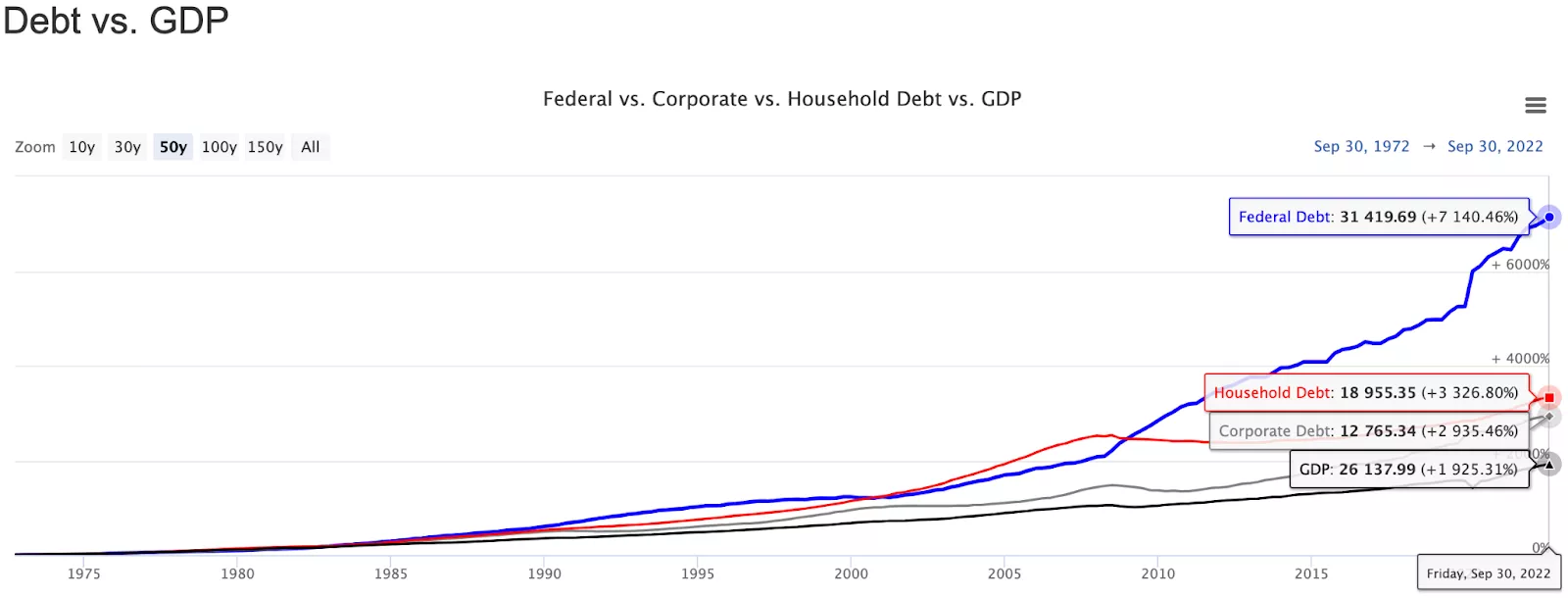
Figure Debt vs GDP
When we add together Federal, corporate, and household debt, the resulting figure is a staggering $63.14 trillion, in contrast to the United States Gross Domestic Product (GDP) of $26.13 trillion. This means that the US has a total debt-to-GDP ratio of 241%. In other words, for every $1 of GDP generated, there is a whopping $2.41 in debt.
$63.14t / $26.13t = 241%
Let’s assume conservatively that the average interest on this debt is 3%.
3% * 241% = 7.23%
The scale of the US's debt burden is such that even servicing the interest payments on the debt would require an annual growth rate of 7.23% - a rate significantly higher than the average GDP growth rate of 3.13% over the last 70 years.
7.23% - 3.13% = 4.1%
Even in the best-case scenario where the US stops running deficits and manages to balance its books, the debt would still increase by 4.1% per year. This is because the country's GDP growth does not fully cover the interest on the debt.
You can probably see where this is going. To address the burden of debt, those in positions of power are compelled to intervene by injecting more money into the economy, devaluing the currency, and leading to higher inflation. We are in a debt spiral with no clear way out.
While this approach provides temporary relief, ultimately, we’re only exacerbating the underlying problem of excessive debt. Finding a long-term solution to reduce debt is going to require difficult choices and a willingness to make tough decisions in the short term. But that's for a whole other course. In the meantime, let’s take a look at why debt and inflation don’t impact everyone evenly. It disproportionately impacts the wage earner.
Wealth Inequality
When money enters the economy, it tends to pool in certain areas: Assets!
Why? You might ask. When central banks increase the money supply by printing new currency, the value of each individual unit of currency decreases. This means that prices for goods and services tend to increase over time, leading to higher costs for basic necessities like food, housing, and healthcare. This inflationary pressure on prices erodes the purchasing power of those who rely on wages and salaries for their income.
With this in mind, are you incentivised to store your hard-earned savings in the currency? Of course not. If you have the capacity, you go out and purchase assets. Given the artificial demand for assets, their value rises. Therefore, those who hold assets such as stocks, bonds, and real estate benefit, to a certain extent, from inflation as the value of these assets tends to increase with inflation. As a result, inflation exacerbates wealth inequality by creating a divide between those who hold assets and those who rely on wages and salaries, leading to a concentration of wealth in the hands of the upper class.
Let's use our newfound understanding to analyse real estate.
With the constant barrage of social media and news coverage, you’ve probably noticed the issue of rising social unrest and wealth inequality on a global scale. One of the underlying causes of this growing unrest is the increasing difficulty for the average person to afford a house, as evidenced by the fact that the ratio of house prices to wages has increased from just above four in the 1980s to above seven today. In other words, the average person must now spend seven times their annual wage to afford an average-priced house.
Why is it so much harder to purchase a house? It is becoming significantly harder to purchase property for two reasons.
Inflation is devaluing our currency’s purchasing power. With a deteriorating currency, people are no longer incentivised to save. This forces Individuals with wealth to direct their resources toward financial assets while individuals without wealth towards consumption. As consumption directs money toward corporations held by the wealthy, and smart money directs their cash toward assets, we see the knock-on effect of rising asset prices due to increased demand. This is all while inflation is wreaking havoc on the purchasing power of the currency.
Due to our excessive debt burden, governments are incentivised to suppress interest rates. In doing so, debt consumption becomes more enticing, especially to those with wealth. When the cost-of-capital is so cheap, people borrow beyond their means, funnelling more capital into assets and driving up prices. This is great for asset holders; however, prices are becoming ever more unobtainable for those trying to get on the property ladder or dip their toes into the financial markets. A simple rule of thumb is that as interest rates decline, asset prices increase as capital is more freely available.
How does this inflation amplify wealth inequality? Considering the upper class holds assets and the lower class tends to hold currency, what ensues is greater and greater wealth inequality as the purchasing power of the currency diminishes and the cost of assets steadily rises, becoming more and more unobtainable. This can be seen in “Figure X” below. You’ll notice a significant difference in the appreciation of assets compared to wages.
Performance By Asset Class
| Asset Class | Total Growth (Jan 2010 - Jan 2021) | Annualized Growth (Jan 2010 - Jan 2021) |
|---|---|---|
| Stock Market | 236.84% | 11.67% |
| Real Estate | 66.38% | 4.74% |
| Gold | 73.10% | 5.11% |
| Average Hourly Wage | 33.37% | 2.65% |
Figure: Performance by Asset Class (Stocks, Real Estate, Gold, Wages)
With this lagging of wages to asset prices, we have seen one of the greatest transfers of wealth from the lower class to the upper class in recent history

Figure: Share of Total Net Worth
Boom & Bust
In a natural, free-market business cycle, expansion and contraction refers to the recurring patterns of growth and decline in an economy driven by market forces. During the expansion phase, businesses experience growth, consumer spending increases, and overall economic activity expands. This phase is typically characterised by increased investment, rising employment rates, and higher profits.
However, economic expansions also contain the seeds of their own contraction. Factors such as excesses in investment, rising debt levels, or changes in market sentiment can lead to a slowdown in economic activity. This contraction phase, often referred to as a recession or economic downturn, is marked by reduced consumer spending, lower business profits, and potential job losses.
Economic contractions, though challenging, serve as a necessary cleansing process, holding irresponsible behaviour and those burdened by debt accountable for their actions. They create financial pressures incentivising individuals and businesses to rectify their behaviour or face consequences. This natural ebb and flow of market expansion and contraction promotes innovation and growth during expansion and purges fiscal irresponsibility during contractions.
However, this process can only occur effectively when interest rates are allowed to freely adjust based on supply and demand. Why, you might wonder? Interest rates serve as a measure of economic risk, rising when demand for debt exceeds available capital and falling when capital is abundant but demand is low.
Regrettably, our current system deviates from this ideal. Central bank interventions intended to stabilise the economy often have unintended consequences. Manipulating interest rates disrupts the natural market signals, distorting the functioning of these cycles. Artificially suppressed interest rates encourage excessive borrowing and speculative bubbles, while abrupt rate increases for inflation control lead to financial instability and economic slowdown.
As a result of interest rate manipulation, economic expansions tend to be prolonged, leading to increased debt levels and fiscal irresponsibility. Conversely, economic contractions become more severe, exacerbating instability and hardship for those at the bottom of the social ladder.
Conclusion
Our current path of monetary intervention is not sustainable. The ever-increasing debt burden, coupled with uncomfortable inflation and rising costs of living, is leading to greater wealth inequality and social unrest. We can only expect these problems to worsen if we continue down this path.
Fortunately, there are options available to us. With the emergence of Bitcoin, we now have the ability to opt out of the traditional fiat monetary system and into an alternative system that places control back into the hands of the community. The decentralised and transparent nature of Bitcoin offers a more equitable and secure financial system free from the control of central banks and governments. This allows individuals and communities to transact with greater freedom and confidence without being subject to the inflationary pressures and wealth inequality created by traditional monetary policy. And with stablecoins, those living under far greater monetary pressures can easily exit their local currency and move into something more stable, i.e. the USD.
As we move forward, we encourage you to approach this new technology with an open mind and a critical eye, exploring how it can offer an alternative to our present-day financial systems. By doing so, we have the potential to address the problems of rising inequality and social unrest while building a more sustainable and equitable economic future.
Exam
Now that you went through the Module "The Price of Progress" you will have to test your newly acquirred knowledge to make sure that you have understood the last sections. We'll start with several Open-Ended Questions and then a small quizz.
- Consider the emergence of Bitcoin and stablecoins as alternative systems to traditional fiat currency. What do you feel are some of the potential advantages and disadvantages, and how might they contribute to a more equitable economic future?
- What information can you gather from the debt-to-GDP ratio of the United States? What is the debt to GDP of your own country?
- How does suppressing interest rates impact the overall debt burden?
- How does the current monetary system exacerbate wealth inequality?
- In light of the information provided about debt and inflation, what is your opinion on the sustainability of the current monetary system? Do you think our current system is beneficial or detrimental in the long run?
Financial Liberation - An Introduction to Bitcoin
Pioneers, Innovators, & the Foundations of Bitcoin
Welcome to Module Two, where we'll explore the fascinating world of Bitcoin. Building on our understanding of the history of money, this module will cover the following topics:
- Bitcoin's backstory and creator
- The benefits of Bitcoin as a digital currency
- The distinction between bitcoin the asset and Bitcoin the network
- How to interact with Bitcoin and its various layers
By the end of this module, you will have a solid understanding of Bitcoin's origins, features, and potential uses. But before we dive into the intricacies of Bitcoin, let's first explore the history of digital currencies that paved the way for this technology that is changing how we think about money.
What is this thing called Bitcoin
Bitcoin is a trustless and permissionless decentralised digital currency. That may sound confusing, so let us explain. Since no government or institution controls Bitcoin, you do not have to trust any third parties or require permission to use it. Instead, it's maintained by a network of users around the world who validate and process transactions on something called the blockchain.
Think of the blockchain as a giant ledger or a digital spreadsheet that maintains a record of every transaction made via Bitcoin. As anyone globally with an internet connection can monitor, validate or process transactions, this ensures that the currency is secure and can't be counterfeited.
Bitcoin is also unique in that it has a limited supply. Only 21 million bitcoin will ever be created, which gives it scarcity, like gold and other precious metals. This scarcity is part of what gives bitcoin its value.
Lastly, and arguably most importantly, given that it operates independently from governments or banks. bitcoin enables people to exchange value with one another directly, just like cash transactions. However, unlike cash, bitcoin can be used to purchase goods and services online, without relying on traditional payment methods. This means that given its decentralised digital nature, Bitcoin eliminates the need for intermediaries, physical banknotes and coins, making transactions easier, faster, and more secure.
For the first time in a long time, Bitcoin represents a new way of thinking about money and value. This is why we're excited to take you down the rabbit hole with us.
Pioneers of Digital Currency
Before Bitcoin's creation, a handful of visionaries laid the groundwork for Bitcoin as they envisioned a world where money could be transferred electronically without intermediaries. These individuals unknowingly played a pivotal role in the development of Bitcoin, as without their contributions to cryptography, it would not exist today. Among the most prominent of these pioneers are:
The Cypherpunks
The Cypherpunks are a group of tech-savvy rebels who came together in the 70s to fight for individual freedom and civil liberties using one powerful tool: cryptography. They believed that the ability to encrypt information would give people the power to take back control from centralised authorities. Imagine being able to keep your online communication private and secure from prying eyes - that's what they were fighting for!
One of the most notable outcomes of the Cypherpunks was the Cypherpunks mailing list, established in 1992. Through the list, individuals could share ideas and discuss cryptographic technologies, digital currency concepts, and privacy-focused initiatives. This led to the formation of a community of like-minded individuals, including developers, activists, and researchers.
Today, the cypherpunks' visionary ideas continue to shape the evolution of our digital landscape, empowering individuals with greater control over their data and communications. One of their most significant legacies is Bitcoin, as it draws heavily from Hashcash— a technology developed by cypherpunk Adam Back in 1997 to combat email spam.
Other notable Cypherpunks include:
- Timothy May: Founding member of the Cypherpunks mailing list and wrote extensively on cryptography and privacy throughout the 90s and early 2000s. His writing laid the groundwork for discussions on digital privacy and electronic cash systems.
- Eric Huges: Another founding member of the Cypherpunks and co-author of "A Cypherpunk's Manifesto," which emphasised the importance of privacy and anonymity in the digital age.
- Whitfield Diffie and Martin Hellman: Developed the concept of public-key cryptography, revolutionising secure internet communication.
- Julian Assange: Founder of WikiLeaks, which publishes classified and sensitive information to promote transparency and accountability.
- Bram Cohen: Created BitTorrent, a peer-to-peer file-sharing protocol that decentralised content distribution and enabled faster downloads.
- John Gilmore: An entrepreneur and libertarian who co-founded the Electronic Frontier Foundation (EFF) and advocated for digital rights and online privacy.
...and the list goes on.
David Chaum (The Father of Digital Currency)
In the early 1980s, David Chaum revolutionised the world of digital currencies with his groundbreaking work on "blinded signatures." This enabled cryptographically signing a message without knowing its content, ensuring privacy and security in digital transactions. In 1982, David Chaum conceptualised Ecash, an anonymous electronic cash system that used cryptography, which was later implemented through his corporation Digicash.
Although Digicash was used as a micropayment system at one US bank from 1995 to 1998, Chaum eventually filed for bankruptcy. That said, his innovative ideas inspired others to explore digital currencies, paving the way for the development of modern cryptocurrencies, such as Bitcoin.
E-gold
Following Chaum's footsteps, in 1996, two innovators, Douglas Jackson and Barry Downey, introduced E-gold, the first widely used digital currency, allowing users to transfer gold ownership electronically. The concept quickly gained traction and attracted millions of users who saw the potential of this unique form of money. With E-gold, people could easily and quickly transfer funds across borders without dealing with the slow and cumbersome traditional banking systems.
However, as with any new technology, E-gold faced regulatory challenges and issues with illegal activities such as money laundering and fraud. As a result, the company was forced to shut down its operations, marking a significant blow to the early development of digital currencies.
Despite its ultimate failure, E-gold was a crucial step in the evolution of digital currencies. The lessons learned from E-gold's experiences provided a roadmap for future innovators to address regulatory challenges and security concerns.
Given Bitcoin's meteoric rise, many people mistakenly believe it was the first digital currency ever to exist. However, as hopefully is now evident, this assumption is far from the truth. Bitcoin's emergence resulted from decades of research and experimentation by pioneers in the cryptography field. Without the contributions of the individuals above and many others, Bitcoin may have never been created. Although these early digital currencies eventually failed, Bitcoin learnt from their mistakes, ultimately becoming the digital currency we know today.
That said, if it weren't for one individual... or group (we don't know for sure), Bitcoin would not exist. And that is Satoshi Nakamoto. The enigmatic creator.
Satoshi Nakamoto
Although Bitcoin has captivated the minds of millions with its disruptive potential and unique technology, despite its popularity, its mysterious origins continue to fascinate and puzzle people. Satoshi Nakamoto, the creator of Bitcoin, remains unknown to this day, despite numerous attempts to uncover his true identity. Even though it has been over a decade since the emergence of Bitcoin, we are still no closer to solving the question of: Who is Satoshi Nakamoto? However, given Bitcoin's decentralised nature, does it really matter?
Either way, let's take a look at the myth and legend.
Satoshi Nakamoto emerged on the internet in 2008 with a revolutionary idea: peer-to-peer electronic cash. He shared his vision in a nine-page paper titled "Bitcoin: A Peer-to-Peer Electronic Cash System" with the cypherpunk mailing list. Despite initial disinterest from most mailing list members, the idea sparked enough curiosity in one member, Hal Finney, who eventually reached out to Satoshi. Hal's involvement in Bitcoin development proved to be a turning point, leading to more people offering their support.
However, after two years of working on the project, Satoshi vanished without a trace, with his last credible communication on April 23, 2011, where he stated that he had "moved on to other things."
The mysterious disappearance of Satoshi Nakamoto has led to various theories about where he went. Some speculate that he felt he had accomplished what he set out to do, while others believe he became uncomfortable with the attention that Bitcoin was attracting. In December 2010, when WikiLeaks was banned from using traditional payment methods, it turned to Bitcoin for funding. Satoshi's concerns about the increased attention on Bitcoin and the potential legal ramifications of creating a currency used to interfere with US geopolitical interests may have prompted him to step back. Alternatively, he may have shifted his focus to other projects, may still be contributing to Bitcoin under other names, or even passed away.
Although we may not know who Satoshi is, we have a clearer picture of his intentions behind Bitcoin. He created Bitcoin as a response to the 2008 Global Financial Crisis and the resulting distrust around traditional banking systems and government-controlled currencies.
In his online communications, he expressed cynicism towards the centralised nature of money and banking, highlighting the dangers of trusting central banks not to devalue their currency. Case in point, written into the first Bitcoin block, is:
"The Times 03/Jan/2009 Chancellor on brink of second bailout for banks."
This is a reference to a Times newspaper article, reflecting his concerns that banks were engaging in risky behaviour, with little consequence to them, and that losses would be shared amongst currency holders. Furthermore, we know from his more recent messages that Satoshi disagreed with how our current monetary system functioned:
"The root problem with conventional currency is all the trust that's required to make it work. The central bank must be trusted not to debase the currency, but the history of fiat currencies is full of breaches of that trust."
While the enigma of Satoshi adds intrigue to Bitcoin's history, there is one thing we cannot argue about. Satoshi's decision to remain anonymous underscores the core principles of decentralisation and individual freedom that underpin Bitcoin's design. Satoshi's anonymity ensures that the focus stays on the technology and its potential impact rather than on the cult of personality.
Conclusion
To summarise, Bitcoin has revolutionised the way we think about money and value. For the first time in history, we have a digital currency that is:
- Peer-to-Peer: Bitcoin allows individuals to send and receive payments directly without the need for intermediaries, such as banks or payment processors.
- Decentralised: Bitcoin operates on a decentralised network, meaning there is no central authority or control over the currency.
- Secure: Bitcoin transactions are secured using cryptography, making counterfeiting or double-spending coins difficult.
- Limited in Supply & Divisible: The supply of bitcoin is finite—with only 21 million coins in existence—while at the same time, it is divisible to eight decimal places, enabling transactions for a fraction of a cent. This scarcity is designed to give the currency value and prevent inflation.
- Psuedoanonymous: While Bitcoin transactions are not completely anonymous, they offer a level of privacy and pseudonymity that traditional payment methods do not.
These points combined mean that Bitcoin offers anybody financial privacy, security and the ability to transact globally with minimal fees and friction. Ultimately, Bitcoin is a powerful tool for those seeking greater economic freedom and autonomy. This is a game-changer for those looking for a secure savings vehicle, let alone living under authoritarian regimes, experiencing hyperinflation, fleeing war-torn countries, or remitting money back to loved ones overseas. As Bitcoin offers an affordable alternative to traditional money transfer methods, this leaves more money in the hands of those who need it most. With Bitcoin, anyone can become their own bank and take control of their own financial future.
To end, regardless of who Satoshi Nakamoto is, it is undeniable that the invention of Bitcoin has sparked a new way of thinking about the transfer of value.
How Does Bitcoin Work? The Inner Workings of This Magical Internet Money
Bitcoin is often referred to as magical internet money… and for a good reason. Think about it – with Bitcoin, you can send value to anyone, anywhere in the world, without the need for a middleman like a bank or government. It's like having control of your own personal bank, the power to transfer funds across borders with just a few clicks of a button.
Given the numerous benefits that Bitcoin has to offer, from providing a fast, secure, and low-cost way to transact to allowing individuals to take control of their own financial futures without the need for a centralised authority, in addition to the complex cryptographic hurdles it has had to solve to make peer-to-peer digital currency a reality, it's natural to feel as though its functionality is something only a handful of individuals must understand. You may even feel a little intimidated by the idea of a decentralised digital currency. But the truth is that Bitcoin is actually quite simple once you understand its inner workings.
In this section, we're going to take a closer look at the key players in the Bitcoin ecosystem and how they work together to make this magical internet money function.
Let's get started!
As discussed in the introduction to this module, Bitcoin is unique in that we have a fully functional, widely used peer-to-peer decentralised digital currency for the first time in history. This means that instead of relying on a central authority like a bank or government to manage transactions, it is managed by a network of participants that work together. This innovative approach allows us to transact with one another without the need for intermediaries.
When compared to traditional banking systems, while Bitcoin functionally operates differently, the roles it must perform are no different. For instance, both banks and Bitcoin have to:
- validate and process transactions,
- monitor transactions to ensure there is no cheating or bad behaviour,
- ensure everything is up-to-date, functioning smoothly and securely.
While banks perform these roles in-house, giving them complete control over the process, Bitcoin requires collaboration by the community to perform these roles. In other words, for Bitcoin to replicate these processes in a decentralised system, Bitcoin must outsource each of these tasks to ensure that no one individual or centralised entity has outsized control over the system.
To achieve this revolutionary feat, Bitcoin has divided these tasks into three key roles: nodes, miners and developers. Where nodes verify transactions and set and enforce rules, miners order and confirm transactions, and developers keep the network up-to-date and propose upgrades. By distributing these tasks amongst these key players, Bitcoin has created a system that is secure, transparent, and accountable to all users.
Let's, therefore, take a look at each of these roles…
The Roles of Bitcoin
Nodes
Nodes are essential to the integrity and security of the Bitcoin network. They serve as the system's gatekeepers, ensuring that transactions are processed accurately and according to the rules. Every node downloads and locally verifies a complete copy of the blockchain, which is essentially a digital ledger that records every transaction ever made on the Bitcoin network. Through consensus, nodes agree on the validity of each transaction and ensure that the rules are being followed. This means that the nodes will reject the transaction if someone tries to cheat the system, e.g. by sending more bitcoin than they actually have or attempting to spend the same bitcoin twice.
To further elaborate on this idea of consensus, when developers propose changes or upgrades to Bitcoin, nodes play a role in adopting or rejecting these changes. They do this by either upgrading their software to the new version or continuing to run the old version. This process often involves discussions and debates within the Bitcoin community to achieve consensus. That said, Bitcoin's consensus is not as black and white as a voting machine. The majority does not necessarily rule. If some individuals disagree with the change, they can launch a new Bitcoin-derived token. Now, the original Bitcoin exists without the change and a new one with the change. Through buying and selling, it is up to the community to highlight which version they deem more valuable. This consensus mechanism ensures that any changes made to the Bitcoin protocol are agreed upon by the whole community, making it difficult for any individual or group to manipulate the system for their own benefit.
It's also important to note that a node is simply a piece of software anyone can run on their home computer. The only requirement is an internet connection and, depending on how much of the blockchain you wish to store, anywhere from 5 to 500gb of free space.
Miners
Bitcoin miners, on the other hand, play a critical role in record-keeping, as they are responsible for ordering and confirming transactions. To do this, miners use specialised computers to perform a function called hashing. Without diving into the nitty gritty of hashing, think of it as miners competing with one another to add new transactions to the blockchain, the public ledger of transactions. In exchange for their work, miners are rewarded with newly created bitcoin and the transaction fees for any transactions processed. The mining process is designed to be difficult, competitive, and randomised, with only a limited number of new bitcoin released each year, ensuring that the supply of bitcoin is limited and their value is maintained. Without miners, transactions would not be processed.
Given that miners have to compete with one another to process transactions and are rewarded for doing so, this competition minimises the chance that any single miner or entity can control the network and incentivizes miners to act honestly and follow the rules. If a miner tries to cheat or break the rules, they risk losing their reward, so there is a strong incentive to play by the rules.
Developers
Developers are highly skilled and respected members of the Bitcoin community who work together to ensure the network remains secure, reliable, and up-to-date. They play a critical role in the Bitcoin ecosystem by maintaining and improving the software that powers the network. They are responsible for proposing and implementing changes to the Bitcoin codebase, fixing bugs, and improving performance and security.
Without developers, the Bitcoin network would not be able to evolve and adapt to changing circumstances. They are responsible for ensuring the network's long-term viability and ensuring it remains a trusted and decentralised payment system for years to come. In short, developers are the backbone of the Bitcoin ecosystem, constantly working to improve the network's underlying technology and ensure its continued success.
Finally, there is one more role that we want to highlight: the community, which is what gives bitcoin its value. The community consists of everyone who uses the network, transacts back and forth, and incentivises the nodes, miners, and developers to continue working on Bitcoin. As the community grows, so does the value of the Bitcoin network.
Side Note: It's important to emphasise that Bitcoin's decentralised nature allows anyone, regardless of their background or status, to participate in the network and take on any of the roles necessary for its functioning. This distinguishes Bitcoin from traditional currencies, which are often subject to control by central banks or governments. In other words, Bitcoin gives power back to the people by enabling them to be active participants in the network rather than passive consumers of a centralised system.
A Transaction From Start to Finish
To understand how all these players work together, let's imagine a simple Bitcoin transaction between two people, Alice and Bob. Alice wants to send Bob one-thousandth of a bitcoin, around $29 at the time of writing.
Transaction Initiation
Every Bitcoin transaction begins with its initiation when the sender, in this case, Alice, creates a transaction specifying the recipient, Bob, and the amount, 0.00100000 bitcoin. The node associated with Alice's wallet then broadcasts the transaction to the network, where the nodes confirm its validity, and it is sent to the miners for confirmation.
At this point, the transaction enters what is known as the mempool, essentially a waiting room for transactions ready to be added to the blockchain. Think of it as a list of pending transactions, much like the ones you see on your credit card statement, that have been initiated but are waiting to be processed. Once the transaction has been initiated and is sitting in the mempool, it is now in the hands of the miners.
Transaction Confirmation
Miners now take these pending transactions, bundle them up into a new block, and compete against one another to perform a certain task laid out by the software underpinning Bitcoin. The competition winner then appends their block and the enclosed transactions to the blockchain, finalising these transactions. The winner is also rewarded with newly issued bitcoin and the fees associated with the transactions processed, incentivising them to continue processing transactions.
Transaction Validation
Once the transaction is confirmed, Bob should now be able to see the 0.00100000 bitcoin in his wallet. But it doesn't stop there. The nodes then verify that the miner has done their job correctly and that the transactions included in this new block meet the rules agreed upon by the nodes. If the block fails to do so, then the new block will be rejected, and the miner will lose their mining reward.
Fun Fact: Even after a Bitcoin transaction is confirmed, the possibility of reversal exists if nodes reject blocks. However, with each new block added to the blockchain post-transaction, the likelihood of reversal decreases exponentially. To enhance security, exchanges and wallets often place a hold on your bitcoin until several subsequent blocks are appended— usually three to six. This safeguards funds and guarantees transaction peace of mind.
Conclusion
As explained throughout this section, while Bitcoin may appear as a complex cryptographic system under the hood, it's merely a collaborative effort between three essential roles and the community.
- Nodes, through transaction validation, ensure the integrity and security of the network by serving as gatekeepers.
- Miners are responsible for ordering and confirming transactions.
- Developers are highly skilled members of the Bitcoin community who work together to maintain and improve the software that powers the network.
- The community, through the use of Bitcoin, is what gives it value.
Each of these roles is essential to the functionality and success of Bitcoin as a digital currency. By entrusting these crucial tasks to the key players, Bitcoin can operate as a secure, transparent, and accountable medium of exchange for all users, making it a significant achievement in the history of currency.
What Makes Bitcoin Different From Fiat?
In the previous section, we delved into the unique functionality of Bitcoin that sets it apart from traditional currencies and how Bitcoin achieve the coveted badge of being decentralised. Now, let's shift our focus and explore how Bitcoin differs from fiat in terms of the characteristics that make a currency great. Only by examining these key characteristics can we gain a deeper understanding of why Bitcoin is unique and in a world of its own when it comes to money.
If you recall from Module One, we took a look at both the functions and characteristics of money, these being:
Store of Value: Retains purchasing power over time.
- Durable: Resistant to wear and tear.
- Scarce: Limited in quantity.
- Immutable: Cannot be changed or altered.
Medium of Exchange: Used as a means to trade goods and services.
- Portable: Easily carried or transported.
- Divisible: Can be divided into smaller units.
- Accepted: Widely recognized and accepted as a form of payment.
Unit of Account: Used to measure value.
- Fungible: Interchangeable with other units of the same type.
Let's now analyse fiat and Bitcoin through the lens of these functions and characteristics to better understand how they differ.
Store of Value
While fiat currencies are subject to inflation and have historically proven to lose value over time due to government policies, bitcoin's finite supply and decentralised nature make it a strong store of value that is not subject to manipulation by any central authority. What makes bitcoin a powerful store of value is that it is:
- Durable: Bitcoin is digital and, therefore, not subject to physical damage or decay like paper or metal currencies. Additionally, its decentralised nature ensures that it has no single point of failure for an attack.
- Scarce: The supply of bitcoin is strictly limited to 21 million coins, making it inherently scarce compared to fiat currencies, which governments can print endlessly. This limited supply means that bitcoin's value is not subject to the same inflationary pressures as fiat currencies.
- Immutable: Bitcoin's blockchain technology ensures that once a transaction is recorded on the network, it cannot be changed or tampered with. This level of immutability is not possible with fiat currencies, which see much greater fraud, counterfeiting or the reversal of transactions.
Medium of Exchange
While bitcoin is not yet as globally accepted as fiat currencies, its peer-to-peer nature, fast transaction times, and low fees make it an increasingly attractive medium of exchange, particularly for cross-border transactions. This is made possible by the fact that it is:
- Portable: Bitcoin, being digital, allows for borderless and intermediary-free transfers between individuals, making it a convenient and accessible medium of exchange. While some fiat currencies also offer digital solutions, those in developing or war-torn countries may struggle to access banking services that fulfil this need. Bitcoin's decentralised nature makes it accessible to anyone with an internet connection, providing a viable alternative to traditional banking systems in areas with limited access to financial services.
- Divisible: bitcoin's extreme divisibility is one of its key advantages as a currency. With each bitcoin divisible up to eight decimal places, the smallest unit, a Satoshi, is worth a mere fraction of a cent. Depending on the method of transacting, i.e. layer one or two, this makes bitcoin highly adaptable to transactions of any size, from small purchases to large investments.
- Accepted: While acceptance of bitcoin is not yet universal, its increasing adoption by merchants, institutions, and individuals around the world suggests that it is becoming more widely accepted as a legitimate form of payment.
Unit of Account
As bitcoin has gained recognition as a medium of exchange, it has quickly climbed the ranks as a reliable unit of account for goods and services, much like fiat currencies. However, what sets Bitcoin apart from fiat is its ability to provide a secure, transparent, and decentralised method of transacting. The major contributor to Bitcoin's increasing adoption as a unit of account is the fact that it is:
- Fungible: Each bitcoin is indistinguishable from any other, making it easily exchangeable, which is not always the case with physical currencies that may have unique identifiers or be of varying quality.
The Asset vs The Network
You may have noticed above that Bitcoin isn't simply a powerful asset for which to store value, but its unique characteristics also make it an incredibly secure and efficient network for transacting. This may sound a little confusing, so let us explain. Bitcoin, like fiat, is made up of two components:
The asset (referred to as bitcoin with a lowercase “b”) – This is what we purchase that's accessible from our wallet. When stored outside centralised exchanges or wallets, our reliance on trust is minimised, primarily centring around the security of our hardware. Even then, we can minimise that trust by securely backing up our seed phrase or using custodial options such as multi-signature. Moreover, considering that any decisions aimed at modifying the fundamental attributes of Bitcoin, such as its total supply, are determined and upheld by the community, there is a robust safeguard against the implementation of detrimental changes that could harm users, i.e. currency debasement through supply expansion.
The network (referred to as Bitcoin with an upper case “B”) – These are the rails which facilitate the trade of bitcoin-the-asset. The network allows anyone to send, verify or confirm transactions. Bitcoin's decentralised nature, supported by numerous nodes, miners, and developers, ensures a distributed structure where no single entity holds dominance over another. This offers a reassuring sense of security and reliability when transacting, eliminating concerns about potential reversals, denials, freezes, or other interruptions.
When we view fiat currencies from the perspective of "the asset" and "the network," it becomes apparent that we must place far greater trust and dependence on third parties and intermediaries. For example:
The Asset - The fiat currencies we use as a store of value (E.g. US dollar, euro, yen, franc, pound sterling, etc.).
Central Banks oversee Monetary Policy – Monetary policy refers to the measures taken by a central bank to manage the interest rates and the total supply of money in circulation. When the central bank lowers interest rates or increases the money supply, it injects new money into the economy, thereby diluting the value of the existing currency in circulation. This results in a reduction of the currency's purchasing power, creating inflation.
Governments oversee Fiscal Policy – Fiscal Policy pertains to government actions related to taxation and government spending. For instance, if the government decides to stimulate the economy by lowering taxes and providing stimulus checks, it increases the disposable income of the population, leading to higher spending. This increased spending can drive up prices, leading to inflation and lowering our purchasing power over time.
As citizens, we are subject to the decisions made by those in charge of monetary and fiscal policies, and we must rely on their judgment. We entrust our government and unelected central bankers to act in our best interests, but their choices can significantly affect our currency's purchasing power and, consequently, our standard of living. And history has demonstrated on numerous occasions that this trust has been violated, resulting in monetary debasement.
The Network - The rails that allow us to transact with one another.
When purchasing a coffee using our credit card, there are four or more different intermediaries - First is the bank with which the coffee shop uses. Second, are the communication networks that enable the banks to transfer funds between each other. Next, there is the association that processes the transaction, such as Visa, Mastercard, or Discover. And finally, there is our own banking institution, which verifies and records the transaction.
When sending a wire transfer, we touch four or more third parties - To initiate a wire transfer, we need to provide our bank with the recipient's bank details. Since our bank may not directly connect with the recipient's bank, the transaction information is sent through the SWIFT (Society for Worldwide Interbank Financial Telecommunications) network using a correspondent or intermediary bank. These banks then contact the recipient's bank to complete the transfer.
Regulatory bodies oversee various arms of the financial rails we use daily - If our political views conflict with the regulations governing the monetary networks or any part of the intermediary process, our transactions may be at risk of being blocked, and our assets could be seized. In extreme cases, we may even face the possibility of being excluded from the financial system altogether.
Does this sound frightening or improbable? In early 2022, during the trucker rally in Canada, individuals donated to support the cause. Prime Minister Trudeau had some of these individuals' bank accounts frozen by his decree. Irrespective of one's opinion on the matter, the fact that people's assets were seized for their differing views should be a red flag.
With this in mind, there are immense advantages to not only having access to a valuable, scarce asset but a secure, efficient, trustless, global, and low-fee network for exchanging value. And this is where Bitcoin excels. As discussed at length, Bitcoin's decentralised and digital nature makes an unparalleled network for fast, secure, and cost-effective transactions without the need for intermediaries or third parties. Here are a few examples of those benefiting from Bitcoin's unparalleled asset and network:
Commerce
Bitcoin gives merchants unprecedented control over their transactions, allowing them to bypass traditional financial intermediaries such as banks and credit card companies. This means that more money stays in the hands of the merchant rather than being siphoned off by costly transaction fees and other charges. With Bitcoin, merchants can also choose to accept payments from anywhere in the world without the need for currency conversion or other intermediaries, further reducing costs and increasing profit margins. By giving merchants greater control over their transactions, Bitcoin is changing the way we think about commerce, empowering businesses of all sizes to compete in an increasingly globalised economy.
Inflation
As of late 2022, almost half of the world was grappling with double-digit inflation, making it a pressing concern. If inflation rates remain at this level for the next decade, it will result in a 65% loss of purchasing power. However, bitcoin now offers anyone a way out. Being a truly scarce asset, its value cannot be eroded through supply expansion, offering us an escape from the negative impacts of debasing currencies.
Fleeing War-Torn or Unstable Countries
Bitcoin provides a viable option for moving value for those fleeing war-torn or unstable countries. In many cases, individuals in these situations are unable to access traditional banking services due to a lack of infrastructure or government control over financial systems. Bitcoin allows these individuals to store value in a decentralised and secure way without the need for intermediaries or physical assets that may be vulnerable to theft or confiscation. With bitcoin, individuals can carry their wealth in their heads, across borders and without any fear of losing their assets to any physical or political upheaval. This provides a level of financial freedom and independence that is unparalleled in the traditional financial system.
Money Transfer
We will discuss this in much greater detail in the following module, but for now, we want to mention that Bitcoin provides individuals with an efficient and cost-effective way to remit money back to loved ones abroad. Unlike traditional remittance methods, which often involve high transaction fees and lengthy processing times, Bitcoin transactions can be completed quickly and with minimal fees.
In light of this, while bitcoin, the asset, may offer significant benefits to those looking to escape inflation or store value in a more secure currency, we recognise that many individuals may not be able to take advantage of the asset, i.e. the volatility of bitcoin as an asset, may not be suitable for short-term value storage or those with limited savings. Luckily, Bitcoin's network will play a crucial role here, especially for individuals without access to banks or financial assets, given that the network's payment rails facilitate digital financial transactions for anyone with a mobile phone and internet connection.
Bitcoin is also quickly becoming the underlying value-transfer protocol of the internet. Because of the low-cost transaction capability, services such as value-streaming are starting to proliferate, connecting content creators directly to their audiences. Similarly, this low-cost streaming capability is seeing breakthroughs in paid-for-services such as energy metering, whereby users are able to pay for instantaneous demand, streaming bitcoin on a pay-for-use cost basis. Frictionless peer-to-peer payment offerings are revolutionising the way people interact with goods and services through the digital realm.
Conclusion
Bitcoin's unique characteristics as a store of value, medium of exchange, and unit of account make it a currency that is in a class of its own. Its decentralisation, scarcity, durability, immutability, portability, acceptance, divisibility, and fungibility combine to create a powerful and efficient network that can be used for transactions with finality, security, efficiency, and low fees.
Furthermore, these combined attributes not only position Bitcoin as a potent instrument for storing and building wealth over the long term (bitcoin the asset) but also offer many advantages for those looking to employ Bitcoin as a transactional medium (Bitcoin the network). This starkly contrasts fiat currencies, which necessitate trust and intermediaries in both scenarios. This makes Bitcoin an attractive currency for individuals and businesses alike, regardless of whether it is used for saving or transacting.
Interacting With Bitcoin
Bitcoin has taken the monetary system by storm, captivating the attention of developing countries, tech-savvy individuals and investors alike. However, with its rapid growth, many wonder how this digital asset can compete with traditional payment methods like Visa and Mastercard. Additionally, individuals are curious about how they can personally engage with Bitcoin.
In this section, we'll delve into the different layers of transacting, whether in fiat or Bitcoin. We'll also explore some best practices for keeping your bitcoin safe, including the importance of choosing the right wallet.
The Layers of Bitcoin
Bitcoin's blockchain is composed of blocks, as its name suggests. These blocks have a theoretical maximum size of 4 megabytes. That said, the average block size at the time of writing comes in at around 1.5mb. Because of this limit, there is a restriction on how many transactions Bitcoin can process per second, which is between seven to ten transactions per second (tps).
Therefore, you may wonder: How can Bitcoin’s blockchain possibly compete with networks such as Visa or Mastercard that transact at 1,700 tps?
The answer is simple. It is not competing with them.
Comparing Bitcoin’s blockchain to Visa or Mastercard is like comparing an international container ship to a checkout at a local hardware store. The container ship is intended for infrequent bulk transactions, whereas a checkout is built around high-frequency, small transactions. Although both move goods, comparing them is like comparing apples to oranges.
With this in mind, Bitcoin offers trustless, permissionless transactions with final settlement, while Visa and Mastercard provide convenience and ease of use. However, that is not to say Bitcoin’s blockchain doesn't offer these things, too. It just doesn't try to achieve them on the base chain or base layer as it's commonly known.
Let's explore what this means...
When inspecting any monetary system, there are often different methods, or layers, of transacting, with each method offering various benefits to the user. The layers of transacting in our current monetary system include:
Layer One: These transactions typically involve large amounts of money but have a low processing capacity, meaning that only a limited number of transactions can be processed per second. Examples of layer one transactions in the traditional monetary system include bank wire transfers and Fed Wire interbank transfers. These transactions are used for high-value transactions, but they are often slow and expensive, with wire transfer fees ranging from $10 to $50 and processing times that can take several days. While layer one transactions are secure and dependable, they may not be the best choice for consumers who need to make small transactions quickly and cost-effectively.
Layer Two: This layer typically includes smaller value high-volume transactions, enabling many transactions to be processed per second. It provides faster and cheaper transactions, with fees usually around 1-3% of the transaction value. Common examples of layer two transactions in the traditional monetary system are credit and debit card payments, online payment services, and gift card transactions.
Where does the Bitcoin blockchain fit into layer one and layer two transactions?
Bitcoin blockchain is a great alternative to layer one transactions. While it may not be able to match the speed of a layer two Visa payment, it is capable of processing high-value transactions at a fraction of the speed and cost of traditional layer one methods. Moreover, Bitcoin operates in a permissionless and trustless manner, meaning that transactions can be conducted without intermediaries.
However, despite its advantages as a layer one solution, Bitcoin can also compete with layer two transaction methods. There are technologies built on top of the Bitcoin network, such as Lightning, which enable users to transact near-instantaneously and for fractions of a cent. These technologies can be thought of as layer two solutions for the Bitcoin network. With this in mind, just like our traditional monetary system has layer one and two transactions, so does Bitcoin.
If you're looking for a reasonably quick (but not instant), cost-effective and secure way of sending a large amount of money, then Bitcoin layer one is your best bet. Whereas, if you're looking to transact near-instantaneously and for fractions of a cent, you will want to direct your attention to some of the technologies built on Bitcoin, which include innovations such as Lightning.
Bitcoin Lightning Network is a layer two scaling solution built on top of the Bitcoin layer one. It allows for near-instant transactions with minimal fees, making microtransactions and small purchases possible. Since El Salvador has adopted bitcoin as a legal tender, many people have been using the Lightning Network to transact Bitcoin instead of the standard layer one due to its benefits. With the Lightning Network, users can pay a fraction of a cent for almost instantaneous transactions, making it a perfect fit for merchants who want to accept Bitcoin payments without the higher fees and slower transaction times of traditional on-chain Bitcoin transactions. This has made it easier and more accessible for El Salvadorians to use bitcoin for everyday transactions, increasing the potential of Bitcoin adoption as a global currency.
Let's now turn our focus on what to do once you've acquired some bitcoin or decided to make a purchase.
Safely Securing Your bitcoin
What makes Bitcoin revolutionary is that, for the first time in history, we can take self-custody of a digital asset. This feat cannot be overstated! Just like how we can store cash under our pillow, we can do the same with bitcoin, but digitally. However, this new level of control over our money comes with new responsibilities. To keep our bitcoin safe, we must learn how to secure it properly. This means taking steps to protect against loss, theft, and hacking attempts.
Where To Store Your bitcoin
The first step in securing your bitcoin is to choose the right wallet. Without going into too much depth, there are primarily two types of wallets available: custodial and non-custodial.
Custodial Wallets These are wallets where, although you can access your wallet and move funds around, a third-party stores and secures your bitcoin.
One common example of a custodial wallet is an exchange account. When you purchase bitcoin through an exchange and leave your bitcoin on the exchange, you are using a custodial wallet. The exchange has custody over your bitcoin and is responsible for storing and securing your funds.
There are also countless other custodial wallet solutions available for mobile devices that give you easy access to your bitcoin. These wallets are typically user-friendly and offer a simple way to manage your bitcoin, but they still hold the keys to your bitcoin.
Non-custodial wallets (a.k.a. self-custody) Non-custodial wallets are a type of Bitcoin wallet where you are the sole custodian of your funds, meaning you have complete control over your private keys. Private keys are like a password to your wallet and are used to sign and authorise transactions. Without them, you cannot access or transfer your bitcoin.
Non-custodial wallets offer a higher level of security and privacy over custodial wallets since you are the only one responsible for the safety of your funds. Examples of non-custodial wallets include hardware wallets like Coldcard and Trezor, which are physical devices that store your private keys offline and provide an extra layer of security. Other popular non-custodial wallets are software wallets like Sparrow, Electrum, and Blockstream Green, which can be downloaded and installed on your computer or mobile device.
*Although we cannot recommend a specific wallet, we highly advise taking control of your bitcoin through self-custody or collaborative custody, which involves selecting a wallet that suits your needs and preferences. It is essential to conduct thorough research before deciding on a wallet to ensure that it aligns with your security and usability requirements.
While custodial wallets may appear convenient, they come with significant risks. By giving custody of your private keys to a third party, you effectively give them control over your funds. If the custodian becomes insolvent, hacked, or shuts down, you could lose access to your bitcoin. And this has happened on countless occasions, with high-profile examples including the Mt. Gox and QuadrigaCX hacks resulting in the loss of customer funds, or FTX, Voyager, BlockFi, and Celsius experiencing catastrophic insolvencies, leading to the loss of their customer funds. Especially for savings, practising self-custody and taking responsibility for safeguarding your bitcoin is crucial.
Safety Tips
Once you have decided on a wallet, the fun and games aren't over just yet. Now it's time to minimise the risk of loss. To protect your bitcoin, consider these steps after choosing your wallet:
- First and foremost, back up your wallet when taking self-custody. Hardware wallets come with a recovery seed phrase, a set of words that can be used to recover your private keys in case your device is lost or damaged. Create a physical copy, such as a metal seed plate, of this seed phrase and store it in a safe place. It's important to keep this recovery seed phrase secure. NEVER share it with anyone.
- When safeguarding a substantial amount of bitcoin that exceeds the threshold you wouldn't want to lose, it's important to explore estate planning options for the unforeseen event of your passing. This ensures that your family and loved ones can access and manage your bitcoin effectively.
- Be vigilant against phishing attempts and other scams. Scammers often try to trick you into giving them access to your bitcoin by posing as a trusted company or individual. No reputable company will ever ask you for your private keys, so never share your private keys with anyone, and always verify the authenticity of any website or individual before sending bitcoin.
While self-custody is our recommended approach, we understand that it may not be suitable for everyone. Here are some general guidelines to help minimise risk:
- Use exchanges to purchase bitcoin, mobile wallets for everyday transactions, and hardware wallets to store your long-term bitcoin savings.
- Treat exchanges or mobile wallets like your physical wallet, keeping only the amount of bitcoin you would carry in your everyday wallet.
- Consider your hardware wallet as your savings account. It's meant for infrequent access and prioritises safety and security for the long term.
And if you are using an exchange:
- Create a strong, unique password. Avoid using common phrases or easy-to-guess passwords. Consider using a password manager.
- Enable two-factor authentication (2FA) whenever possible. This adds an extra layer of security by requiring a code from your phone or hardware device in addition to your password.
If you're still unsure, we highly recommend checking out Ben from BTCsessions on YouTube.
Remember, with great power comes great responsibility, and taking the time to secure your bitcoin properly is essential to protecting your financial future.
Before closing out this module, I'd like to leave you with one last thought...
Diving Deeper
If you are interested in further exploring the world of Bitcoin, many options are available. Such as:
- Nodes: Running a node is an excellent entry point for those curious about Bitcoin beyond basic transactions. It allows you to not only contribute to the Bitcoin network by verifying the blockchain and influencing new updates or changes but minimises trust and offers enhanced privacy by giving you the ability to verify your own transactions and balances. By running a node, you become a part of the decentralised network and help ensure its security and integrity.
- Mining: Mining is another way to contribute to the Bitcoin network and potentially earn bitcoin. While it requires a little more resources than running a node and is not as profitable as it used to be, mining is a rewarding activity for those interested in the technical aspects of the network.
- Development: If you have experience in software development and are interested in contributing to the development of Bitcoin, a great starting point is Bitcoin's GitHub repository.
Regardless of your interests, there are many resources available to help you learn more about Bitcoin and get involved.
Conclusion
Although we often hear that Bitcoin can never rival Visa or Mastercard, hopefully, this section has proven this notion to be untrue. Rather than competing directly with these companies, Bitcoin's base layer is designed to process high-value transactions much more efficiently than traditional methods. This makes it a fantastic alternative to traditional layer one solutions. Moreover, technologies like The Lightning Network, built on top of the Bitcoin layer one, enable nearly instantaneous transactions for just a fraction of a cent. Thus, Bitcoin can still compete with Visa and Mastercard, offering solutions for both businesses and individuals alike.
Bitcoin's biggest advantage is that it allows us to have self-custody of a digital asset, which was never possible before. If you feel overwhelmed after going through this section, don't worry. Taking control of your own bitcoin is a powerful step towards financial freedom, but it also comes with new responsibilities. However, with a little bit of research and due diligence, these new responsibilities will quickly become second nature to you, and you'll feel comfortable taking on the task of safely securing your bitcoin.
Exam
Now that you went through the Module "An Examination of How We Got Here" you will have to test your newly acquirred knowledge to make sure that you have understood the last sections. We'll start with several Open-Ended Questions and then a small quizz.
- What are your thoughts on the concept of a trustless and permissionless decentralised digital currency like Bitcoin? How do you think it compares to traditional forms of currency?
- Do you believe that the limited supply of bitcoin, with only 21 million coins, gives it value and makes it more desirable? Why or why not?
- Based on the information provided about Satoshi Nakamoto, do you think it is important to know the true identity of Bitcoin's creator? Why or why not?
- Do you agree with Satoshi Nakamoto's concerns about centralised banking systems and the trust required in conventional currencies? Why or why not?
- Imagine you live in a country experiencing high inflation. How could bitcoin provide a solution for preserving your purchasing power?
- Consider a scenario where you need to send money to a family member in a different country. How could Bitcoin's peer-to-peer nature and low fees benefit you in this situation?
Stability Amidst Chaos - An Introduction to Tether & the World of Stablecoins
An Introduction to Tether & the World of Stablecoins
As previously discussed, money has been an essential part of humanity for thousands of years. It has helped us purchase goods and services, enabled us to trade with one another, and assisted us in storing wealth.
But as society has evolved, our relationship with money has changed. From coins to paper currency and digital bank accounts to Bitcoin, our money has had to keep up with the times.
In recent decades, the internet has revolutionised the way we interact with each other, and our money has had to evolve alongside it. Cryptocurrencies, such as Bitcoin, have emerged, and while they have garnered immense popularity and offered promise to those let down by our present-day monetary system, they have also highlighted the limitations of traditional banking.
Given Bitcoin's digital nature, it is always open for business, running 24 hours a day, 365 days a year, with people buying and selling every second of every day. Meanwhile, there are countless individuals worldwide who are unable to access banking services. That aside, even when lucky enough to be "banked," the average bank operates for a fraction of the day, leaving us largely at the mercy of their operating hours.
It's easy to overlook these facts until you start crunching the numbers.
First, one-quarter of individuals globally are considered unbanked. That means there are well over one billion individuals who cannot transact digitally, let alone save securely.
And second, considering that there are 8760 hours a year and that the average bank only operates from 10 am to 5 pm Monday to Saturday and is closed on Sundays and public holidays, the average bank is only open for a mere 2100 hours a year. That's only 24% of the time!
So, outside of the billions unable to access banking services and online banking services that do not require assistance, accessing money efficiently and timely remains a challenge for many.
To make matters worse, unless we resort to cash, all of our funds are subject to the constraints of traditional banking. This presents a significant risk should our government impose overbearing banking reform, as was seen during the Greek government's 2015 bankruptcy.
During this crisis, banks were closed, ATM withdrawals were limited to a mere $67 per day, and after all that, the government still withdrew a significant portion of individuals' bank deposits to fund their fiscal irresponsibility.
While cash may provide a workaround to such a crisis, relying on physical currency in a world where digital transactions are a necessity is not a viable long-term solution.
This begs the question: Given the friction with traditional banking and that bitcoin's short-term volatility can be seen as a hindrance for those with minimal savings, how can we securely transact in the digital age without facing these risks and limitations?
We need a currency tied to something of relative value, digitally native and available whenever we need it, regardless of the time or day of the week.
And this is where Tether comes in.
Who is Tether?
In the ever-evolving landscape of fiat currencies, Tether has emerged as a pivotal player, driven by a vision to address the financial needs of the modern world. As traditional currencies continually struggle to keep pace with the demands of our rapidly changing global economy, and Bitcoin's short-term volatility makes it challenging for those who lack the capacity to save, the founders of Tether recognised an opportunity to bridge these worlds.
Tether is "a disruptor to the conventional financial system and a trailblazer in the digital use of traditional currencies." Their primary purpose is to enhance Bitcoin adoption by bridging the traditional financial world to the digital world of Bitcoin. They achieve this through offering a variety of digital tokens, often called “stablecoins,” which hold value due to their tether—no pun intended—to physical-world assets. Tether also invests in Bitcoin mining, Bitcoin education, Bitcoin payment infrastructure, and advanced Bitcoin research and development.
What is a stablecoin?
Stablecoins, as mentioned above, are digital tokens designed to maintain a stable value with respect to something current markets reconise as valuable, such as gold or widespread fiat currencies like the US dollar. They offer a mixture of both worlds - the digital self-custodial characteristics of Bitcoin, at least to a degree, with the relative short-term price stability of traditional currencies.
Tether’s Stablecoins, such as USDt, backed by US dollars, or XAUt, backed by gold, offer a distinct advantage over traditional currencies in that they operate independently, outside of the constraints of traditional banking hours and limitations. As a result, they are accessible 24/7, granting individuals greater control and flexibility over their money.
With this in mind, people can transact on their own terms, regardless of whether their bank is open, and they have access to a level of security that traditional banking systems cannot match. In the event of a government-imposed banking reform, like the one in Greece in 2015, stablecoins can offer a way to avoid the risks associated with having your money held within the traditional banking rails. With stablecoins, individuals can maintain control over their money, even in uncertain times.
How do Tether's stablecoin offerings differ from Bitcoin or fiat currencies?
Unlike Bitcoin, whose value, to the benefit or detriment of the holder, can fluctuate wildly in the short-term, Tether's various stablecoins, as the name implies, attempt to provide short-term stability in value. This makes them a perfect option for bridging the traditional world of fiat currencies with the ever-evolving world of Bitcoin by granting users the ability to move in and out of Bitcoin without moving back onto the traditional banking rails, something impossible before Tether.
To achieve this stability, Tether ensures each digital token is backed with collateral (along with its reputation), and transactions can be facilitated via various peer-to-peer systems, including blockchains of other cryptocurrencies. This increases transparency and eliminates the necessity of intermediaries such as banks. This not only provides those with an internet connection access to banking services but results in fast, low-cost transactions that can be completed 24/7, 365 days a year, regardless of traditional banking hours or holidays.
Having said that, the stablecoins offered by Tether, like USDt, also differ from traditional fiat currencies. While they maintain a peg to the value of assets like USD, they are not government-issued currencies and have no allegiance to any nation. This characteristic grants them a unique advantage, especially in countries grappling with inflation, where accessing more stable currencies like USD can be challenging. Unlike physical cash, obtaining USDt or other stablecoins through an online exchange merely requires an internet connection, ensuring accessibility regardless of one's geographical location. Therefore, the key distinction between fiat and Tether's various stablecoins lies in the jurisdictional indifference: it operates seamlessly across borders, allowing global access to a stable digital currency. Moreover, stablecoins offer benefits such as reduced transaction fees, faster cross-border transactions, and increased financial inclusivity, making them an attractive alternative to traditional fiat currencies.
How many different types of stablecoins are there?
After the advent of Tether, many other companies and initiatives launched similar Stablecoin products. These numerous attempts can be broadly categorised into three main types: fiat-backed, commodity-backed, and algorithmic stablecoins.
- Fiat-backed stablecoins, like Tether's USDt, are backed by traditional currencies like the US dollar or the Euro, and their value is directly tied to the value of the underlying fiat currency.
- Commodity-backed stablecoins are backed by commodities like gold or oil, i.e., Tether's gold stablecoin, XAUt,
- Algorithmic stablecoins rely on a set of rules or algorithms to maintain their value. That said, we have yet to see a purely algorithmic stablecoin succeed in the market.
In conclusion, as our society continues to evolve and technology advances, so too does our relationship with money. From coins to digital currencies, we have seen a shift in how we interact with and transact using money. While traditional banking systems have their limitations, Tether, via its stablecoin selection, offers a potential solution to these challenges. By providing the relative short-term stability of traditional currencies with the flexibility and accessibility of native digital currencies, their stablecoins offer users greater control over their money. Whether you lack access to banking services, face government overreach or simply need to transact outside of traditional banking hours, stablecoins like USDt may provide a reliable alternative. As a result, they are quickly becoming an integral part of our financial system.
Side Note: Don't worry if some of these terms don't quite make sense. We will explore each of the topics in greater detail throughout this module.
History of Stablecoins
Stablecoins have become a popular topic in the cryptocurrency world, offering a less volatile alternative in the short term to cryptocurrencies like Bitcoin. As detailed in the introduction to this module, stablecoins are digital assets that are pegged to a stable asset like fiat currency or precious metals, designed to maintain a stable value. Let's, therefore, explore the history of stablecoins and take a closer look at some of the first stablecoins, including Tether’s USDt, the most well-known and widely used stablecoin.
Fun Fact: At the time of writing, Tether's USDt averages $20 billion in daily transaction volume. This surpasses bitcoin's recent daily volume of $15 billion. Furthermore, USDt is sitting in third position for the largest market cap behind Bitcoin and Ethereum.
The idea of stablecoins dates back to the early days of cryptocurrency, with the concept of a stable asset-backed cryptocurrency being proposed in 2012 by the Mastercoin project. However, it wasn't until a few years later that stablecoins gained momentum, with projects like Bitshares and NuBits launching in 2014.
Bitshares introduced the first stablecoin called “bitUSD,” which was designed to be pegged to the US dollar, with the value of one bitUSD always equal to one US dollar. This meant that bitUSD was backed by US dollars held in reserve, ensuring that its value remained stable in times of market volatility. NuBits, on the other hand, used supply and demand mechanics to maintain its peg to the US dollar. But more on that in the next chapter.
Despite these early attempts, it wasn't until Tether’s USDt was launched in 2014 that stablecoins gained mainstream attention. USDt, just like bitUSD, is a stablecoin that is designed to be pegged to the US dollar, with the value of one USDt equal to one US dollar. USDt was created by a company called Tether Limited, whose parent company also owns the cryptocurrency exchange Bitfinex.
Initially, Tether was primarily used by traders to move funds between exchanges without the need for conversion to fiat currency. However, as more people started to use Tether, it gained its own momentum and popularity. Today, Tether is the most widely used stablecoin globally, processing over $30 billion daily. To put this number in perspective, MasterCard) and Visa process, on average, $8.1 billion and $12 billion per day, respectively. Essentially, 50% more US dollars are transacted daily on USDt than Visa and Mastercard combined.
Despite its widespread use, Tether has not been immune to controversy. In 2017, Tether and BitFinex, both owned by iFinex Inc, were accused of artificially inflating the price of bitcoin. These accusations were related to the allegation that Tether and BitFinex were issuing new USDt tokens without having the corresponding amount of US dollars to back them up. This would increase the supply of USDt, which in turn was allegedly used to inflate the price of bitcoin artificially.
Tether has consistently denied such allegations. In fact, an independent audit conducted in 2017 found no evidence of price manipulation attempts. Moreover, consider this: if Bitfinex intended to conjure USD seemingly from nowhere to boost bitcoin's value artificially and inflate its own worth, wouldn't it be more straightforward to do so privately and deniably within its own USD internal accounts, making detection more challenging compared to executing such actions on a public ledger like USDt?
However, critics still question whether Tether has enough US dollars to back all the USDt in circulation. To address these concerns and increase transparency, Tether now releases quarterly reserve reports performed by the international accounting firm BDO. These reports provide detailed information about Tether's reserves. While some still have doubts about Tether's reserve practices, the company's efforts to improve transparency have helped to build trust with its users and the broader cryptocurrency community.
That said, in the face of these controversies and questions about its reserves, USDt has managed to maintain price stability since its inception. As a result, it remains the most popular stablecoin in the market, even as many others have emerged and competed for market share. Today, there are numerous stablecoins available, each with its own unique mechanism for maintaining a stable value.
Furthermore, as the stablecoin market has grown, Tether has expanded its reach to keep up with the demand. Initially, Tether only offered USDt on the Bitcoin blockchain using the Omni “metaprotocol,” but as the market grew and on-chain scalability issues became more apparent, it began offering USDt representations on other cryptocurrencies’ blockchains, including Ethereum, Tron, Algorand, and others. Today, there is active research and development to once again add Tether’s stablecoins on top Bitcoin, through RGB and Pear Credit. Tether has also launched new stablecoin products pegged to different fiat currencies like the euro, the yen, and the Chinese yuan.
In conclusion, stablecoins have come a long way since their inception. From the early days of bitUSD and NuBits to the mainstream popularity of Tether products and the emergence of other stablecoins, the stablecoin market has evolved rapidly. While the controversies surrounding Tether have raised concerns about the transparency and accountability of stablecoin issuers, the stablecoin market continues to grow, offering a global and flexible bridge to Bitcoin. However, this convenience comes at the cost of increased centralisation and reliance on trust.
Characteristics of Stablecoins
As should be evident by now, a stablecoin is a type of digital token designed to maintain a stable value based on an underlying pegged asset. These assets can include fiat currency, precious metals, commodities, or a combination of these (e.g. a basket of fiat currencies).
The purpose of a stablecoin, like USDt, is to provide a relatively stable digital store of value compared to the volatility experienced by not only other cryptocurrencies but other fiat currencies like the Argentine peso, which lost 97% of its purchasing power between 2012 and 2022.
Essentially, a stablecoin acts as a bridge between traditional assets and Bitcoin, enabling users to transact with greater confidence and predictability.
As for how they maintain this price stability, let's take a look…
The majority of stablecoins often choose to use a fiat currency as their peg, with the US dollar being one of the more popular fiat currencies by which to peg to. For this reason, we'll dive into fiat-backed stablecoins first. However, there are multiple types of stablecoins, such as commodity-backed and algorithmic, which we will also explore.
Fiat-Backed
Stablecoins are designed to maintain a stable value relative to a pegged asset. When it comes to fiat-backed stablecoins, like USDt, the simplest way for the token to maintain its value is for the issuer of the token to hold the currency the token is pegged to in a 1:1 ratio.
Sounds a little confusing? Don't worry. Here is an example:
Suppose you have $50 US and want to send this money to your friends and family using USDt. To initiate this process, you log into your online exchange and trade your $50 US dollars for $50 USDt. However, this exchange doesn't merely conjure up $50 worth of fresh USDt. Instead, periodically, when the exchange's USDt reserves run low, the issuer, in this scenario, Tether, generates new USDt for the exchange in return for USD. The USD backs these newly created USDt tokens. This ensures that each circulating $1 USDt is substantiated by equivalent cash or cash equivalents.
With this in mind, when you acquire USDt, it's not a freshly minted issuance. Rather, at a prior point, the exchange swapped USD for USDt, which you're now acquiring from the exchange. As time progresses and more users purchase USDt, the exchange's reserves dwindle while its USD holdings expand. This prompts the exchange to once again communicate with Tether to generate additional USDt in exchange for USD.
This system of "backing" stablecoins with a reserve of assets is designed to provide stability and confidence to users, as it ensures that the stablecoin's value is tied to a tangible asset. In the event that everyone holding USDt decides to exchange their tokens for US dollars, the reserves held by Tether should be sufficient to cover the demand and prevent a loss in the value of the USDt.
Now, it is worth noting that not all stablecoins are created equal. Some, from a functionality standpoint, operate differently, whereas others may have different levels of collateralization or decentralisation, which can impact their stability and reliability as a store of value. Regardless, they’re all trying to achieve the same result: a stable price.
Although most of these institutions are heavily regulated and audited to ensure that they are trustworthy, this centralised approach does pose a potential risk.
For instance, as these stablecoins rely on not only a centralised issuer but also financial institutions to manage the currency held in reserves, if any of these entities were to fail, there is the potential for a decline in the value of the stablecoin and the publics loss in confidence in the issuer.
Consider USDC, the second most popular stablecoin after USDt. When Silicon Valley Bank collapsed in March 2023, USDC temporarily lost its 1:1 peg to the USD and traded as low as $0.88. That's a 12% loss of purchasing power overnight, which is concerning for something meant to be stable in price. The reason behind this drop in price was that Circle, the issuer of USDC, had kept a portion of its reserves at Silicon Valley Bank. As a result, when people caught on, they began to sell their USDC holdings out of fear that Circle would be unable to honour all redemption requests. Luckily for Circle, the Federal Reserve and the Federal Deposit Insurance Corporation (FDIC) intervened and guaranteed all the bank's deposits. This meant that Circle would not lose its reserves, and USDC quickly recovered to $1. However, it could have easily gone the other way, leaving USDC a relic of the past. With this in mind, it's important to research the different stablecoins available before choosing to invest or trade.
Despite these shortcomings, the majority of trusted stablecoins are fiat-backed. Tokens like Tether’s USDt use this backing method and regularly move $5 billion or more daily.
Let's now take a look at the next type of stablecoin…
Commodity-Backed
Just like fiat-backed stablecoins, commodity-backed stablecoins enable tangible assets deemed of value in the physical world to enter the digital world.
However, unlike fiat-backed stablecoins, which rely on government-issued currencies as their backing, commodity-backed stablecoins use assets such as precious metals, stocks, or even real estate.
In the case of a commodity-backed stablecoin, the issuer, typically in collaboration with a financial institution, would acquire physical assets, holding them as reserves while issuing stablecoins equivalent in value to these assets. The stablecoin owner can then trade their tokens without needing to handle the underlying physical asset or, in some cases, exchange their tokens for the physical commodity if needed.
Tether Gold (XAUt) is an example of a commodity-backed stablecoin whereby Tether holds one troy fine ounce of gold for each token issued. This ensures its price moves in sync with the price of the underlying commodity, in this case… gold.
What is interesting to note about XAUt is that token holders can track the company's gold holdings to ensure transparency, minimising any misconduct. Moreover, they can redeem their tokens for gold at any time, providing additional security and flexibility.
In light of this, in exchange for increased counterparty risk, XAUt offers several benefits over physical gold.
First, XAUt provides a more convenient and accessible way to invest in gold, as it is digital and can be easily traded and stored in digital wallets. This eliminates the need for physical storage and transportation costs associated with physical gold.
Second, it allows for fractional ownership, making it easier for investors to purchase smaller amounts of gold.
Why might one want this? In the physical world, buying a whole ounce of gold for $1900 would be out of reach for many. But 1/1000th of an ounce of gold is now achievable through fractionalising the tokens. In the digital realm, a claim to a spec of gold dust is achievable— something infeasible in the physical realm.
Lastly, XAUt is often more liquid than physical gold, which means it can be easily converted into fiat or bitcoin, enabling investors to quickly liquidate their holdings if needed.
However, just like fiat-backed stablecoins, commodity-backed stablecoins rely on a centralised institution for their operations, which makes them vulnerable to the same weaknesses. Additionally, these stablecoins have to factor in storage costs since physical commodities such as gold and real estate take up space. Therefore, you should expect to pay a small fee for the service.
Let's now have a look at the third form of stablecoin...
Algorithmic
An algorithmic stablecoin is the final type of stablecoin we'll discuss and, just like the others, is designed to maintain a stable value.
Unlike other stablecoins backed by physical assets, algorithmic stablecoins use mathematical formulas or algorithms—often in conjunction with some assets—to regulate their supply in relation to demand to maintain price stability.
For those unfamiliar with the term algorithm, you can think of an algorithm as simply a set of rules to be followed. This may sound confusing, so let's look at one type of algorithmic stability mechanism, called the rebase method, as an example.
Let's say we release a new algorithmic stablecoin called AlgoCoin that uses the rebase method to ensure a price of $1. In such a scenario, AlgoCoin would automatically adjust the supply of tokens to maintain a stable price. This would be achieved by increasing or decreasing the supply of tokens based on the price change of the token.
If the price of AlgoCoin were above $1, the algorithm would increase the supply of tokens, effectively reducing the price of each token. Conversely, if the price of AlgoCoin was below $1, the protocol could somehow decrease the supply of tokens to increase the price of each token.
This method would ensure that the price of AlgoCoin remains stable over time while still allowing for fluctuations in market demand.
Now, it's important to note that reducing the circulating supply of a token, for example, by buying it automatically at market price or by destroying some supply with fees or storage costs, all without hurting its utility and thus its demand, is not as trivial as it may seem. When algorithmic stablecoins rely on complex rulesets to maintain their price stability, this makes them prone to technical and financial vulnerabilities. Which, if you follow the space, are taken advantage of regularly.
In May 2022, some traders exploited a vulnerability in TerraUSD (UST), one of the major algorithmic stablecoins. As a result, UST's value plummeted from $18.7 billion to under $100 million within a month, representing a staggering 99.5% decline.
With this in mind, while algorithmic stablecoins have gained attention for their potential to revolutionise the way we think about stable value in the digital world, it is important to note that they are still a relatively new concept and have been prone to bugs and vulnerabilities. As they are only partially, or at times, not backed by physical assets and rely heavily on developers and coding, as well as on delicate attempts at financial engineering, we recommend exercising caution and thoroughly researching before using any algorithmic stablecoins.
In conclusion, stablecoins offer a bridge between the traditional world and Bitcoin, enabling different tradeoffs between sovereignty and practicality. While there are three primary types of stablecoins—ones backed by fiat currency, precious metals, or algorithms—fiat-backed stablecoins are by far the most popular.
While stablecoins are often considered safe due to their “stable” nature, it's important to remember that they are not entirely risk-free. Since stablecoins rely on centralised issuers, i.e., Tether, and financial institutions, there is a potential for loss. To mitigate these risks, it is crucial to thoroughly research different stablecoins before investing. By doing so, you can make informed decisions and minimise the potential for unexpected losses.
Advantages of Tether’s Stablecoin Offerings
Meet Adanna, a young woman living in a rural African village where the CFA Franc, which has lost a staggering 99.5% of its purchasing power over the last 70 years, is the only currency available— making saving, an impossibility.
Adanna has always been intrigued by the idea of having control over her money, but it has remained an impossible dream until recently. The currency she uses is overseen by individuals who have shown not to have their people's best interests at heart, and her rural location limits her access to banking services. Consequently, Adanna has no choice but to rely on physical cash, leaving her vulnerable to theft and loss in addition to deterioration in purchasing power.
But that is all to change.
One day, a friend introduced her to Bitcoin and USDt, these new digital currencies operating independently of traditional banking systems. While Adanna recognises the merits of Bitcoin, its volatility poses a hurdle. Given her modest savings and immediate financial challenges, it's not presently a feasible option for her. However, with USDt, she learns that she can not only transact in US dollars, a far more stable currency, but she can self-custody her money and, with a basic internet connection, can transact with anyone anywhere without ever needing to visit a bank branch.
This is a game-changer for Adanna. With the ability to securely store and access her funds, she no longer has to worry about the risks associated with carrying cash or excessive currency devaluation. And more importantly, she can now make purchases online and send money to family members in other parts of Africa without dealing with the hassles of traditional banking.
As she continues to explore the possibilities of USDt, Adanna realises that this technology can potentially transform people's lives in similar situations. With USDt, everyone has access to financial freedom and security that has predominately been out of reach for so many.
These are but two of the numerous benefits associated with stablecoins, like USDt:
- Financial Choice: Stablecoins offer a life-changing opportunity for individuals like Adanna who live in rural areas with limited access to reliable banking services. With a basic internet connection, individuals can use stablecoins to access currencies of their choice, such as the US dollar, and escape their quickly deteriorating local currency. This means they can have more control over their money without ever having to worry about currency instability.
- Banking the Unbanked: Stablecoins provide a necessary solution for the unbanked population, including those residing in remote areas or facing difficulties opening traditional bank accounts. By enabling access to digital currencies, stablecoins offer a convenient and efficient way of transacting digitally and globally, empowering individuals who previously lacked such opportunities. Therefore, let's look at some of the other opportunities awarded to us since the emergence of Tether’s stablecoins.
Remittances
Imagine for a second that you were born and raised in Tonga. But as much as you love your home country, at an early age, you realise that there are limited job opportunities in your local community. So, as soon as you move out, you decide to leave Tonga and move to a nation with a greater job opportunity pool. In doing so, you can now better support your family when sending a portion of your paycheque home.
While this scenario may seem improbable, it is, in fact, a reality for billions around the world, especially those in Tonga. As of 2021, remittances—the act of sending money back to loved ones for support—accounted for an astonishing 45.5% of Tonga's gross domestic product (GDP).
You're probably wondering: What's the problem here?
To send money back overseas through a money transfer service such as Western Union is not free. It costs money, and not just a little, a significant amount.
Sending $100 US back to Tonga incurs a cost of $12.61 plus an additional loss of $8.60 due to the unfavourable exchange rate. This means more than 21% of the total amount sent goes to Western Union, a multinational corporation. As a result, a considerable sum that could have been in the hands of deserving Tongan families ends up in the pockets of the money transfer service provider. Can you imagine the benefits of having an extra 21% added to your income?
Furthermore, considering that Tonga's GDP was $469 million in 2021, and 45.5% of it comes from remittances, the exorbitant fees charged for sending money back home means that Tonga is missing out on an additional $45.2 million. This amount would translate into a 9.6% increase in GDP if it weren't for these fees.
And if you thought Tonga was alone in this, guess again.
Here is a sample of how much Western Union charges for sending $100 US dollars to some other prominent nations:
- China: $21.21 fee + $2.60 exchange rate loss (23.81% loss)
- Canada, USA, Mexico: $16.86 fee + $1.20 exchange rate loss (18.06% loss)
- UK, Albania, Bosnia, Serbia, Slovenia: $17.92 fee + $3.10 exchange rate loss (21.02% loss)
- Oceania and Southeast Asia: $12.61 fee + $8.60 exchange rate loss (21.21% loss) This is a staggering amount of money that is now in the hands of major US corporations. And this is where USDt comes in, as they provide a solution to the issue of high remittance fees.
Unlike traditional money transfer services, USDt is a digital currency that, for the purpose of transacting, moves upon the rails of blockchain. Since it does not require intermediaries such as banks or money transfer services, the fees are significantly lower. Additionally, as transactions are executed on a public blockchain, this ensures greater transparency as well as privacy. This means individuals can send money to their loved ones in other countries almost instantly, securely, and at a far lower cost.
For example, USDt, which operates primarily on the Ethereum and Tron blockchains, has averaged $1.02 and $0.000005 transaction fees, respectively, over the last year, regardless of the amount sent— the fee remains the same whether sending $5 or $10,000. And as we speak, developers are working on stablecoins built on Bitcoin's Lightning network, which would see fees of around $0.0003.
With USDt, Tongans, as well as all others who send money back to their families, can receive far more of their remittances, which can significantly improve their quality of life and contribute to the economic development of their country.
Let's look at how Tether’s stablecoin offerings offer stability to those living in unstable situations.
Stability
As Adanna's story demonstrated, inflation is a painful reality for countless individuals worldwide, particularly those residing in nations with unstable economies. However, while significant inflation was once only a problem in developing nations, over the last two years, inflation rates have doubled in 37 out of 44 advanced economies. That means, as of October 2022, 81 countries are now reporting double-digit inflation. That's nearly half of all inflation-reporting countries!
To illustrate the effect of double-digit inflation, a 10% inflation rate, as experienced by Europe in October 2022, would mean a 61.5% loss of purchasing power over ten years.
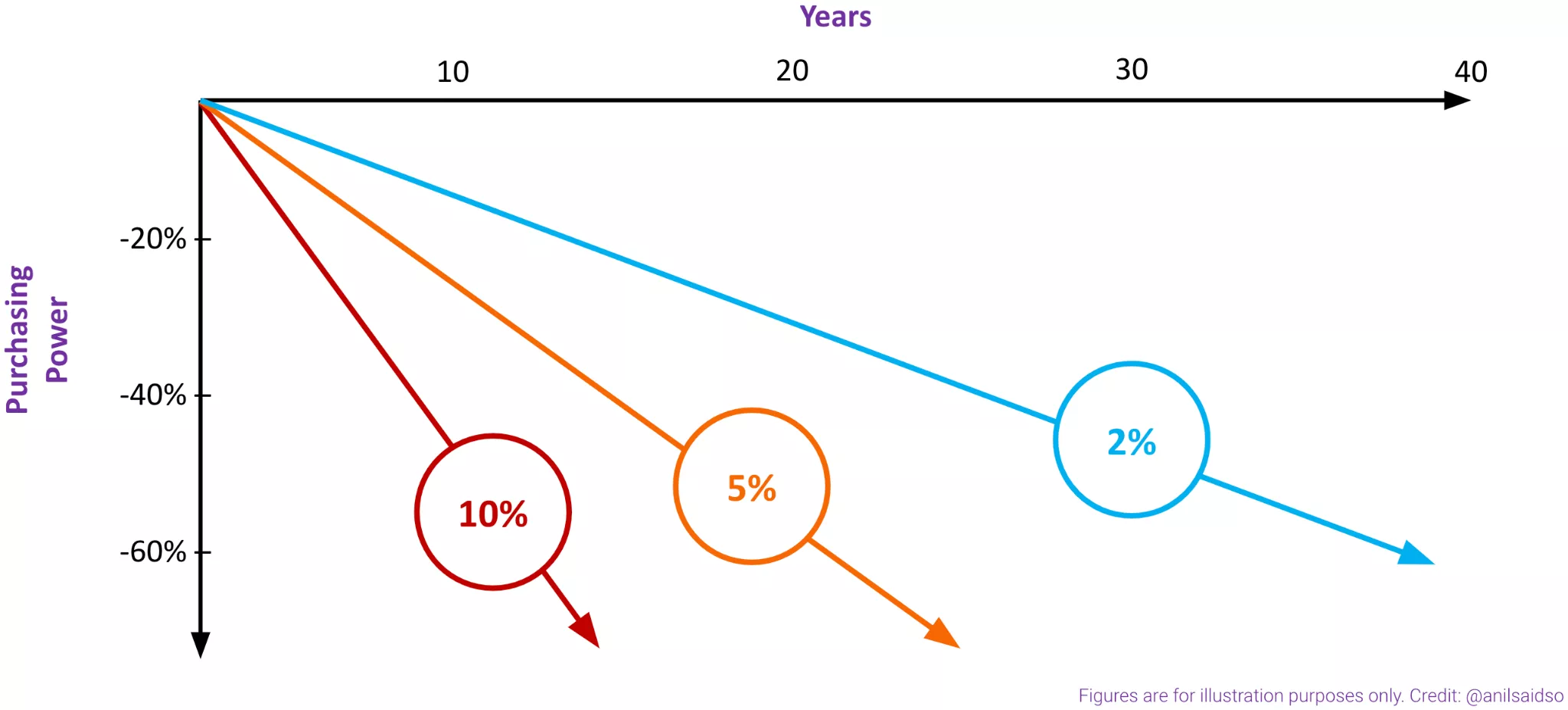
Figure: Inflations Effect On Purchasing Power
Inflation not only leaves millions struggling to keep up with the rising costs of everyday goods and services, but it also erodes their purchasing power, making it increasingly difficult to save money for the future. Moreover, it often hits the most vulnerable the hardest, including low-income families, retirees on fixed incomes, and individuals with limited access to financial services.
Once again, this is where Tether’s stablecoin offerings can make a significant difference.
As their stablecoins are pegged to the value of an underlying asset, such as the US dollar or gold, their price is relatively stable compared to other currencies experiencing rampant inflation. As a result, they offer a viable alternative for people living in countries with unstable currencies. They provide these individuals with a way to move their money into a currency that is not subject to the same inflation rates as their local currency. This can help them maintain the value of their savings and protect themselves from the erosion of purchasing power caused by inflation.
However, this begs the question: What about when currencies like the US are experiencing elevated inflation?
On top of USDt pegged to the USD, Tether offers XAUt—backed by gold—offering an even more robust alternative for people looking to escape high inflation rates.
Gold has been a trusted store of value for centuries, thanks to its scarcity and price stability. However, until recently, it was not possible to use gold as a means of digital payment. XAUt, backed by gold, solves this problem by providing a method of transacting in gold without the need for physical ownership. As a result, people can protect their purchasing power regardless of whether it's their currency or the USD experiencing high inflation.
You may say: But what about e-gold in the 90's?
First, eGold's operational and reserve structures were highly centralised and lacked the transparency of modern stablecoins like XAUt. Consequently, doubts emerged regarding the genuine gold backing supporting eGold tokens.
Second, eGold made its debut during a period when the cryptocurrency market was considerably less developed. Consequently, it grappled with achieving widespread recognition. These combined challenges resulted in eGold encountering significant regulatory obstacles and legal complications, ultimately leading to its downfall.
In contrast, products like XAUt have since surmounted these obstacles, benefiting from enhanced cryptocurrency regulatory frameworks, the wisdom gained from past failures, and a commitment to heightened transparency.
This makes gold-backed stablecoins a safe and reliable option for those looking to protect their wealth from inflation or during periods of economic uncertainty.
Ultimately, stablecoins offer a compelling solution for people living in countries with instability or high inflation. By providing access to currencies that are more stable or by allowing for transactions in gold, stablecoins offer a way for people to protect the value of their savings and escape from the negative effects of inflation. As more people become aware of the benefits of stablecoins, their popularity will likely continue to grow as a means of providing financial stability in an uncertain world.
Improved Usability
Given everything we have touched on so far, I have a feeling you’re starting to grasp how stablecoins offer increased usability over traditional currencies. But to make sure, let's beat the drum a little more. Tether’s stablecoin offerings have revolutionised the world of finance by offering a level of usability that traditional fiat currencies simply cannot match.
What do I mean by increased usability? Let's dive into some of the primary benefits and explore why their stablecoins uptake is growing rapidly.
Firstly, self-custody allows us to take ownership of our money without relying on centralised banking services. This means we have complete control over our funds and can access them whenever we need to, without the need for a middleman. No more waiting for our bank to clear a transaction or worrying about our account being frozen for no reason— with stablecoins, we are in charge. That said, we haven't completely removed centralised oversight by taking self-custody. Most stablecoins, including Tether’s, are issued by centralised companies built upon centralised blockchains such as Ethereum and Tron. Therefore, we put an inherent level of trust in these companies and systems.
Secondly, given that stablecoins, such as USDt and XAUt, are digital in nature, we can transact digitally, 24/7. No more fretting about bank opening hours or delays caused by different time zones— with stablecoins, we can transact whenever it suits us, from wherever we are in the world.
Reduced fees, as discussed above, are another major advantage of Tether’s stablecoins. Unlike traditional fiat currencies, USDt, as well as any of their other offerings, have fewer intermediaries involved in each transaction, which means we retain far more of our purchasing power— with stablecoins, we get to keep more of what we earn.
Finally, stablecoins offer reduced oversight, which means we have greater freedom to direct our money where we see fit. Unlike traditional fiat currencies, which are subject to all sorts of regulations and restrictions, stablecoins are cash-like, meaning far fewer intermediaries are involved in a transaction. This gives us greater freedom to move our money around more easily without having to worry about government oversight or red tape.
Overall, Tether’s various stablecoins offer a level of flexibility and freedom that traditional fiat currencies simply cannot match. With self-custody, digital transactions, reduced fees, and reduced oversight, it's no wonder that more and more people are turning to their stablecoins as a safe and reliable way to transact and store wealth.
Increased Bitcoin Adoption
Last but not least, Tether is playing a vital role in increasing Bitcoin adoption by acting as a bridge between traditional banking and the decentralised, trustless and permissionless rails of Bitcoin.
Before the advent of stablecoins, like USDt, transacting in and out of bitcoin was a complex and risky process. We had to either find someone willing to swap their bitcoin for our money or locate a Bitcoin-friendly bank or exchange. This made it challenging to purchase and sell bitcoin, especially if we lived in a jurisdiction that was hostile towards this magic internet money. And even if we found a way to transact in and out, we had to rely heavily on the traditional banking sector and trust that they wouldn't freeze our account or impair our ability to buy or sell bitcoin.
With the rise of Tether’s various stablecoins, the situation has changed. USDt and XAUt now offer a reliable digital medium of exchange that connects the traditional banking rails to the decentralised and trustless rails of Bitcoin. By using these stablecoins, individuals can now transact in and out of bitcoin with ease and without having to move back onto the traditional banking rails. This has led to increased adoption of Bitcoin, as people can now transact in and out without worrying about the barriers imposed by the traditional financial system.
For example, suppose a user wants to buy bitcoin. In that case, they can simply purchase USDt on an exchange and then use the stablecoin to purchase bitcoin directly, eliminating the need to transfer funds through a bank. Alternatively, if they need to sell bitcoin, they can exchange it for USDt without having to convert it back to their local currency.
With this in mind, stablecoins are changing how we transact with sovereign assets, like Bitcoin, by providing a seamless and easy-to-use bridge between traditional banking and the decentralised digital world. As the adoption of stablecoins continues to grow, we can expect to see even greater adoption of Bitcoin as more people realise there is no need to reenter the traditional banking world, given the usability and digital nature of stablecoins.
In conclusion, Tether’s stablecoin offerings aid financial freedom and security for not only everyday individuals but also those living in remote or unstable areas with limited access to reliable banking services.
Take, for example, Adanna's story, which illustrates how USDt can help people like her escape their quickly deteriorating local currency and have more control over their money without ever having to worry about currency instability or the fact that USDt offers a crucial solution for the unbanked population, enabling access to a digital currency, which empowers individuals who previously lacked such opportunities.
And if that wasn't enough, these stablecoins not only increase the usability of traditional currency, they help reduce the costs associated with remittances, allowing individuals to send money back to their loved ones without incurring high fees.
Overall, stablecoins, like USDt and XAUt, have the potential to transform the lives of billions by offering them access to inclusive and much-needed financial services.
Exam
Now that you went through the Module "Stability Amidst Chaos" you will have to test your newly acquirred knowledge to make sure that you have understood the last sections. We'll start with several Open-Ended Questions and then a small quizz.
- What are the advantages and disadvantages of using fiat-backed stablecoins compared to traditional fiat currencies like the US dollar?
- In your opinion, what are the potential benefits of USDt for individuals who lack access to banking services?
- In your opinion, how significant is the role of stablecoins in protecting individuals from the negative effects of inflation? Can stablecoins truly provide financial stability in an uncertain world?
- How do you think stablecoins can contribute to financial inclusion and economic development in developing countries?
- In your opinion, what measures should stablecoin issuers take to ensure the stability and trustworthiness of their stablecoins? How important is it for stablecoin issuers to be transparent about their reserve practices and provide regular reports?
Overcoming Doubts - Debunking Common Misconceptions & Real-World Use Cases
Misconceptions
Bitcoin has been surrounded by pushback, criticism and misconceptions since its birth in 2009. Despite its growth in popularity and adoption, many still consider it a bubble waiting to burst. Along these same lines, stablecoins have attracted similar attention and scepticism. The idea of a currency backed by a stable asset sounds promising, but many people misunderstand how stablecoins work and their potential impact on the financial system.
In this section, we will explore some of the most common misconceptions surrounding Bitcoin and stablecoins. We will delve into the truth behind these misconceptions and debunk the ones that have caused the most confusion and scepticism. From the belief that bitcoin is too volatile to be a viable currency to concerns about its energy usage, we will examine each issue so that you can form your own opinion. By the end of this chapter, you will have a much greater understanding of these technologies and whether there is legitimacy behind these pushbacks. Bitcoin Misconceptions Although numerous misconceptions surround Bitcoin, let's touch on the nine most prominent:
- Bitcoin is a bubble waiting to burst
- Bitcoin is too volatile to be of any value
- Bitcoin is worthless as it is not backed by anything
- Bitcoin’s technology is already obsolete
- Bitcoin is too slow and expensive to be an effective medium of exchange
- Bitcoin is mainly used for illegal activity
- Anyone can duplicate the Bitcoin code, making it worthless
- Bitcoin consumes too much energy
Let's dive in…
Misconception One: Bitcoin is a bubble waiting to burst Since its inception, Bitcoin has been pronounced dead in mainstream media 473 times (As of March 2023), yet it continues to function flawlessly.
This begs the question: What about Bitcoin gives people the impression that it is a bubble waiting to burst? Throughout history, when something has experienced a monumental rise in price, it also tends to see a catastrophic collapse, as this price is unsustainable and often fueled by speculation and greed. So, what makes Bitcoin different?
First, bitcoin has a limited supply of 21 million coins, which means that, unlike traditional fiat currencies, it cannot be devalued by monetary expansion. This scarcity, combined with the increasing global adoption of Bitcoin, has led to a steady but volatile increase in its value over time. This is unlike any other asset, whereby as prices rise, so does supply. This means supply will overwhelm demand at some point, and prices will have to collapse.
Second, built into Bitcoin's code is a feature called the halving. Approximately every four years, this event slashes the mining reward by half, impacting miners' nominal revenue. Unless the price of bitcoin doubles, miners experience a substantial decrease in their earnings. This aspect has led to Bitcoin being characterised as "number go up" technology, as this feature exerts upward pressure on the price every four years to ensure miners receive adequate compensation for securing the blockchain. Consequently, we witness these volatile price fluctuations approximately every four years.
Side Note: If you've studied finance, you may have heard of the "efficient market theorem," built around the idea that markets are perfectly efficient due to rational behaviour. It, therefore, posits that asset prices in financial markets reflect all available information, making it impossible to consistently achieve above-average returns by analysing historical data or other market information.
However, this theory forgets that markets are composed of individuals, and human nature is inherently irrational and influenced by emotions. This irrationality leads to biases, herd behaviour, and cognitive errors, causing prices to deviate from their true value. For example, in the context of Bitcoin's halving events, rational markets should anticipate and reflect future reduced supply in bitcoin's present-day price. However, the periodic price surges highlight that participants have not accounted for such information. This irrationality has proven to provide significant financial rewards to patient long-term holders.
Third, Bitcoin has the potential to revolutionise global exchange. For the first time in history, we have a method of transacting in a trustless, permissionless and decentralised manner. As discussed earlier in this course, this is unparalleled and offers immense benefits to both developed and developing countries alike.
Lastly, bitcoin's total market value is sitting just shy of $550 billion US dollars. This may seem like an astronomical amount until you realise that gold, depending on one's calculation, is anywhere from $10 trillion to $20 trillion. That means that although Bitcoin offers many of the same benefits as gold, it trades at 1/40th of the value. And when we look at other assets, that divergence is even larger.
- Global stock market: $124.4 trillion
- Global fixed income/bond market: $126.9 trillion
- Global real estate market: $326.5 trillion
- Global derivatives market: Estimated at over $1 quadrillion
All in all, when people call bitcoin a bubble, either:
- They have not done the research to understand its numerous benefits and use cases.
- Or they misunderstand the functionality of Bitcoin and the total amount of value stored in the above assets from which Bitcoin has the potential to take a share of overtime.
Misconception Two: Bitcoin is too volatile to be of any value
Critics often point out that bitcoin's volatility makes it a poor investment option, but this argument ignores a few crucial facts about why bitcoin is experiencing such volatility.
First, bitcoin's volatility is a hot topic of debate and has caused some to criticise the asset for its sharp price swings. We believe this is a narrow view of volatility as volatility measures an asset's price movement, not just its declines. Those with the fortitude to hold onto bitcoin through its fluctuations have been richly rewarded. Take assets A and B, for example. Asset A increases on average by 10% per year with a deviation of 15%, while asset B moves by 5% per year with a deviation of 10%. Although asset B has lower volatility than asset A, asset A outperforms asset B in the long run. You must be willing to stomach the volatility to reap the rewards of bitcoin's price movements. Moreover, the USD may be less volatile day to day. However, if you have held the currency over the last 100 years, you've lost 96% of your purchasing power.
Second, volatility is a natural phenomenon when it comes to technological adoption. When a new technology is introduced, there is bound to be uncertainty and speculation about its potential, which leads to price fluctuations. Artificial intelligence (AI) is a prime example of a highly volatile sector. From [2021 to 2022](https://www.precedenceresearch.com/artificial-intelligence-market#:~:text=The%20global%20artificial%20intelligence%20(AI,USD%2051%20billion%20in%202021.), the total value of AI increased from $51 billion to $119 billion. However, despite its volatility, the benefits of investing in AI cannot be ignored. From self-driving cars to personalised healthcare, the potential applications of AI are immense. So, if you're interested in AI, you wouldn't want to miss out on the opportunities it presents just because of its volatility.
Furthermore, bitcoin's volatility is not unique. Traditional financial markets also experience fluctuations in asset prices, such as the stock market, commodities market, and even currencies. In fact, the volatility of bitcoin is arguably less severe than many other assets.
Lastly, the argument that bitcoin is excessively volatile fails to consider a significant aspect: its valuation is currently tied to fiat currency. The observed fluctuations in bitcoin's value are primarily driven by the inherent instability of the underlying unit of measurement, such as the dollar or other currencies. As Lawrence White aptly points out in his book Better Money, these price swings largely result from people seeking a hedge against inflation. Put differently, in our fractional reserve system governed by central banks, those in positions of power have the capacity to alter the supply of money in circulation. As a result, when they perform monetary policy, such as quantitative easing, asset prices rise, and when they tighten, prices fall. This whipsaw effect is a byproduct of a centralised monetary system, creating uncertainty and instability in financial markets. Consequently, assessing bitcoin's volatility based on its behaviour under a fiat standard is misleading. In essence, it merely highlights the inherent volatility of fiat currencies.
In contrast, Bitcoin operates on a decentralised network, where supply is fixed and cannot be manipulated by a central authority. While this means there may be short-term volatility, the scarcity and predictability of bitcoin's supply will most likely reduce volatility and increase stability in the long run.
To illustrate this:
- In 2018, two independent studies conducted by Charles Schwab and Grayscale Investments revealed that bitcoin's volatility had substantially decreased between 2011 and 2013.
- A report by Bitwise Asset Management in 2019 found that bitcoin's volatility had decreased significantly since 2014 and was now comparable to other traditional assets such as stocks.
- A study published by Coin Metrics in 2020 found that bitcoin's volatility had decreased significantly over the past two years.
With this in mind, it is important to view bitcoin's volatility in the context of the broader economic system and not simply dismiss it as a flaw. Bitcoin's potential as a store of value and means of exchange should not be discounted based on short-term price fluctuations.
Misconception Three: Bitcoin is worthless as it is not backed by anything
Bitcoin is often dismissed for not being backed by anything of value, like gold or government currency. The idea that, given bitcoin is not backed by anything tangible, it must be worthless is a fallacy.
Value is subjective and is in the eye of the beholder. Something is valuable because people believe it to be so. Take the example of art. A painting is just canvas and paint, yet some pieces are worth millions of dollars. Why? Because enough people value them that highly. Regardless of what others think, paintings offer value to the owner, which is why they purchased them.
The same goes for bitcoin. People value it because it is a decentralised currency that is not controlled by any government or bank. It is scarce, with a limited supply, and is secure due to the technology behind it. Some people may not see these characteristics as offering value, and that is ok. But that doesn't mean that it is worthless.
Price is a reflection of what people are willing to pay for something. If bitcoin were truly worthless, as it was not backed by anything, then it would be trading at $0, as nobody would be willing to exchange their hard-earned money for it.
Furthermore, the idea that currency must be backed by something of value is inaccurate. Fiat currencies, like the US dollar, are not backed by gold or anything tangible. Instead, their value is based on trust in the government that issues them and the belief that they can be exchanged for goods and services. In the case of bitcoin, its value is based on trust in the technology that underpins it and the belief that it can be used to store value or exchange goods and services.
Ultimately, the idea that something must be backed by something else of value to be valuable is a misnomer. Value is subjective and based on people's experiences and beliefs. Just because one person deems something worthless doesn't mean everyone does, and vice versa.
Misconception Four: Bitcoin’s technology is already obsolete
Let's now dive into the repeated argument that Bitcoin is obsolete, breaking down why this could not be further from the truth.
First, in the world of cryptocurrencies, there is this idea called the blockchain trilemma. In essence, there are three primary characteristics cryptocurrencies tend to focus on:
- Scalability
- Security
- Decentralisation
Without diving into the weeds, in the realm of cryptocurrencies, the trilemma emerges when a cryptocurrency must determine its trajectory and values. The cryptocurrency can only prioritise two out of the three aforementioned characteristics, forcing difficult decisions and trade-offs to be made.
Bitcoin chooses to prioritise decentralisation and security over scalability. Nevertheless, this scalability is still achieved. It just does so through alternative means (Discussed in the next misconception). Other cryptocurrencies, however, often prioritise scalability, but in doing so, they sacrifice decentralisation, making them vulnerable to attack or no different from fiat currency or a security.
Secondly, Bitcoin is built on consensus, which means no matter who you are or where you live in the world, by running a piece of software, you can have a say in the direction of Bitcoin. This means that as the world advances, Bitcoin can adapt to its changing environment. This is illustrated by the many upgrades that have been made to Bitcoin over the years, such as SegWit, which improved its scalability, and the Lightning Network, which enables faster and cheaper transactions.
Lastly, while there are thousands of other cryptocurrencies that offer different benefits, Bitcoin is not trying to be all things to all people. Instead, it is trying to do one thing incredibly well: to be a decentralised, trustless, and permissionless currency. And... it does this better than anyone else, as evidenced by its market cap, which is multiples of any other cryptocurrency.
However, it should be noted that the landscape of "cryptocurrency" is often packed with buzzwords, many of which are rooted in ideas proposed, tested, and subsequently abandoned by OG cryptographers and Bitcoin developers. An array of examples highlights this trend: The now-hyped zero-knowledge (ZK) technology found its genesis in discussions by Satoshi himself in 2010 and Gregory Maxwell in 2013. Concepts like confidential transactions (CT) and bulletproof, now integral to Monero and Grin, were crafted and realised on two Bitcoin sidechains, Elements and Liquid. The notion of "braiding"—interweaving or linking multiple blockchain chains together to achieve certain benefits or functionalities—was originally proposed by Bitcoin developers as a potential solution to certain scalability and interoperability challenges and is now employed by Kaspa, Byteball, Nano, and Hedera. The origin of much "NFT" innovation traces back to Bitcoin's pioneering efforts in 2013/14/15. Even the widely-marketed "Proof of Stake," which gained prominence through Peercoin, Bitshares, NXT, and Ethereum, is a revived concept derived from Wei Dai's second b-money protocol, originally conceived in 1998—though Satoshi ultimately dismissed it, favouring Proof of Work. While delving into every detail isn't necessary, it's evident that the "innovation" underpinning many alternative coins finds its roots in the evolution of Bitcoin itself.
Therefore, once again, the argument that Bitcoin is obsolete is unfounded. It may not be perfect for everyone, but it continues to evolve and improve.
Misconception Five: Bitcoin is too slow and expensive to be an effective medium of exchange
If you recall from Module Two Section Four, Bitcoin's blockchain is made up of blocks, each with a maximum size of around 1mb. Due to the limited block size, Bitcoin's base layer has an upper limit of processing around seven transactions per second (tps), much lower than networks like Visa or Mastercard, which transact at 1,700 tps. Thus Bitcoin is often said to be too slow to ever function as a viable medium of exchange.
However, it is vital to point out that Bitcoin is not trying to compete with Visa or Mastercard. Instead, it is more similar to layer one, capable of processing high-value transactions but a fraction of the speed and cost of traditional layer one methods while also being trustless, permissionless and offering transactions with final settlement.
But Bitcoin also competes with layer two transaction methods, with technologies like Lightning built on top of layer one. Lightning allows for near-instant transactions with minimal fees, making microtransactions and small purchases possible. Since El Salvador has adopted Bitcoin as legal tender, the general populace has been using Lightning to transact with Bitcoin due to its unparalleled benefits, such as almost instantaneous transaction times and fees for a fraction of a cent. This makes it a perfect fit for small merchants and individuals.
Misconception Six: Bitcoin is mainly used for illegal activity
Despite the numerous studies debunking false claims, Bitcoin is still often criticised as being primarily used for illicit activity. Once again, this could not be further from the truth.
One study conducted by the ex-deputy director of the CIA found that "broad generalisations about the use of Bitcoin in illicit finance are significantly overstated." In fact, since 2016, less than 1% of Bitcoin's total transaction volume has been used for illicit activity. By comparison, "some put the underground economy at 11% to 12% of US gross domestic product," of which the majority is facilitated using the US dollar.
And according to a report by Chainalysis in 2020, illicit activity only accounts for about [0.34%](https://www.europol.europa.eu/cms/sites/default/files/documents/Europol Spotlight - Cryptocurrencies - Tracing the evolution of criminal finances.pdf) of all Bitcoin transactions.
However, even with this evidence, misleading statements continue to be made by those in power, such as US Treasury Secretary Janet Yellen claiming, "Cryptocurrencies have been used to launder the profits of online drug traffickers; they've been a tool to finance terrorism."
Although countless studies disprove such false claims, it is clear that certain individuals have an agenda and are determined to construct negative and unfactual narratives around Bitcoin. The reality is that Bitcoin has the potential to bring about significant positive change in the world, from providing access to financial services for the unbanked to reducing transaction costs and increasing financial freedom.
In light of this, while there is no denying that illicit activity does occur within the world of Bitcoin, the evidence shows that it is a fallacy to believe that it is the primary use case. In fact, the percentage of Bitcoin transactions used for illicit purposes is significantly lower than that of traditional finance.
However, it’s important not to paint all illegal behaviour with the same brush stroke. Certain activities deemed "illicit" in one jurisdiction may be seen as a fundamental right in another. For example:
- The practice of non-Islamic religions in Saudi Arabia,
- Same-sex marriage in countries like Russia and Iran,
- Or access to education for girls in Pakistan
...are deemed illegal in their respective jurisdictions. This underscores that what is deemed illegal is not black or white. There's a complex relationship between legal definitions and the diverse values upheld across different regions.
Misconception Seven: Anyone can duplicate the Bitcoin code, making it worthless
The argument that Bitcoin's code can be easily copied and, therefore, is worthless misses a crucial aspect of what gives bitcoin its value. While it is true that the code for Bitcoin is open source and can be copied, the value of bitcoin is not solely derived from the utility it offers.
One of the most important aspects of Bitcoin is its network. Bitcoin has been around since 2009 and has built up a significant user base over time. This user base includes individuals, businesses and nations that have invested in bitcoin and use it as a store of value or a means of exchange.
This network creates a powerful incentive for people to continue using Bitcoin. Even if a new token were created with the same functionality as Bitcoin, it wouldn’t have the same level of trust and adoption. This is because it would lack the established network of users and the history of transactions.
Simply put, just like how you cannot spin up a brand new Facebook tomorrow and expect it to be as valuable as the original Facebook, a new token cannot simply replicate Bitcoin's network overnight. The value of bitcoin is not just in its code but in the trust and adoption that it has built up over time.
In summary, while Bitcoin's code may be open source and can be copied, its value is derived from its network of users and the trust and adoption it has built up over time. A new token with the same functionality as Bitcoin would not have the same level of trust and adoption and, therefore, would not be a viable substitute for Bitcoin.
Misconception Eight: Bitcoin consumes too much energy
Bitcoin frequently becomes the target of smear campaigns, claiming it consumes more energy than small countries or will boil the oceans. However, these critics conveniently overlook comparable examples from other energy-consuming endeavours to provide a reference.
It is also worth noting that the criticisms regarding Bitcoin's energy usage often originate from individuals in privileged and developed societies. These individuals typically have access to banking facilities, use clothes dryers, rely on air conditioners for heating or cooling, decorate their homes with Christmas lights, and frequently engage in overseas or long-distance holidays. All of these endeavours consume energy. With this in mind, we want to discuss three points:
- The Subjectivity of Value: Why there is no such thing as "too much" energy consumption. The amount of energy consumed by a particular activity or industry reflects the value people attribute to it. If something requires energy to operate, it is because there is a demand and perceived benefit associated with it.
- Direction Energy Monetisation: We have a method to monetise energy directly for the first time in history.
- Fair Comparisons: By comparing Bitcoin's energy usage to that of other sectors, we can gain a more balanced perspective and assess the validity of the claims made against it.
But first, let's answer the glaring question: Why does Bitcoin consume energy?
Similar to how energy is consumed in mining physical gold, Bitcoin miners consume energy in their pursuit of acquiring bitcoin. This requirement of real-world energy anchors an otherwise intangible digital asset to the physical world. Moreover, with the vast network of miners globally expending energy to secure the Bitcoin network, energy consumption to obtain bitcoin serves as a powerful defence mechanism against centralisation and undue manipulation. For this reason, it is exceedingly difficult for centralised entities to co-opt the network or manipulate the rules in their favour, as they would have to outcompete the countless globally distributed miners.
In light of this, let's take a look at the three discussion points above.
The Subjectivity of Value
At some point, you may have come across the argument that bitcoin has no intrinsic value, leading to questions about why it should be allowed to consume energy.
As discussed in misconception three, intrinsic value is subjective and dependent on individual circumstances and needs. For example, imagine yourself in a scorching desert, and someone offers you a thick down jacket. It would be useless. Now, imagine you're in the freezing cold Arctic. Suddenly, that jacket becomes immensely valuable. This illustrates that value is not inherent in an object but rather determined by the specific context, conditions, and utility the object provides to an individual in meeting their needs. However, subjectivity doesn't just extend to value. It extends to the consumption of energy as well. If something requires energy to operate, it clearly indicates that people find value in it, as they are willing to dedicate their time, resources, and energy towards it.
Every day, we witness countless examples of energy consumption arising from individuals' perceived value of certain activities or industries. Energy consumption is intricately tied to value creation, from the use of appliances in our homes to Bitcoin mining to the energy required to power the vast infrastructure that drives our economy.
Consider the advancements in technology, transportation, and entertainment that have emerged over time. These innovations often demand significant amounts of energy, yet they have fundamentally transformed our lives and brought immense value. Bitcoin is no different. Whether it is the convenience of modern transportation, a peer-to-peer digital currency, or the enjoyment derived from various forms of entertainment, these experiences and benefits are made possible by energy consumption.
With this in mind, it is important to recognise that the perception of value varies among individuals and communities. What one person may deem as a worthwhile energy use, another might view as excessive or unnecessary. However, this subjectivity should not diminish the recognition that energy consumption is intrinsically linked to the value people attribute to certain endeavours.
For instance, many individuals deem Bitcoin a worthwhile use of energy due to its ability to provide a decentralised, trustless, and permissionless means of transacting without intermediaries. While some people in developed countries may not fully appreciate this value proposition, it holds tremendous significance for those living in countries where government control is restrictive and inflation is rampant. In such circumstances, a currency like Bitcoin offers immense value, leading to people in these situations being willing to dedicate their energy and resources to support its operation.
Direct Monetisation of Energy
In the past, power plants, solar farms, hydro dams, and similar entities depended on selling their energy to the energy grid, individuals, or businesses to drive revenue. However, this reliance on local buyers often led to the wastage of unused energy when there were not enough buyers. Consequently, this scenario creates what is commonly referred to as stranded energy, where energy is produced but has no alternative purpose or buyer and is ultimately wasted. One might suggest storing the excess energy in batteries, but unfortunately, the limitations of battery technology make this an impractical solution.
And this is where Bitcoin comes in. For the first time in history, Bitcoin enables the direct monetisation of energy.
Energy producers can now redirect stranded energy towards Bitcoin mining, allowing them to earn Bitcoin from unused energy. This innovative approach not only significantly reduces wasted energy but also opens up an additional revenue stream that was previously inaccessible. Conversely, this newfound revenue helps lower the overall energy cost for everyone else, as in the traditional energy market, the price of energy includes the cost of wasted stranded energy. Why? By utilizing Bitcoin mining to monetise this previously unusable energy, energy producers can offset their costs and pass on the benefits to consumers, reducing energy prices.
Expanding on this concept, our energy grid is designed to operate with excess capacity, typically utilising only 40-60% of the energy it can produce at any given moment. This precautionary measure allows the grid to quickly accommodate unexpected surges in energy demand during events such as extreme weather conditions, like heatwaves or cold spells, when people intensify their use of air conditioning or heating systems. Since energy producers cannot instantaneously increase their output to match the sudden rise in demand, generating a surplus of energy becomes necessary, introducing excess capital costs and the potential for wasted energy.
And this wastage doesn't look to be improving anytime soon. As the strength of the wind varies, and solar intensity diminishes with cloud cover, wind energy is around 15-30% efficient at best, while solar energy comes in at approximately 16-24% efficient. Given our plans to transition towards 100% reliance on renewable energy sources, it becomes necessary to have an energy capacity of at least three times the maximum demand of the grid. This surplus capacity is required to ensure that the grid remains stable in the event of supply interruptions, minimising the threat of blackouts. However, that also means a large portion of our energy production will be stranded at any time! This energy has no other use. There is no one willing to buy it.
However, now energy producers have a way of capitalising on this stranded energy that would otherwise go to waste. By monetising the surplus energy through Bitcoin mining, energy producers can optimise their operations, benefit financially, and ultimately reduce costs for everyone on the grid.
Lastly, Bitcoin miners are motivated to seek out inexpensive energy sources since their profits depend on the cost of energy. Consequently, they actively look for stranded energy or other forms of energy that would otherwise go unused. One notable example is flare gas, which is released when petroleum companies extract oil from the ground. Flare gas is a byproduct of this process and is typically burned off due to the high cost associated with capturing it. This practice, known as flaring, not only results in wasted energy but also releases methane and various other gases into the atmosphere.
Figure: Flare Gas
However, with Bitcoin, engineers have devised a way to utilise this otherwise wasted natural gas by converting it into energy to power Bitcoin miners. This breakthrough not only provides an additional revenue stream for these companies but also has significant environmental benefits. By harnessing flare gas to generate electricity for Bitcoin mining, these companies can reduce emissions which would otherwise pollute the air we breathe. In essence, Bitcoin is carbon-negative in this scenario by offering a means to reduce emissions and make productive use of previously discarded energy sources.
All in all, given that Bitcoin miners are incentivised to seek out cost-effective energy sources, often favouring renewable energy, Bitcoin boasts one of the most sustainable energy mixes among industries and even countries. So, the next time someone raises concerns about Bitcoin's environmental footprint, you can confidently counter with the fact that Bitcoin is at the forefront of sustainable energy practices.
And lastly…
Fair Comparisons
We want to start by saying: Everything consumes energy, whether we realise it or not. Even a simple act, like running with your dog, necessitates fueling yourself and your furry companion. Both you and your dog are energy consumers.
Now our intention is not to criticise other industries for their energy consumption because, as discussed above, energy usage signifies the value people find in the services or products provided. However, it is essential to put Bitcoin's energy usage into perspective. Consider the following comparisons:
- Washing machines consume 18% more energy than Bitcoin.
- Gold mining and jewellery production consumes ten times more energy than Bitcoin.
- Sea transportation consumes over 51 times more energy than Bitcoin.
- The financial and insurance sector consumes a staggering 62 times more energy than Bitcoin.
- And remarkably, the building sector consumes a staggering 457 times more energy than Bitcoin.
By examining these comparative examples, it becomes evident that before passing judgment on Bitcoin's energy consumption, we must consider the energy usage of other industries. This perspective allows for a more comprehensive understanding of the broader energy landscape.
Furthermore, when we consider the extensive benefits that Bitcoin provides, including:
- Banking access for the unbanked population
- Global peer-to-peer transactions without intermediaries
- Cost-effective remittance options for individuals to send money to their families
- A trustless and permissionless digital currency system
- A means for those living under authoritarian regimes to save and transport value securely
- Direct monetisation of stranded energy
We gain a deeper understanding of why people not only find immense value in Bitcoin but are also willing to direct their energy towards its operation.
To end, we hope these Bitcoin misconceptions have given you a deeper understanding of Bitcoin beyond the surface-level criticisms it often receives. Upon closer examination, it should now be evident that many of these critiques prove to be baseless. With this in mind, it's time to shift the focus away from misguided portrayals of Bitcoin and towards a more comprehensive understanding of the broader financial system. By doing so, we can work towards creating a more fair and equitable system that benefits everyone, not just those in power.
Let’s now turn our attention to the common misconceptions surrounding stablecoins…
Stablecoin Misconceptions
- Most stablecoins are not fully backed by reserves
- Even the most stable of stablecoins depeg
- Given most stablecoins are centralised, the issuer can freeze your funds
- You'll lose your funds if the underlying chain goes down
- Both Bitcoin and stablecoins benefit the rich in developing countries
Misconception One: Most stablecoins are not fully backed by reserves
When understanding stablecoins, it is essential to recognise that each stablecoin operates under unique principles and frameworks. Some stablecoin projects exhibit exceptional diligence and transparency by providing detailed information about their reserves and regularly releasing attestations verifying them.
For instance, Tether strongly supports transparency visible by their attestations, which can be accessed to gain insight into their reserve backing here. These attestations serve as a testament to their commitment to putting the customer first.
However, this is not the case for all stablecoins, with many not offering the same level of transparency. Therefore, we cannot stress the importance of conducting thorough research before entrusting significant wealth to any particular stablecoin. Furthermore, there is a level of trust that the user must place with the stablecoin issuer, regardless of the level of transparency.
Another common criticism is that stablecoins are often not fully backed by cash but rather "cash and cash equivalents." This is the technical term for cash and cash-like reserves that can easily be converted to cash. However, it is important to consider two points:
First, stablecoin issuers often invest in cash equivalents rather than holding cash, as cash can significantly impact the stablecoin issuer's balance sheet. With current banking regulations, any balance sheet assets, such as cash, are subject to potential loss in the event of bankruptcy, and the Federal Deposit Insurance Corporation (FDIC) only provides insurance coverage for up to $250,000 USD, with amounts exceeding this limit at risk. To mitigate this exposure, stablecoins aiming to safeguard users against unforeseen events often invest in government-issued treasury bills. By investing in assets like treasuries, not only do they generate a yield, these assets can be deemed off-balance sheet securities. As a result, stablecoin issuers can protect their funds in the event of bank bankruptcy, as these securities could be returned to the customer. A compelling illustration of this occurred in February/March 2023, involving Silicon Valley Bank (SVB) and Circle, the company behind the stablecoin USDC. At that time, Circle had a substantial $3.3 billion in cash deposited with SVB. And then, SVB went bankrupt. To avert a financial disaster, the FDIC intervened to rescue Circle and other affected companies by covering the missing funds. However, this is not the standard course of action. This unprecedented event marked the first time in history such a situation had unfolded. Without the FDIC's intervention, Circle might have faced bankruptcy as well.
Second, we often criticise stablecoin issuers for investing in non-cash assets, yet our existing banking system operates on a fractional reserve basis. In simple terms, banks do not hold sufficient reserves to meet the withdrawal demands of their customers. If a significant portion of our national population were to withdraw their deposits, the banking sector would quickly collapse. In fact, since 2020, the reserve requirement in the United States has been set at zero, meaning that banks are not obligated to retain ANY customer deposits.
We want to be clear. This observation does not imply that we should disregard concerns about stablecoins substituting cash reserves for assets that could depreciate in value, potentially destabilising the stablecoin. Instead, we should acknowledge the double standards between traditional and modern cryptographic finance.
All in all, while misconceptions about stablecoins exist, and rightly so in many instances, it is essential to recognise that each stablecoin operates uniquely, with varying degrees of transparency and diligence. By conducting thorough research into whichever stablecoin you decide to store value in, you can mitigate many of the common pitfalls associated with cryptocurrencies.
Misconception Two: Even the most stable of stablecoins depeg
When it comes to the misconception that even the most stable of stablecoins depeg, it is important to differentiate between the primary and secondary markets.
The primary market exists between the stablecoin issuer, i.e. Tether, and the primary exchanges that have the ability to redeem the underlying asset of value, such as USD, or issue stablecoins to maintain price stability. These primary market transactions ensure that the stablecoin remains closely pegged to its intended value.
On the other hand, the secondary market is between the customers and the exchanges. This is where individuals can buy and sell stablecoins, whether trading, investing or whatever else their heart desires.
A depeg occurs when a stablecoin no longer has the necessary reserves to meet the withdrawal demands of its holders or in the event of a hack compromising the stablecoin. However, it is important to note that most short-term price volatility experienced by stablecoins is not indicative of a depeg. Instead, it is often a result of liquidity issues.
Let us explain. Suppose a smaller exchange lacks the capability to redeem the underlying asset of value, and there is strong selling pressure from people seeking to withdraw the underlying asset of value backing the stablecoin. In that case, the stablecoin's price may temporarily drop below its ideal pegged price. This temporary drift from the peg is a short-term occurrence and should normalise once the exchange obtains the necessary underlying assets to meet its customer's needs. This temporary price volatility does not necessarily indicate that the stablecoin has failed and is collapsing. Instead, it reflects low liquidity levels impacting users' ability to withdraw funds in a timely manner.
On the flip side, it is also possible to observe stablecoin trading above their pegged price. This situation arises when the demand for stablecoins surpasses an exchange's capacity to meet customer demands. Typically, this phenomenon occurs on smaller exchanges that lack a direct link to the stablecoin and when the underlying asset holds significant value, prompting individuals to pay a premium to acquire it. For example, consider a scenario where individuals residing in an authoritarian country experiencing rampant inflation seek refuge in stablecoins like USDt. In such cases, people may be willing to pay a premium to obtain dollars in the form of USDt. This willingness stems from the understanding that failing to do so would expose them to a greater decline in their purchasing power caused by the inflationary environment.
In light of this, price volatility is out of the hands of the stablecoin issuers, such as Tether, as they do not interface directly with the customer. Instead, customers obtain USDt through exchanges. They are, therefore, reliant on the exchange to maintain adequate stablecoin/underlying asset liquidity to meet the needs of their customers.
In summary, next time a stablecoin trades above or below its intended price, be aware of the distinction between short-term price volatility caused by liquidity issues and a genuine depegging event.
Misconception Three: Given most stablecoins are centralised, the issuer can freeze your funds
In addressing the misconception that stablecoins can freeze your funds due to their centralised nature, it is important to emphasise the distinction between centralised and decentralised entities, each with its own advantages and disadvantages. While we strongly advocate for decentralised assets like Bitcoin, this does not mean centralised stablecoins lack value or benefits.
One of the primary advantages of centralisation is the ability to intervene when it is in the best interest of users and the overall stability of the system. Although it is true, stablecoins issuers have the potential to freeze funds. In essentially all instances, this is not used as a malicious attack on the stablecoin holder. Instead, it is in conjunction with law enforcement to protect consumers. A notable example is the case of the FTX exchange collapse. In collaboration with law enforcement, Tether froze $46 million worth of USDt to protect consumer funds.
Another instance demonstrating the benefits of centralised intervention occurred after the KuCoin hack in September 2020. Tether froze approximately $35 million worth of USDt to prevent hackers from profiting from their illicit activities. These examples highlight how centralised stablecoins, in certain scenarios, can swiftly respond to malicious actors and safeguard the interests of their users.
With this in mind, while we prioritise bitcoin for long-term savings due to the absence of intermediaries or individuals who can co-opt the network, centralised stablecoins still hold several benefits, i.e. while the centralised nature of stablecoins allows for the potential freezing of funds, this trait can be a valuable tool in combating illicit activities and protecting users.
Misconception Four: You'll lose your funds if the underlying chain goes down
One of the common misconceptions about stablecoins is that you'll lose your funds if the underlying chain of a stablecoin goes down. We, therefore, feel it is important to explain how stablecoins operate on their transport layer, such as TRON, Ethereum, and Algorand, among others. While it may initially seem concerning to lose access to your stablecoins when the underlying chain faces issues, you'll be happy to know there are measures in place to safeguard your funds.
Take, for example, USDt. Many fall into the trap of thinking the USD backing USDt sits on the transport layer. In reality, the USD is held in reserves by Tether and not directly by the underlying chain. Therefore, if the chain on which you hold USDt experiences a disruption, it does not mean the underlying USD reserves are lost. Instead, one of two scenarios is likely to unfold:
- In most instances, disruptions in the underlying chain are temporary hiccups, and the chain will resume functioning shortly. These interruptions are often resolved, allowing users to regain access to their stablecoins.
- In more significant cases, such as a major hack or chain failure, Tether can take remedial action. They may establish a staging website for USDt holders of the non-functioning chain. Through this website, users can then prove ownership of their USDt tokens using their private keys. Once ownership is confirmed, Tether can burn the non-functioning USDt tokens held by users and reissue them on a functioning chain. These reissued USDt tokens are then sent to the users, ensuring the continuity of their funds.
With this in mind, there are measures in place that even if the underlying chain of a stablecoin encounters difficulties, stablecoin issuers have steps they can take so you can recover your funds.
In summary, while it is natural to have concerns about losing access to your funds if the underlying chain of a stablecoin goes down, it is important to recognise the contingency plans and processes established by stablecoin issuers.
Before moving on, we want to highlight, once again, that every stablecoin operates differently. Therefore, it is imperative that you research any stablecoin you intend to use to familiarise yourself with the safety measures implemented to safeguard customer funds.
Conclusion
To end... Remember, Bitcoin and stablecoins inherently challenge the established power structures and authority of governments, which naturally invites pushback. Much of this resistance often arises from the fear of disrupting the existing financial system and questioning governments' control over currency and monetary policies. That said, not all of this pushback is grounded in fact. It is, therefore, imperative to approach these criticisms with a critical mindset.
By objectively assessing any pushback you encounter, you can better navigate the sea of baseless criticisms. Take the initiative to educate yourself on the intricacies of Bitcoin and stablecoins, delve into their underlying technology, and further explore their potential for financial innovation and empowerment.
Ultimately, the future of decentralised finance rests with those willing to venture beyond the confines of convention, challenge preconceived notions, and evaluate information objectively. Strive to make informed decisions about Bitcoin and stablecoins based on accurate knowledge and a balanced understanding of their capabilities and limitations.
Roya Mahboob
In today's globalised world, access to financial services is a critical component of economic participation and independence. Despite this, far too many individuals are still excluded from the traditional banking system, with women often bearing the brunt of this exclusion. Shockingly, although an unnecessary one-quarter of the global population remains unbanked, in countries like Saudi Arabia, 36.5% of women lack access to basic banking services, preventing them from fully participating in their country's economy and society.
Here are just a few examples of the conditions that women around the world still endure today:
- Restrictions on opening bank accounts: In 72 countries worldwide, women are not allowed to open bank accounts in their own name. This means they cannot access financial services, save money, or take control of their financial lives.
- Dependence on male relatives: In many patriarchal societies, women are dependent on male relatives for financial support. This means that they are unable to make financial decisions for themselves and are often at the mercy of their male relatives. For example, in Afghanistan, women often have to rely on male family members for financial assistance, and they may not be able to access financial services without the permission of a male guardian.
- Restrictions on employment: In certain countries, women are not allowed to work outside the home, which makes it difficult for them to achieve financial independence. For example, in Syria, Iraq, Afghanistan, Algeria, Palestine, Jordan and Iran, women only make up between 15 - 18% of the workforce.
- Lack of property rights: There are still 75 nations globally where women do not have property rights, which means they are limited in their ability to own land or other assets. This makes it difficult for them to start businesses or access credit, as they do not have any collateral to offer. For example, in some parts of India, women are not allowed to own property, and they may not be able to access credit without the permission of a male relative.
These are just a few examples of the kinds of obstacles that women in many present-day societies still face when it comes to accessing financial services and achieving financial independence.
This lack of access to fundamental services makes it incredibly difficult for these women to achieve economic independence and take control of their financial lives. However, there is hope on the horizon. Since the rise of Bitcoin, these women now have a solution to this problem. Through a simple internet connection, they now have access to a trustless, permissionless and decentralised medium of exchange that the traditional banking industry has failed to provide. Bitcoin is empowering women who have been left behind by the traditional financial system.
Let's look at one such example of how Bitcoin has transformed women's lives...
Afghanistan is a country that has been plagued by conflict for decades, and the situation for women in the country is particularly dire. The Taliban's oppressive regime, which ruled from 1996 to 2001, stripped women of their basic rights, including the right to education and the right to work. Even after the fall of the Taliban, women in Afghanistan continue to face significant challenges, including limited access to education and employment opportunities and a lack of financial independence.
However, in recent years, Bitcoin has emerged as a powerful tool for financial empowerment, especially for women who are often marginalised. One individual who has taken advantage of Bitcoin's potential is Roya Mahboob, an Afghan entrepreneur who has used the digital currency to help women in her country access financial services and regain their dignity.
While the world watched in horror as the Taliban seized control of Afghanistan in 1996, this young girl Roya was living in the heart of the conflict. At just seven years old, she found herself caught up in the turmoil and uncertainty of war as her hometown was invaded and occupied by the Taliban. Despite the danger and adversity she faced, on top of the fact that she was unable to go to school, Roya refused to be defeated. Instead, she turned to education as a way to overcome the limitations imposed upon her by her circumstances.

*Figure: Roya Mahboob
Roya Mahboob is a trailblazer in Afghanistan's technology and entrepreneurship field. Not only was she named TIME Magazine's 100 Most Influential People in the World for 2013 after "building internet classrooms in high schools in Afghanistan." She also founded the Afghan Citadel Software Company in 2010, which aims to "create jobs for recent university graduates - especially women." And if that wasn't enough, she then went on to start the Digital Citizen Fund. This non-profit organisation works to empower women and children in developing countries through technology.
However, throughout this journey, Roya was not alone. Bitcoin has proven to be an invaluable tool in her mission to empower women. Despite facing numerous obstacles, including legal barriers preventing women from working and opening bank accounts, Roya was determined to find a way to pay the women who were working with her.
This is where Bitcoin came in… Because holding bitcoin doesn't require the owner to have a traditional bank account, anyone with an internet connection can use it. This means that women in Afghanistan who may not have access to traditional banking services can still access financial services through Bitcoin.
Therefore, given its trustless, permissionless and decentralised characteristics, it provided a lifeline for these women who had previously been shut out of the traditional financial system.
Roya Mahboob recognised this potential early on and began to incorporate it into her work with the Digital Citizen Fund. She saw that Bitcoin could provide a way for women in Afghanistan to access financial services and take control of their financial lives.
One of the ways that Roya Mahboob has used Bitcoin is through a program called the Women's Annex Foundation. The Women's Annex Foundation is a platform that provides educational and employment opportunities for women in Afghanistan. It gives women the opportunity to create content such as blogs, videos, and social media posts. This content is then shared on the Women's Annex platform, enabling them to connect with a global audience and earn money in the form of bitcoin in exchange for their work. This is something that would have been previously impossible before the emergence of Bitcoin. Since its inception, the Women's Annex Foundation has been a tremendous success, helping countless women in Afghanistan to gain financial independence and take control of their financial lives. By earning bitcoin, these women can bypass traditional financial institutions and access financial services that would otherwise be unavailable to them.
In addition to providing financial independence, Bitcoin has also given women in Afghanistan back their dignity. Because Bitcoin is decentralised, it has enabled women to take control of their financial lives without the need for a male guardian. This is a significant step forward in a country where women are often treated as second-class citizens.
Furthermore, with the help of Mahboob and Bitcoin, these women in Afghanistan can now connect with a global audience. Hopefully, in the years to come, these women will continue to share their stories and perspectives with the world, helping to break down the barriers that exist between different cultures and communities.
Overall, Bitcoin has been a powerful tool for women's financial empowerment.
Mercedes
Born in Mexico in 1949 into impoverished circumstances, Mercedes experienced the stark inequalities plaguing her society from an early age. Throughout her childhood, she faced numerous challenges, including government repression of student movements and unique struggles experienced by women living in poverty. Moreover, the vast gap between the rich and the poor, combined with limited access to quality education, trapped her family and countless others in poverty. Frustrated by these injustices, Mercedes gravitated toward Marxism (Communism), advocating for social change and economic reform.
Despite holding strong Marxist beliefs, Mercedes eventually came to acknowledge the inherent constraints of these traditional systems when it came to power and wealth distribution. This realisation prompted her to look elsewhere, which is when she encountered Bitcoin and its potential to challenge the very financial systems she had long criticised. Motivated by the prospect of fostering financial liberation and empowerment, Mercedes redirected her energy toward advocating for the transformative potential of Bitcoin.
In her native Mexico, where drug-related violence and economic instability disproportionately affect women, Mercedes works tirelessly to provide these individuals with access to bitcoin as a secure and alternative means of managing their finances. By teaching them how to set up and use digital wallets, she enables them to have more control over their money and break free from the traditional cycles of poverty and crime.
Mercedes believes empowering women is the key to unlocking Bitcoin's full potential. By providing women globally with access to bitcoin and the necessary tools to understand and use it, she hopes to enable them to break free from poverty and oppression, creating a brighter future for themselves and their families.
Her experiences in countries such as Mozambique, Mexico, Venezuela, and Argentina showcase her unwavering commitment to empowering women through Bitcoin. In Mozambique, where access to financial services is limited for women in rural areas, Mercedes actively helps these women learn about Bitcoin and how it can be utilised for safer transactions, secure savings, and increased financial autonomy.
In both Venezuela and Argentina, countries plagued by economic instability and high inflation rates, Mercedes has been actively involved in promoting Bitcoin adoption. She combats the crippling hyperinflation in Venezuela that has left countless women struggling to provide for their families by introducing Bitcoin as a more stable currency, empowering them to protect their hard-earned savings and ensure access to essential goods and services. Meanwhile, in Argentina, Mercedes focuses on guiding women entrepreneurs through the process of setting up their businesses to accept Bitcoin payments, opening up new opportunities for growth and financial independence in a challenging economic climate.
Mercedes' unwavering commitment to the distinct hardships endured by those living in poverty, coupled with her pioneering efforts to bridge the divide between technology and real-world impact, stands as a testament to the profound transformative influence of Bitcoin and the spirit of humanity. Reflecting on her journey from Marxism to Bitcoin enthusiast, she realised that money and power were not as important as connections, compassion, and positive impact when it came to human relations and the true meaning of life.
Filled with hope and excitement, Mercedes sees the potential for Bitcoin to change the world for the better, given that it is in the hands of passionate, committed individuals. With women at the forefront of this change, she believes there will be no limit to what they can achieve together.
Mercedes' life has been an incredible journey, and the impact of Bitcoin on her life is truly remarkable. Her story serves as a beacon of hope for Bitcoin to bring about meaningful change and empower individuals from all walks of life. As an advocate for financial equality, she leverages her extensive knowledge and travel experiences to educate and uplift those marginalised by traditional financial systems. Her ongoing efforts exemplify how one person's passion and determination can inspire positive change in communities worldwide.
Stablecoin Stories
As we approach the end of this course, we'd like to present a collection of inspiring stablecoin stories. These testimonials showcase real-life experiences from individuals, business owners, and companies who have harnessed the power of stablecoins to elevate their lives.
In the following examples, you'll hear firsthand accounts of how stablecoins have empowered this diverse group of people to navigate the complexities of the modern financial landscape with greater ease and efficiency. From seamless international transactions and expanded business opportunities to enhanced financial inclusivity and a more stable store of value, each story highlights the impact of stablecoins on their respective journeys.
Loc Owner of A Cafe, Vietnam
“At my cafe in Binh Thanh district, we cater to a young clientele and occasional tourists, offering a variety of beverages, including coffee, soft drinks, and cocktails. Tether has become our go-to solution for processing payments from foreign customers who lack local currency or bank accounts. While the sales through Tether may be small currently, it provides us with a convenient way to bridge the currency gap and accommodate our international patrons. Customers are often amazed by our openness to accepting cryptocurrency payments, leaving a lasting impression on their experience."
 Parvinee Ratchaphokhinpiti Retired, Thailand
“USDt revolutionised my international money transfers. As a retiree, I used to rely on slow bank wires. Thanks to USDt, I can now send money effortlessly through a digital asset exchange. Within 30 minutes, my sister received the funds. The time-saving benefits are invaluable, ensuring swift and hassle-free transactions.”
 Jamie Tran Piano Teacher, Vietnam
"Sending money to my relatives overseas has been a frequent necessity, yet the process of converting currencies at local exchanges proved to be both time-consuming and expensive. To address these challenges, I introduced my relatives to the convenience of using USDt. This simple shift has enabled our family to save significant time and money in our financial transactions. With USDt, we now enjoy streamlined overseas transfers, ensuring efficient and cost-effective support for our loved ones."
 Roman Russian Expat living in Vietnam
“Living in Vietnam, I frequently send Tether to my relatives and cousins in Russia. Transferring money overseas with Tether is hassle-free compared to using traditional banking methods. No bank visits, notarised documents, or explanations are required. With no sending limits, minimal fees, and fast transactions, funds are delivered within minutes.”
 Luis Graterol Audiovisual, Venezuela
“My name is Luis Graterol, and Tether helped me secure my savings in another way. In Venezuela, we suffer due to the high inflation, and Tether has helped a lot. Its usability is simple, and in many cases, you can make transactions without any fees. USDt makes my life easier! It also helps me educate and encourage its use in the audiovisual media; since I discovered its ease, I receive my payments by USDt, and I save the tedious local fiat that affects many of us!”
 Dubraska Villanloga CEO Tu Cachapa Caricuao, Caracas, Venezuela
“I’m from Venezuela and run a small breakfast delivery business. Tether USDt has been a viable solution for the problem of physical cash for me. USDt has also helped me with my savings because if I held my business accounts in the Venezuelan Bolivar, I could not have planned ahead with my sourcing of foods due to the constant devaluation”
 Marcela Romero Marketing and PR Manager, Guanacaste, Costa Rica
“A few years ago, I moved to my husband's country. Due to the pandemic, I faced a unique migratory condition, resulting in a lengthy wait for residency or citizenship. For nearly three years, I lacked access to a bank account and couldn't work legally in the country. However, leveraging my online work capabilities and receiving my salary in USDt, I continued my career remotely with international companies. With Tether, I can instantly send money back home without high fees or delays. Tether has enabled me to pursue my professional goals and maintain financial independence despite government restrictions.”
 Simoneth Gomez QA Engineer, Venezuela, living in Argentina
“Hi, my name is Simoneth Gomez. I'm from Venezuela, but I am currently living in Buenos Aires, where I work as a software quality analyst. When I came to Argentina, I had a distance of 12 km between my work and the place where I had to change money to send to my family in Venezuela. So I was introduced to USDt and started using it because instead of having to go that route for $5 or $10 on a bus, I was able to solve it from my desk in two minutes”
 Carlos Caballero Psychologist, Argentina
“Tether has been the solution that has allowed me to continue working in my profession during the years of the pandemic. The fact of being a currency anchored to the dollar allows it to have an international reference value. And its stability and security against the volatility of other cryptocurrencies is the main reason that led me to choose it.”
 Heloisa Passos CEO Sp4ce Games, Brazil
"I have been working remotely for international companies for about five years now, and most of that time, I suffered with high interest rates from the national banks, which charge a large percentage rate for every international remittance made, in addition to the waiting time for clearing payments through the Swift system (about 24 hours). When I started receiving my salary in Tether, I realised how much time and money I started saving just by being paid in USDt."
 Samuel Trading Company, Nigeria
“Using USDt has saved our business a lot of time because, as a Nigerian business getting USD requires going to our bank while spending valuable time filling out forms and queuing for hours to make withdrawals or transfers. With USDt, however, we can exchange it for local currency in less than 5 minutes and execute any transaction we might have.”
 Joshua Student, Nigeria
“Tether has helped me in numerous ways. Earning in Tether has helped me beat the tension of the rising inflation in the country, and it has helped me cut down on wasteful spending. Also, it helps my savings retain their value as I'm not badly affected by the devaluation of the Naira.”
 Esther HR Agency, Nigeria
“In the HR industry, we have a lot of people to pay across different countries. And we simply cannot pay everyone in their national currency. With Tether USDt, we can pay everyone irrespective of their nationality and wherever they are working from, and they can exchange the USDt themselves whenever they want to.“
Conclusion
We hope you’ve found these stories inspiring. That said, it should be clear that stablecoins, such as USDt, play a pivotal role in enabling individuals access to fast and efficient international transfers, USD invoicing and payments, wages denominated in USD, and, most importantly, a relatively stable store of value compared to the countless volatile currencies. Without stablecoins, many of these individuals would face significant barriers when tapping into the global marketplace, connecting with international family members, or reaching otherwise inaccessible customers. Stablecoins have undeniably enhanced their financial connectivity and provided a valuable tool for navigating the complexities of our global economy.
Exam
Now that you went through the Module "Overcomming Doubts" you will have to test your newly acquirred knowledge to make sure that you have understood the last sections. We'll start with several Open-Ended Questions and then a small quizz.
- How do you view the concept of value in relation to bitcoin? Do you think it is necessary for a currency to be backed by something tangible to be valuable?
- Reflecting on Roya Mahboob's work with the Digital Citizen Fund and the Women's Annex Foundation, what do you think are the key benefits of incorporating technology and Bitcoin into initiatives aimed at empowering women in developing countries?
- How important is financial independence for women's empowerment, particularly in countries where they face various forms of discrimination and limited opportunities? Can you think of other ways besides Bitcoin that could help women achieve financial independence in such contexts?
- Given Bitcoin’s ability to offer energy producers the ability to monetise energy directly, do you think this has significant benefits for energy producers and the overall energy market?
- Reflecting on the comparisons between Bitcoin's energy consumption and other industries, is it fair to single out Bitcoin for its energy usage? Why or why not?
Closing Remarks
Congratulations on making it to the end of the course! You've come a long way. Throughout this journey, we've delved into a wide array of topics, including:
- The fascinating history of money.
- The revolutionary invention that is Bitcoin.
- The world of Tether and its various stablecoin offerings.
- Separating fact from fiction surrounding the many misconceptions associated with Bitcoin and Stablecoins.
- Various real-life examples showcasing how these technologies are actively utilised in our dynamic and ever-changing world.
That said, if there were one paramount takeaway from this course, it would revolve around understanding the distinction between Bitcoin and stablecoins by recognising the unique value propositions each of these technologies brings to the table.
Tether’s stablecoins offer a valuable solution for individuals facing economic challenges, living under authoritarian regimes, or lacking access to stable currencies or traditional banking systems. They provide anyone with the means to access more stable currencies, facilitate digital payments, and enable cross-border wealth mobility. However, it's essential to recognise that stablecoins are not without risks. Not only have fiat currencies proven to lose value in the long run, but most stablecoins rely on third-party issuers, necessitating inherent trust. This should not be taken lightly. It is, therefore, of utmost importance to conduct thorough due diligence before storing wealth in stablecoins.
On the other hand, Bitcoin offers a solution to historical issues associated with most forms of money—centralised and prone to debasement—by offering the long-term potential for increased purchasing power through a decentralised digital base layer built around supply scarcity, which puts governance into the hands of the users. While bitcoin's short-term volatility may be a barrier to entry for people with limited capital, for those who have the capacity to look long-term, its ability to transform lives through long-term wealth accumulation is remarkable and unchallenged.
Throughout our journey together, our aim has been twofold: to provide you with a deeper understanding of how money holds the potential to shape the future and, more importantly, to empower you with the knowledge needed to make more informed decisions and participate with greater confidence in the global digital world. Hopefully, we have achieved these goals.
As we conclude this course, we hope you will take the knowledge acquired here and apply it to your personal or professional pursuits. Whether you find yourself navigating financial challenges, driven by curiosity, aspiring to invest, or seeking to harness these technologies for business endeavours, we hope the valuable insights gained from this course will become invaluable in your journey.
May this newfound understanding empower you to navigate the evolving world of finance with confidence and purpose. Best of luck on your path of growth and discovery!
The Future is Bright!
Final Section
Reviews & Ratings
86e358bb-88f4-5d20-af53-93f0f3524590 true
Conclusion
189d80ac-f10e-4a0d-9db8-400523cad978 true