name: Creating a Bitcoin Community or Meet-up goal: Easily create and organize a Bitcoin community or meet-up objectives:
- Learn how to create a Bitcoin community and/or meet-up?
- Building a visual and digital identity for your community, and what tools to start with?
- Set annual goals for your community
- Define projects and initiatives for your community
- Understand the importance of anticipating the future evolution of a community?
The First Step Toward Bitcoin Adoption
Today, there is a wealth of educational content available on the Internet, allowing everyone to educate themselves about Bitcoin and its ecosystem.
However, one thing that many of us, bitcoiners, sorely lack is the opportunity to meet, exchange and share our knowledge. But also, to build together.
To address this growing need, many bitcoiners regularly decide to create new communities around them. Meetings are then proposed, when the number of participants is sufficient; and these meetings, often becoming recurring, then become a fertile ground for the creation of presentations and workshops, both technical and popular.
In this course entitled "BTC302," we will engage in showing the interest in creating a Bitcoin community and/or meet-up, then detail and propose different tools to develop the visual and digital identity of one's community or meet-up.
Next, we will present various projects and initiatives that can be easily implemented, especially from an educational perspective. Several open-source resources will then be offered.
Finally, a deeper reflection will be conducted on the evolution of communities from a national perspective; but also, on their role in the hyperbitcoinization of tomorrow's world.
Introduction
Course overview
e8991b82-4966-5e04-8f05-7cae46eacbaa Welcome to the BTC302 course!
Since 2009, Bitcoin has continued to develop. This includes the implementation of new Bitcoin Improvement Proposals (BIPs), the creation of new layers to scale the network (among others, Lightning Network), and the development of multiple companies and startups.
Its development is also visible on-chain, particularly in the growing number of transactions.
Thus, between Jan. 1, 2018 and Jan. 1, 2024, the number of transactions on Bitcoin's main layer is estimated to have increased by 66.2 percent; while between August 2021 and August 2023, the number of public transactions on the Lightning overlay has increased by 1212 percent.
This statistical view is, of course, closely related to:
- the growing interest in the use of Bitcoin by many individuals around the world, with the goal of emancipating themselves from the banking system and/or using a currency that is less volatile or less devalued than their own, such as in the case of populations living in Lebanon, Syria, Egypt, Argentina, etc;
- appreciation over time, leading it through its monetary issuance to become a store of value and a long-term investment.
- the subsequent development of the speculative cryptocurrency market, particularly in 2017/2018 and 2020/2021;
- bitcoin's increasingly regular appearance in the media.
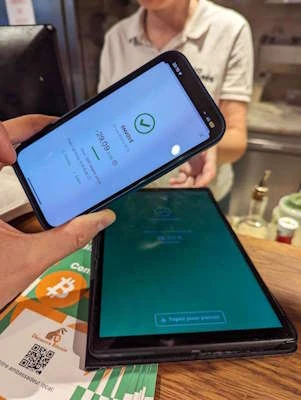
While Bitcoin is still in its early stages, this observation-which you are surely already familiar with-leads us to reflect on two things.
On the one hand, how can we encourage Bitcoiners to go further in their learning and projects in order to exploit the full potential of Bitcoin?
On the other hand, how could we encourage new people who arrive attracted by the gain in the "cryptocurrency ecosystem" not to lose their money in the latest trendy memecoin, but to educate themselves on the fundamentals of Bitcoin?
For these two problems, the best solution is to be in the field and educate.
The purpose of this course is to provide you with all the essential tools to effectively create and organize a Bitcoin community or meetup. Whether you want to build a local initiative or develop an online group, this course will guide you through each step of the process, from creating your visual identity to setting up regular events and managing your communication channels.
Section 1: Introduction
We will begin by putting into context the importance of bringing people together
around Bitcoin, whether through online communities or local meetups. You will
learn why and where to launch your community, as well as how to define clear
objectives to ensure its growth and sustainability.
Section 2: Designing a Unique Identity for Your Bitcoin Community
To attract new members and establish a sense of belonging, it's essential to
create a unique identity. This section will teach you how to design a logo, poster,
or banner that accurately reflects the spirit of your Bitcoin community.
Section 3: Creating Communication Channels for Your Bitcoin Community
Communication is at the heart of any community. Here, we will discuss the various
communication channels to prioritize and how to effectively set up a Telegram
group or Discord server. We will also cover integrating multi-purpose bots to
facilitate community management.
Section 4: Launching Your Social Media Presence
Visibility is crucial for developing your community. You will learn how to create
a dedicated Twitter profile, establish connections with other meetups near you,
and use platforms like btcmap.org to enhance your visibility and attract new
members.
Section 5: Organizing a Bitcoin Meetup
This section focuses on organizing meetups, from finding a suitable venue to
planning the event itself. We will also explore ways to build participant loyalty
to ensure sustainable growth for your community.
Section 6: Examples of Projects and Initiatives
To go beyond simple gatherings, this section offers concrete and original project
ideas: themed events, workshops, educational content creation, local collaborations,
and much more. You will also learn how to design physical and digital materials
to promote your community.
Section 7: Anticipating the Future
Finally, we will address the natural evolution of your community. What if your
group grows too quickly? How do you decentralize the organization? And how should
you react if the regulatory environment becomes hostile? This section will help
you anticipate upcoming challenges.
Section 8: Bringing Bitcoiners Together
This final section focuses on the very essence of your project: uniting Bitcoin
enthusiasts around a shared vision. You will learn how to structure your approach
to attract and retain new members, how to delegate tasks within your group, and
how to grow your community sustainably.
Ready to learn how to build a strong and dynamic Bitcoin community? Let's go!
Why create a bitcoin community or meet-up?
What is the difference between a community and a meet-up?
Although, in the Bitcoin ecosystem, there is no specific definition for these two terms, a community can be seen as the aggregation of several individuals who share a common passion(s) and communicate together more or less regularly.
In parallel, a meet-up is an event organized by (and for) this community, with a specific goal in mind. It is usually held once the associated community has been created.
In this regard, in the course of this course, we will consider that in order to launch a Bitcoin meet-up, it will be necessary previously to have communicated with other people interested in holding this type of event; and therefore, that a Bitcoin community must have been created previously.
Why create a community?
As mentioned in the previous chapter, creating a community can have several goals.
On the one hand, when composed of bitcoiners, a community can allow its members to exchange and share information with each other. Mutual aid is thus generally at its core, allowing everyone to accelerate their learning.
This makes particular sense in the case of Bitcoin, given its complexity.
In parallel, a community of bitcoiners can also enable peer-to-peer building. This is how multiple meaningful initiatives and projects are born, built and developed.
On the other hand, a Bitcoin community can also have more open goals; especially with the goal of educating people as much as possible about:
what bitcoin is;
how it works;
what it brings to our society;
the unfounded and/or misleading nonsense that some personalities and media try to spread;
its key differences from other cryptocurrencies.
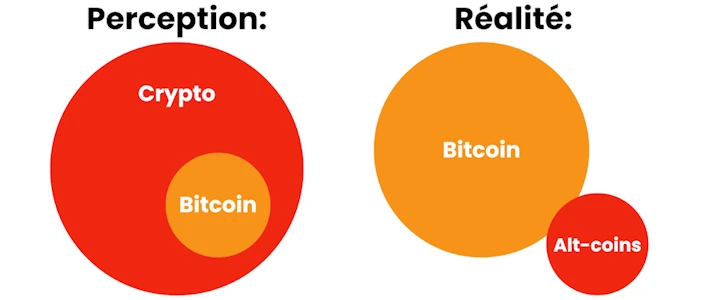
Gradually building the first citadels of tomorrow's world, Bitcoin communities around the world stand as a particularly relevant bulwark against attempts at disinformation and/or censorship in some countries. In parallel, they create fertile ground for teaching the fundamentals of Bitcoin; enabling anyone who has not yet understood it to have, when they are ready, the contacts and resources to imagine a new world.
Furthermore, because Bitcoin is inclusive, it seems to be the role of a community to empower and educate all future bitcoiners on the fundamentals of Bitcoin; including the most reluctant.
Although we will discuss this topic in more detail later in the course, it is still important to state right now that a community can exist entirely digitally. Therefore, a Telegram group "Bitcoin London," a Facebook group "Bitcoin Berlin," a Discord server "Bitcoin Madrid," or an email distribution list "Bitcoin France" constitute, entirely digitally, communities. This means that a community does not technically need physical meetings to exist, progress and develop its projects. Its goal remains, however, to share, build and educate.
Why create a meet-up?
As mentioned earlier, the creation of a meet-up follows the creation of a community, as it is complementary to it.
Indeed, in the journey of a Bitcoin enthusiast, a very significant number of people highlight a desire (and need) to meet and physically exchange with others within the same ecosystem. This is generally explained by the emergence of a sense of loneliness, present among many of them.
Organizing these meet-ups can therefore allow for much more convivial physical encounters than those via audio or video calls. They can take place around a drink or a meal, and allow for more precise and direct exchanges, with more people.
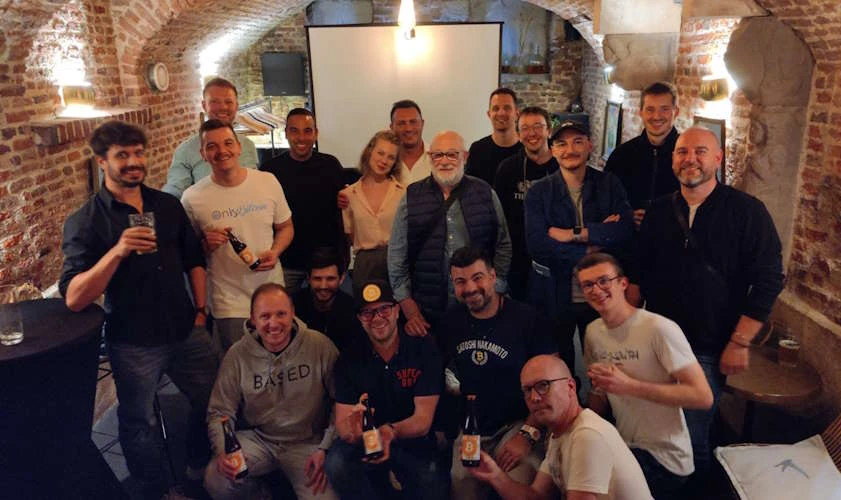
For Bitcoin enthusiasts, meet-ups can thus be a favorable time for discussions on technical topics or projects they are developing; and for "aspiring Bitcoiners," to discover the world of Bitcoin and gradually immerse themselves in it.
In addition, these events can also facilitate the announcement of Bitcoin-related projects, be an opportunity to lend equipment or books, preview a documentary; but also, for a conference or workshop on a given topic. We will discuss this in more detail in part 6/8 of this course, titled "Examples of projects and initiatives.
Although it is up to each community to form its own opinions, initiate its own projects and conduct its own experiments, meet-ups seem to be essential for the development of Bitcoin and its communities; and that, in all territories.
Their organization, however, requires some planning and time; and that is why, in this course, we endeavor to share the summarized experience of the sixty French and Belgian Bitcoin communities; so that you can create and develop your own community and meet-up as easily as possible.
Where to create your community and meet-up?
Once you decide to establish a Bitcoin community, the first question you should ask yourself is: where to establish it? And this question is essential.
Indeed, although the creation of a community is initially based only on communication tools and digital social networks, geographical location must be considered for several reasons.
Initially, when looking to meet other Bitcoin enthusiasts, it is common to start by doing some internet searches. This quickly leads to discovering and turning to Discord servers or Telegram channels such as those of Decouvre Bitcoin, or even discussion forums such as bitcointalk.org.
After a few months of interaction through screens, there often comes a time when one feels the desire to go further. This desire then crystallizes into the need to meet other Bitcoin enthusiasts with whom one feels "close" physically. In other words: Bitcoin enthusiasts from one's city, or even one's neighborhood.
Unfortunately, it is entirely possible that there is no Bitcoin community near you at that time. This is certainly your time to take on the role of ambassador for a new community.
Before we begin, however, it is essential to anticipate the next step: a possible meet-up. A meet-up, in other words!
However, it is clear that if members of your community have to drive two hours to come to your event, few of them will make the trip.
This is why the geolocation of your community (and thus, of your future meet-ups) has a considerable impact on its development.
Here are some thoughts that can guide you:
Create and develop your community in a medium or large city. This will allow you to:
- find a venue** much more easily for your meet-up and/or projects (presentations, workshops, acceptance of Bitcoin as a means of payment, etc.);
- increase the sense of involvement and belonging** of more people toward your community and events;
- make it easier to attend your events** (public transportation, car parking, etc.). Therefore, choosing a location for organizing a physical meet-up, close to public transportation and parking, is clearly advisable.
Choose a name for your community/meet-up that refers to this city, making it easy for people to identify with it. For example, "Bitcoin Paris," "Einundzwanzig Berlin," "Satoshi Spritz Milan," etc.
Another more than relevant point to investigate is: **Does a meet-up already exist near me?
To do this, you should know that the website btcmap.org lists almost all global communities and meet-ups.
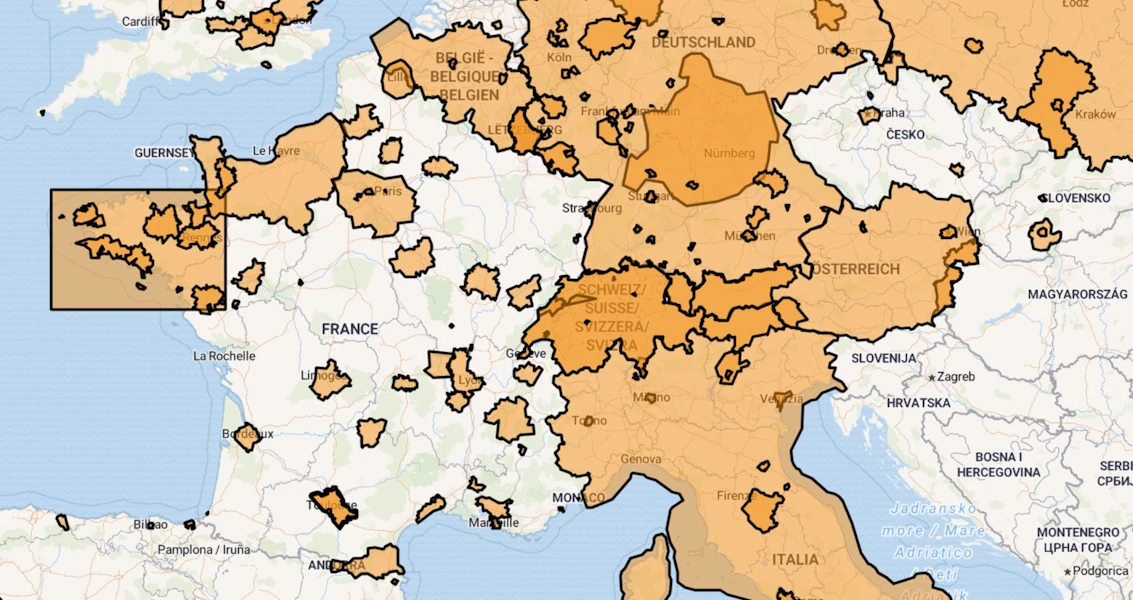
After some research, if you decide to create a meet-up or community in the same (or nearby) city as an active meet-up that has been in operation for several months/years, you should know that this can create a form of competition; even if unintentional. Of course, since Bitcoin is decentralized, everyone is free to do as they wish. However, it is clear that it is better to join forces as much as possible than to multiply neighboring communities; thus decreasing the impactful capacity of each.
In this sense, the following "convention" might help you decide on the issue: if there is no active Bitcoin community within 45 minutes of your location (say in your car, for example), then it might seem relevant to create a new one.
But of course, you are perfectly free to do as you see fit.
If, however, a Bitcoin community exists but is not active, it might be more relevant to take it over and rekindle its flame; contacting, for example, its former creators with the goal of gaining access to the communication channels and social networks previously used.
Conversely, in case an old Bitcoin community has - let's say - "evolved," no longer shares your values, and you don't have the motivation or time to convince them, creating a fork is always possible.
What goals should be set?
Now that you have found the city (or geographic location) to which you want to tie your community, it is essential to think about the goals you would like to achieve.
To help you, we have listed below some thoughts that might be helpful.
- Why, as a bitcoiner, did I create this community? Is it to share my knowledge? To educate? To learn from others? To meet other like-minded people? To involve myself in the ecosystem? To meet professionals? Simply to drink beers and make new friends?
Obviously, depending on your answers, your positioning and motivations will not be the same.
For example, if your goal is sharing your knowledge with the purpose of educating about Bitcoin, it is clear that creating educational content (articles, podcasts, videos, presentations, handouts, etc.) is relevant. You will thus save others dozens of hours of research and work. This can even be taken further through organizing workshops, presentations and conferences.
In parallel, if your goal is "simply" to meet other bitcoiners to share your daily life, this can be done in a much more relaxed way; for example, over drinks.
However, you are undoubtedly aware that toasting helps facilitate social interactions, especially when it involves alcohol. Yet even though it is still common today to feel alone and misunderstood by everyone when you are deeply convinced of what Bitcoin brings to our society, it is important not to forget that drinking beers allows you to discuss the world, but not change it :smirk:
In this sense, it would seem necessary to set concrete goals and projects.
- Is it relevant to give a physical dimension to my community? If so, what types of events could be implemented?
In case you wish to give a physical dimension to your community, your first event will certainly be a meeting. Your goal will then obviously be to gradually meet the bitcoiners who live near you.
However, as we will see later in the section Examples of projects and initiatives, a meeting can be structured in different ways, each with its own objectives.
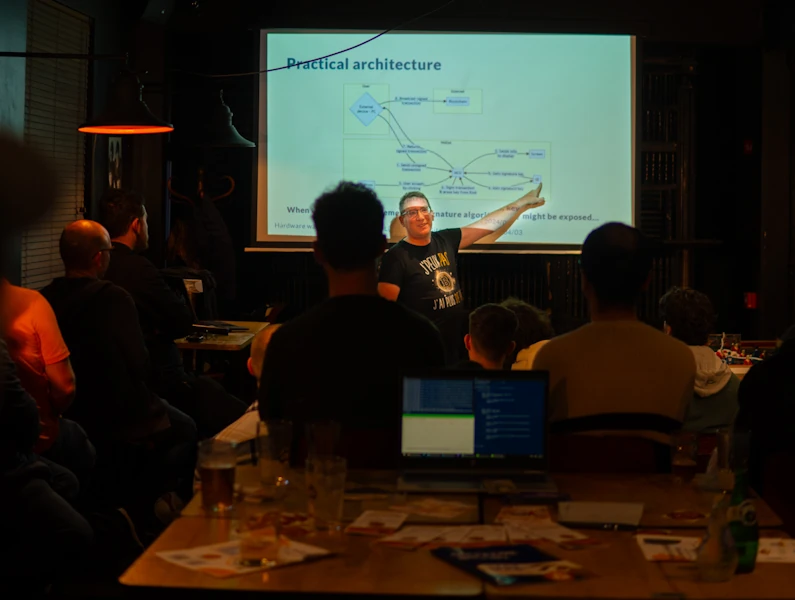
In fact, it can allow meeting new people, attending an educational presentation on a specific notion associated with Bitcoin, professional presentation of Bitcoin solutions or companies, orange-pilling strategy for merchants, etc. It is up to each meeting organizer to position themselves according to their goals.
Sometimes, depending on the topics covered (such as for technical presentations or manual workshops), it may be relevant to hold a event in addition to the meeting, in a different place and at a different time.
- What involvement would I want my community to have in the Bitcoin ecosystem?
This much more advanced question can be considered from the creation of your community.
In fact, if you aspire to develop a united, involved community full of motivated bitcoiners who wish to educate and orange-pill as many people around you as possible, then you will need:
- on the one hand, approaching existing communities, with the goal of accessing a more substantial set of information, having access to a multitude of links and open-source resources that can be reused, but also to receive a helping hand when you need it; * on the other hand, organizing yourself--and thus distributing tasks--within your community in order to move forward together.
Obviously, setting goals is not an easy task. However, short-, medium- and long-term goals can be set at different points in the evolution of your community.
For example, when creating your community, you might choose to focus in the short term on developing social networks and communication channels. In the medium term, development of educational resources (articles, flyers, etc.) that are accessible and relevant. Finally, in the long term, say in 6 months, launching a physical meeting is generally feasible.
A few months later, when your meetings become regular, you could then define in the short term the implementation of presentations or workshops on specific topics; in the medium term, the implementation of an awareness/education campaign on Bitcoin; and in the long term, the creation of an association or the search for a bar that accepts Bitcoin as a means of payment.
However, keep in mind that creating a community does not happen overnight: it requires time, motivation and some organization.
Sometimes, it can also be demoralizing; especially when no one shows up at one of your meetings and you feel alone in pursuing this cause.
That is why this course was built, with the goal of sharing all the resources and advice possible so that your community can grow and become self-sustaining.
Designing a unique identity for your Bitcoin community
Why and how to create one's own identity?
In the continuation of this course, we will consider that:
- you wish to create a community (or possibly a meeting) in a city or geographic location that you have already defined;
- you have set concrete goals on different time horizons.
The second step in creating a community is obviously that of its identity. This involves choosing its name, but also its visual identity.
That is why we will endeavor, in this Part 2/8, to offer you tutorials and software solutions that enable you to design the visual identity of your community; and that, without necessarily having the skills of a designer.####
It is evident that when a human being identifies with a group, he or she feels more involved. In this sense, having a unique identity for your community is essential.
This starts with the choice of name. In fact, depending on the country, there are different national initiatives and/or communities.
For example, in France, the fifty communities that have developed there are named "Bitcoin [CITY]" or "[CITY] Bitcoin"; thus leading their Telegram group to be named "Bitcoin [CITY] meet-up" or "[CITY] Bitcoin meet-up ".
In Germany, the "Einundzwanzig" (meaning "21") initiative has led almost all German-speaking communities to be called "Einundzwanzig [CITTÀ]"; while in Italy, the "Satoshi Spritz" initiative-which is the initiator of most of the current Italian communities-names its communities "Satoshi Spritz [CITTÀ]." Each community thus has its own identity, relative to its city of origin; but also, to the global identity of its country.
Therefore, although it is perfectly possible for you to create a new French community with the name you want, it seems more relevant in our country to call it "Bitcoin [CITY]" or "[CITY] Bitcoin ".
In parallel, the visual identity of your community and your meeting plays an essential role in its development, because it is partly because of it that your initiative will be remembered. That is why, when you create your social networks and communication channels, a logo and banner must have been designed. However, this does not have to be done by a professional designer, and there are simple and free tools available.
To create its visual identity, the best approach is to start with a significant element or place in your city. It could be, for example, the Eiffel Tower in Paris, the bell tower or citadel in Lille, the Monégasque fortress in Monaco, the old port in Marseilles, etc. Starting from this element, you can then design a more or less elaborate logo, depending on the desired complexity.
To give you some ideas, here are some examples of French community logos:
- In Marseille, the logo represents the basilica of Notre-Dame-de-la-Garde, which dominates the city:
- In Monaco, it refers to the Monégasque fortress:
- In Lille, the stylized logo represents the Vauban citadel and its park, located just minutes from the city center:

- In Saint-Malo, the ermine-the emblem of the city-is highlighted:
Now it is up to you find a significant element or place in your city and use it to build your Bitcoin community logo.
Moreover, if inspiration transcends you, you can even go further by creating a coat of arms, motto or even a song related to your community. Your imagination is then your only limit!
Create a Logo, Poster and Banner
Using Canva
For creating logos and banners for your community, you can use Canva.
This easy-to-use and free site is especially popular for its quantity of templates; which you can duplicate and modify as you wish.
When you create your logo, you can then search the homepage for different pre-made logos, to duplicate the one or logos you are interested in; and then modify them as you wish.
You can then add a background element representative of your own city (by importing a photo or by searching for "Illustrations" or "Images" in the left menu "Elements"). Next, inserting Bitcoin's logo or ₿ above-even changing its color if desired-is an option.
In the case of creating a banner or poster, simply search the homepage of the site again to get a pre-designed poster. After duplicating it, you will be able to edit it by changing the text and fonts, adding your community logo, and importing photos to drag into a frame (which you will get by searching for "frame" in the left menu "Elements").
In addition, the left menu "Design" allows you to search for other models according to your need.
Finally, you can also search the homepage for a YouTube miniature or pre-designed banner, duplicate it, and then edit it as you wish.
In short, the possibilities are endless and depend on your needs but also on the graphics you want to create for your community and your meetings/events!
To guide you in more detail, we offer below a non-exhaustive video tutorial that presents some possibilities:
Here are also some pre-designed, duplicable and editable files available to you that we use with our association, Bitcoin Lille:
- meet-up announcement poster** (for social networks, and printed in A4 or A3): link
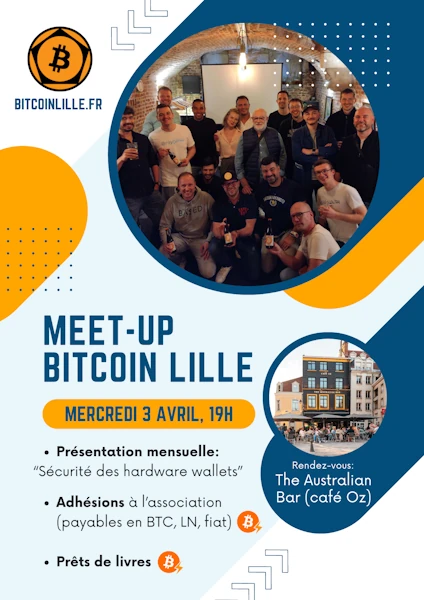
- joint event announcement poster** (for social networks, and printed in A4 or A3): link
- banners for some social networks**: link
- contest announcement**:link
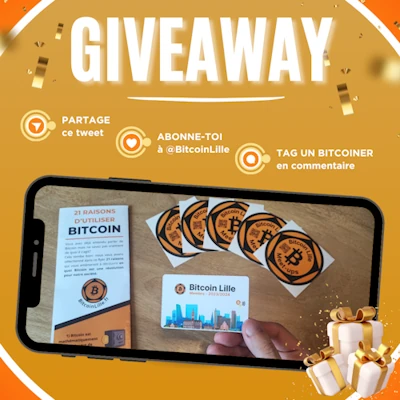
- paper** from our library, displayed in A4 during the meetings: link
- PowerPoint presentation** "Chapter 2 - Understanding Bitcoin Transactions," by @ProfEduStream: link
- Handout** "21 Reasons to Use Bitcoin," written by @ProfEduStream: link
As you can see, the possibilities are endless and obviously depend on your needs. Don't hesitate to design new models yourself, then take a few minutes to share them with others around you so that you can save several hours of work to other communities in your country. In fact, don't forget that every community, sooner or later, will face the same issues and needs as you do. By sharing your resources in an open-source way, you are therefore indirectly accelerating the development of all other Bitcoin communities.
However, when creating your graphic materials, be sure to pay attention to the dimensions expected by the social networks and communication applications you plan to use.
Here are some proportions and standards that you might find useful:
| Network / Platform | Logo | Banner | Poster / Image |
| ------------------ | --------- | ---------- | ----------------- |
| Telegram | 512 x 512 | N/A | N/A |
| Signal | N/A | N/A | N/A |
| Twitter | 400 x 400 | 1500 x 500 | 1200 x 628 |
| Meet-up | N/A | N/A | N/A |
| Discord | 512 x 512 | 960 x 540 | N/A |
| Facebook | 512 x 512 | 851 x 315 | 960 x 720 |
As such, for creating a logo, the appropriate size is 512 pixels by 512 pixels.
For a banner, it depends specifically on the application or site you are using.
As for poster and other images, the classic A4 format is generally relevant.
Use of Artificial Intelligence
Although Canva allows you to do countless things (logos, posters, banners, flyers, etc.), it is obviously not the only site or software that allows you to perform this set of tasks.
As such, if you are more comfortable using another software suite (notable Photoshop or Illustrator), do what is most practical for you.
However, whether it is creating a logo for your community or adding eye-catching images to posters, presentations or flyers, it may be relevant to use artificial intelligence to enhance your material.
To do this, there are numerous AIs. In particular:
- midjourney (fee);
- leonardo (free, limited per account);
- copilot (free, limited per account);
- DALL-E (paid). Of course, many other artificial intelligences have emerged in the field of visual content creation in recent months. This list, therefore, is not exhaustive.####
In case you want to create, for example, a futuristic image or logo for the "Bitcoin London" meet-up, you can then ask the "co-pilot" AI:
- Create a Bitcoin logo with London Bridge and Big Ben in the background. Futuristic - Link

If the co-pilot's four proposals are not realistic enough for your taste, you can add to the conversation:
- Make the fourth one much more realistic - Link

By the way,The last rendering is quite beautiful
However, if you want a much simpler logo, such as for a sticker, you can then put on "co-pilot."
- Create the logo for the "London Bitcoin Meetup" with a British and simplified style - Link
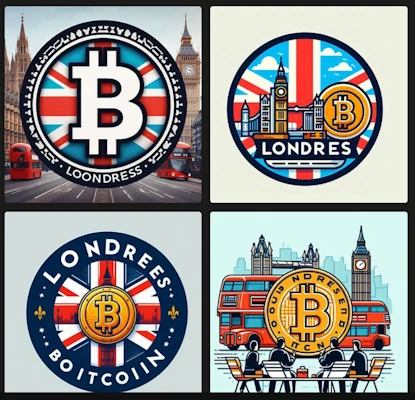
The second rendering is typical and could do the trick!
However, although it allows the creation of very interesting visual renderings in record time, unfortunately artificial intelligence will not be able to achieve exactly what you want in detail.
So, be patient, try to give instructions (or "prompts") as precisely as possible; and if you are not satisfied with the renderings you get, there is nothing to stop you from approaching a more experienced bitcoiner on the subject. For a few sat (or for free), they are sure to create a quality logo for you.
Creating communication channels for your Bitcoin community
Which communication channels to prioritize?
As previously mentioned, depending on individual motivations and habits, a community's communication channels can be different. For example, in France, Germany and Italy, Telegram and Twitter are the main communication channels. Over time, they have become "communication standards" for Bitcoin communities in these countries. However, some communities also use other channels for specific purposes. In contrast, in the Czech Republic, the many communities that have developed there use Matrix, an encrypted instant messaging protocol. In their country, Telegram is in fact rarely used.
In this sense, to choose communication channels, the most relevant approach is to start by taking examples from neighboring communities in your own country. To do this, accessing the map at btcmap.org will give you a very good idea of the most widely used communication channels in your country. In Switzerland, for example, information is mainly conveyed via Telegram, Twitter and the community website.

In the case of France (and the French-speaking world in general), the main communication channel is Telegram. More than 90% of French meet-ups have one: it is a "must-have." Next, the main social network used by communities is Twitter (70% of French meet-ups); a social network on which most bitcoiners are present. In addition, almost 30% of French meet-ups (as well as all Canadian meet-ups) have a paid account on the Meetup app. Indeed, this can be an excellent way to give visibility to events outside the Bitcoin ecosystem. Finally, 30% of French meet-ups also have a website; and 10%, a Discord server and a NOSTR account.
Of course, other communication channels and social networks are sometimes used: Matrix, Keet, Signal, Facebook, Instagram, LinkedIn, etc. Each community is indeed free to develop the channels it wishes. However, it is obvious that the more communication channels and social networks are multiplied, the more time they require from the organizers to manage them, to regularly post important information and to moderate if necessary.
For anyone wishing to start a community in France, it is therefore recommended to start only with:
- a Telegram group**;
- a Twitter account**.
Depending on your time and desires, you can later develop other networks; even assigning moderation to future members of your community.
Create and Configure a Channel, Group or Super-Group on Telegram
As previously mentioned, Telegram is a "must-have" in many countries. However, when creating a communication channel for your community on this instant messaging application, it is important to understand the differences between:
- a Telegram channel;
- a Telegram group;
- a Telegram super-group.
We'll see later, but it is highly recommended that you choose "Telegram group" when creating (or, depending on your goals, "Telegram super-group").
For the tutorials that follow, we will use the "Telegram+" APK application; an application that allows more advanced configuration of Telegram. However, this is not necessary, as creating a group or super-group on Telegram can now be done very easily on a phone:
Creating a Telegram Channel
If you want to create a place where your members can directly discuss, respond to each other, etc., then a Telegram channel is definitely not what you should choose!
Then, go directly to the next section, titled Create a Telegram Group.
In fact, a Telegram channel is just a showcase of information posted by administrators, where members cannot do much more than add emoji.
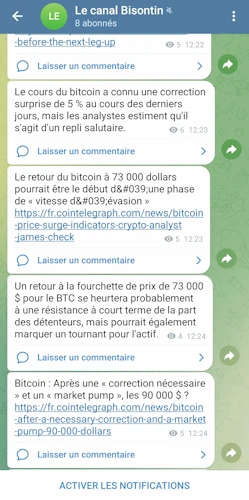
However, it is possible to add the ability for channel members to comment on each post by the administrator, but this will be done in separate threads; significantly dividing communications. Therefore, creating a Telegram channel is generally not recommended for a community.
Tutorial for creating a Telegram channel:
Create a Telegram Group
In contrast, creating a Telegram group is quite relevant.
In fact, to take well-known examples such as Messenger or WhatsApp groups, anyone who joins this Telegram group will be able to talk to others, respond to each other; and that, all within the same discussion.
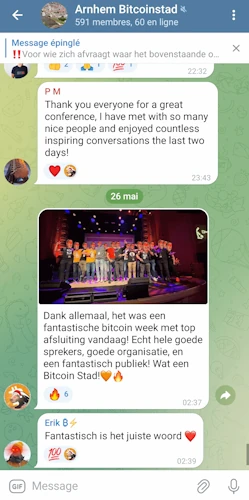
Administrators of this channel will then be able to:
- publish messages personally;
- fix** the most important ones;
- publish surveys (very useful for choosing the date of the next meeting when it is not yet regular, i.e., when the community is still developing);
- create a custom invitation link (as long as the group is "public" and not "private," to be defined in the settings. It is also very practical to have your own Telegram invitation link styled: t.me/Bitcoin[CITY]);
- add or remove permissions, administrators and members**;
- Add a "profile picture "** to the Telegram group (i.e., your community logo), and change its name.
Tutorial for creating a Telegram group:
A note: as mentioned before, the above tutorial was made on a computer with the "Telegram+" APK. However, it is now very easy to create a Telegram group on a phone.
Therefore, you no longer need to download "Telegram+" to perform this task; unless you want to delve into the privacy settings of your group.
Create a Telegram supergroup
The disadvantage of a Telegram group is that when it starts to have several hundred members, parallel discussions in the same communication channel start to become cumbersome. This then leads to an unintended effect: some members no longer follow the Telegram group on a daily basis, sometimes causing them to miss important information; such as the date of the next meeting.
Several solutions can be applied to remedy this:
Fix important messages as administrator so that everyone is notified of them (press once on the message in question with your finger, then select "Fix");
suggest that your community use a Discord server with various and different communication channels, which everyone can mute if they wish;
creating a "supergroup" on Telegram.
But what is a Telegram supergroup?
It is simply a Telegram group in which different "topics " are integrated. Thus, a "Important Information " topic can be created, in which only important information and information associated with upcoming events/meetings will be posted.
A "General " topic can also be set, where all members could discuss.
Finally, specific topics (mining, project development, upcoming conference, etc.) can be added.
It is up to you to modify it according to your wishes; similar, for example, to the Bitcoin Meet-up supergroup in Abidjan.
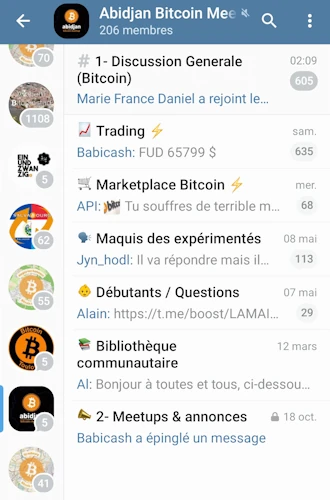
However, it is important to note that a Telegram supergroup may be more difficult for some members to use. In fact, sometimes, some people cannot figure out how to access the other topics in this supergroup (to do so, just click on the group logo; this opens the list of topics created). In this case, helping them by sending a short video tutorial in a screenshot may be a good idea.####
In general, there is no specific number of members at which it becomes relevant to use a Telegram supergroup versus a Telegram group. Therefore, the choice is up to you, based on the needs and demands of your members; knowing that a Telegram group can be easily converted to a Telegram supergroup (and vice versa). To do this, simply create a topic (or delete them all).
Tutorial for creating a Telegram supergroup:
Note: As mentioned above, the above tutorial was made on a computer with the "Telegram+" APK. However, it is now very easy to create a Telegram supergroup on a phone.
To do this, simply create a Telegram group; then, in its settings, click on the "Topics" button to add some. Once the change is validated, a list of topics will appear; and you can edit it as you wish.
You no longer need to download "Telegram+" to perform these operations; unless you want to delve into the privacy settings of your supergroup.
Configuring your Telegram group or supergroup
Now that you've created your Telegram group (or supergroup), it's time to think about permissions and moderation. And, of course, each community is free to do as it sees fit!
However, from experience, it is preferable to remove members' permissions to:
- send a survey**;
- send files** (in case of virus);
- send voice messages**;
- add users** (in case a bot enters the group);
- fixing messages**;
- edit exchange information**.
It is also highly recommended to write a description of your meeting when creating the group or supergroup on Telegram, as it will be visible to anyone who wishes to join. It could be, for example:
Welcome to @Bitcoin's Telegram[CITY] 🔥
We hold a meeting every first Wednesday of the month, at the [NAME OF THE_BAR] bar in [CITY] 🍻
To access our other social networks: [LINK_DESIDERATE] 🌐
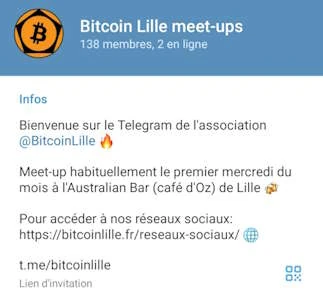
In the image above, we also note that the invitation link was customized by the administrators of the Bitcoin Lille Telegram group, as it is public.
Next, in "Group settings," it may be relevant to enable "Approve new members ".
In fact, from experience, there was a case where a Bitcoin community's Telegram group was attacked by several thousand fake accounts wanting to join the group with the goal of spamming and destroying it. In addition to allowing the removal of pornographic fake accounts that want to join your group, enabling member approval will definitely save you from a spam-like attack.
Finally, in the "Administrators" section, an "Aggressive Anti-spam" feature can be added, which automatically deletes messages considered as such. However, this may not necessarily be required.
Inserting a Multifunction Bot into a Telegram Channel
Another way to configure and protect your Telegram group or super-group is to add a multifunction bot. This in fact allows for much more advanced configuration.
Among the many options available with the @GroupHelpBot bot, we note among others:
- add a set of rules** (/rules command);
- configure an anti-spam mechanism;
- add an automatic, customizable welcome message for new members that cancels after a few minutes;
- configure the anti-flood mechanism;
- add an @administrator command;
- add blocks;
- add a command to get the group link (/link);
- configure command permissions;
- automatically delete certain types of messages;
- etc.
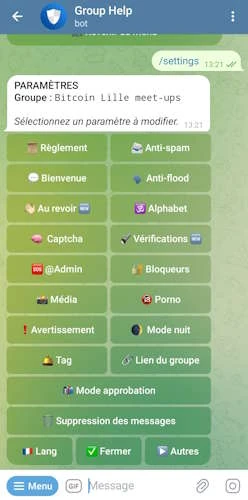
Three other simple ideas are:
- create a "/link "** command to send the login link to the Telegram group;
- same to get social networks ("/socials") or your potential rules in case of moderation ("/rules");
- blocking the entry of bots** and "entry/exit".
Numerous additional options are also available to you. However, a word of advice: don't try to limit communication and information exchanges too much.
Tutorial for adding a multifunctional bot to a group or super-group on Telegram:
Small note: as mentioned before, now all this procedure can be done on phone.
Creating a Discord Server
As the number of members in your Telegram group increases, turning it into a super-group on Telegram might be the solution.
However, as previously mentioned, potential "usability difficulties" and increasing the number of topics and messages in a Telegram super-group may lead to a loss of interest among some active members.
Discord thus presents itself as an alternative to creating a Telegram super-group, as it allows the creation of specific text and voice channels; and, most importantly, its users can mute any channel that does not interest them.
Obviously, besides Telegram and Twitter, this requires even more time in management; especially during its setup and launch.
To make things easier for you, we share a pre-made, duplicable and editable Discord server that you can customize as you wish:
Thus, when well built, a Discord server can be a real asset to its community. In fact, many Bitcoiners already use Discord (and not Telegram) on a daily basis, and allowing them to follow Telegram group conversations directly within the Discord server is a significant time saver. And vice versa.
That is why an open-source bot called TediCross was developed. Its goal is simple: to automatically transfer messages from a Discord text channel to a Telegram group (or a topic in a Telegram super-group); and vice versa. This can therefore be very interesting to set up.####
However, it is important to note that its installation is not very easy, that it requires continuous execution of a command prompt (CMD) on a computer for this bot to work; but also, that sometimes there are errors. Fortunately, in this situation, simply restart it; and then everything returns to normal.
With the goal of saving you time, here is a tutorial on how to add a multifunctional bot to a Telegram group or super-group:
Consider other, private and more secure channels of communication
As mentioned earlier in this section, Twitter and Telegram are the two main communication channels used in Europe (and possibly the world).
However, you are probably aware that Telegram is not the most secure and confidential messaging service and that Twitter is not a company known for freedom of expression.
In this sense, it is entirely relevant--when you have time to allocate--to start thinking about alternatives.
This is in fact why, in the coming months, tutorials on the use of more confidential and secure communication protocols will be offered within this same course, at planb.network.
But why consider these alternatives?
Simply because, like the NOSTR social network and communication applications such as Matrix, Signal or Element, they are decentralized and/or encrypted. In addition to the gain in confidentiality in the exchanges made between different members of your community, this also allows you to protect yourself from a shutdown (censorship?) of your Telegram group or super-group.
What could be better, just like the Bitcoin protocol, than being incensurable and immutable?
Launch your social networks
The importance of visibility for the development of your Bitcoin community
That's it, your community is launched, and now you have one or more communication channels (Telegram and/or Matrix, for example)!
However, for the time being ... you are alone. So, you will have to do - some - communication.
It is indeed obvious that if no one can access your communication channels, on which you regularly post information (date of next meeting, projects, etc.), your work will be in vain. This is why social networks--and some specific platforms, which we will discuss later--will play a predominant role in the development of your community.
Among these social networks, Twitter is positioned as almost essential in the world of Bitcoin. In this sense, it seems important to have a profile on this platform; even if its centralization and development are far from correct.
That's why a NOSTR profile can be created specifically for your community, with the idea of anticipating potential restrictions and/or censorship on Twitter. After all: prevention is better than cure.
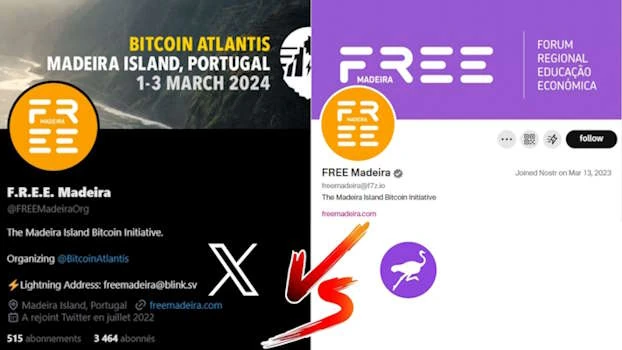
Of course, other social networks can also be used. This is the case with Facebook (in the case of a Facebook group or page) or even LinkedIn.
However, it is important to remember that the more communication channels and social networks one has to create-and then maintain-the more time-consuming it becomes. It is best to focus on the most relevant ones; and Twitter (and NOSTR) seem to be good candidates.
In the following part of this course, we will explain in detail how to create a Twitter account and how to use it effectively for maximum visibility. Similar explanations and tutorials regarding NOSTR will be added to this section Launching Your Social Networks, in a few weeks.
Creating a Twitter Profile
Twitter is very easy to use, requiring adjustment of some settings to improve privacy.
When creating a new Twitter account, four essential pieces of information must be provided:
the @ Twitter, which will define your identity and make you easily searchable. If your community is called "Bitcoin[CITY]," it is therefore quite relevant to choose "@Bitcoin[CITY]."
the logo and banner you created for your community or meeting (see section Creating a logo, poster and banner);
the description, which will allow you in about a hundred characters to give important information about your community. It could be, for example:
Official Bitcoin community account [CITY] #BTC | Meet-up every first Wednesday of the month at [NAME OF THE_BAR] in [CITY] 🍻 | Join us on Telegram 🔽
- Under this description, you can also insert a link. This can take users to a "social networking" page available on your community website, or it can direct them to your Telegram communication channel.
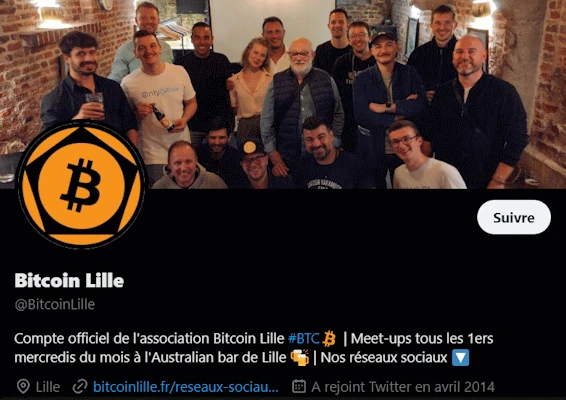
In addition, some privacy settings seem relevant to change; the most pertinent are obviously:
- the choice to leave your Twitter account in "public" mode (posts visible to anyone);
- be identifiable by everyone (watch out for scams);
- disable location tracking and data sharing with other entities** (a privacy issue).
Over time, you will come to post on Twitter. These tweets will then announce your next event, important news in the ecosystem, or even an announcement from another community you follow.
However, as with most social networks, visibility is the key to success.
To save you a significant amount of time, we took the time to study the source code of Twitter's ranking algorithm. Here are the key points to pay attention to in order to increase your visibility:
- General:
- tweet in the language you have set** on your Twitter account, or in English (otherwise, the penalty is severe);
- tweet only information related to your account's domain** (otherwise, there is a strong penalty);
- tweet 1 or 2 times a day (consistency is important);
- tweet at times of high visibility** (the most interesting are Thursday or Friday between 8 a.m. and 10 a.m.; see the "Twitter Analytics" section of your account).
- When you write a tweet:
- add a photo** (or video);
- add only one hashtag to your tweet** (#Bitcoin is usually the most relevant. If it makes sense, and as long as it is related to the scope of your account, add a trending hashtag);
- encourages your community to like** (weight of 0.5), to retweet (weight of 1) but most importantly to respond (weight of 27!);
- respond to people who react to your tweets** (weight of 75!);
- do not add a link in your initial tweet** (this can be done in the first comment, for example);
- write the words in full, without using abbreviations.
- Other points to note:
- tweet based on trends, as long as they are within the scope of your account;
- repost/retweet the most viewed tweets**;
- conducts surveys occasionally**;
- write thread if possible**;
- encourages your community to visit and follow your profile.
In addition, you can fix a tweet on your Twitter profile that you want to make particularly visible.
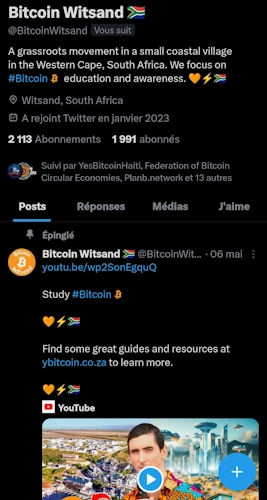
Also note that it is possible on both phone and computer to be logged in to two Twitter accounts at the same time. This can be very convenient so that you don't have to login/logout between your personal and community accounts; just as it can backfire if you accidentally post a photo of yourself in costume with the community account... Be careful, then!
Finally, although your "@Bitcoin[CITY]" username is unique and now belongs to you, it may be wise to create "@Bitcoin_[CITY]", "@[CITY]Bitcoin", or "@[CITY]_Bitcoin" accounts in advance to make sure no one attempts to duplicate your identity. It is indeed better to anticipate!
Tutorial for creating a Twitter account:
Connecting with nearby meet-ups
Now that your communication and social media channels have been created, configured and enriched with your city/community/meet-up's visual identity, it is time to start following the "right people" on these platforms.
On Twitter, this can start by following some of the accounts working on Bitcoin development internationally, such as @Bitcoin, @bitcoincoreorg, @planb_network, @FBCEglobal, and retweeting the famous "Running bitcoin" of January 11, 2009, by @halfin; but also - and most importantly - following the accounts of Bitcoin communities and meet-ups in your country.
In fact, this will enable mutual following, tagging and thus gaining visibility collectively.
This is the case among the fifty or more French Bitcoin communities; and the same is true for most of the "Satoshi Spritz" initiatives in Italy and "Einundzwanzig" in Germany.
Although it might seem superfluous to some, following local communities and initiatives in one's own country can indirectly lead to joint projects, or even "partnerships." This is how the Bitcoin Liège and Bitcoin Lille communities got in touch (the same goes for Bitcoin Aix and Bitcoin Marseille); they now organize at least one joint meet-up a year. The Cercle du Coin dinners are another example.
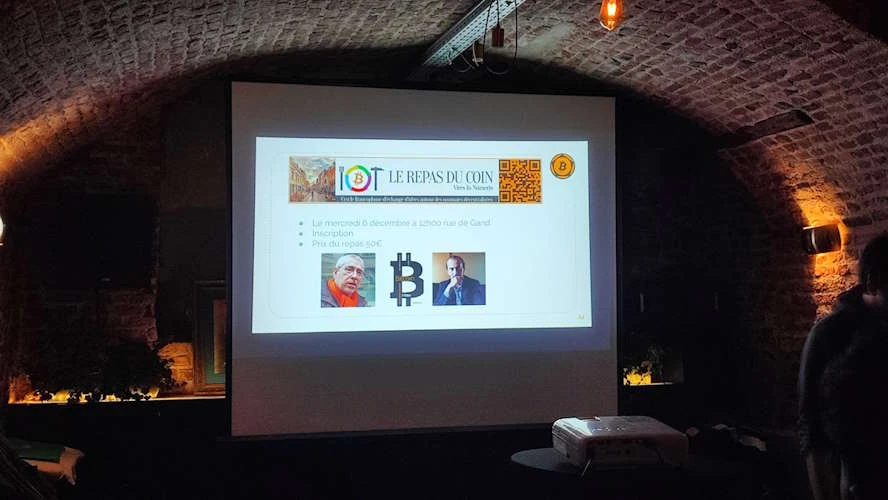
Moreover, in France, it might also be relevant to follow the @KonsensusFR, @bitcoinpointfr, @DecouvreBitcoin and @btcmap initiatives. These are just suggestions, and of course each community is free to do as it sees fit, in full decentralization and autonomy.
The interest in following each other is quite simple: provide visibility for each other. In fact, the more you have a presence on the networks, the more people will talk about you; and the more people talk about you, the more likely people will come to your events. Liking and retweeting posts from other communities on social networks can be just as appealing.
In parallel, it is also possible to offer meet-up organizers and those who have created a community the opportunity to meet at a designated time during physical events. This can allow you to discuss everyone's feelings, talk about the evolution of the communities present, share ideas for projects that have been successful; but also, offer solutions when needed. If you wish you can then be share a written report with the organizers of the communities in your country that were not present.
BTC Map
At this point, your community is already launched. All that remains is to wait for new bitcoiners and interested parties to arrive, with the goal of developing it.
However, you cannot go any further without knowing that there are platforms that allow interested bitcoiners to find communities and meet-ups near them.
That is why it is crucial that you take a few minutes to request to be listed on these sites/platforms.
Among these, we find in particular:
- Btcmap.org**, a website that includes two maps updated daily: the world map of Bitcoin-accepting businesses, and the map of global communities. Many bitcoiners, during their vacations or even in their daily lives, regularly check these maps to make new encounters or purchases. Btcmap is clearly THE global reference point. And for your visibility, your community must be listed there.
- BitcoinerEvents** is a website created by bitcoiners for bitcoiners. You can then publish your community's upcoming events there. Unfortunately, in France, this platform is relatively little used.
Depending on the country, there are also unique initiatives. This is particularly the case in France, with the website bitcoin.fr listing the dozens of Bitcoin events in France each month. If you have not yet followed them on Twitter or contacted them to give information about your community and/or events, now is the time! In addition, with the goal of helping them keep this French event calendar up-to-date, it would be appreciated if all French Bitcoin communities would get into the habit of: ** mentioning @bitcoinpointfr on Twitter at each new event announcement of their community;
- fix the announcement of said event in their community Telegram group**.
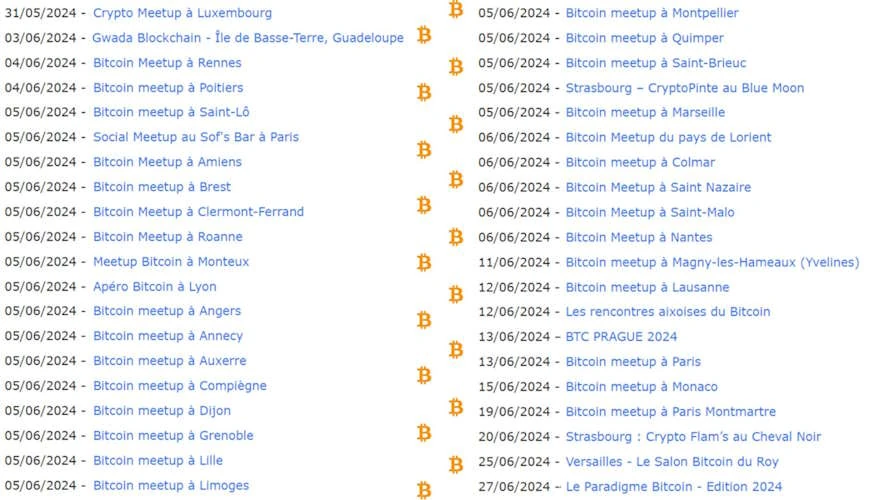
It is important to note that other platforms and applications also allow for increased visibility. Meetup is one of them. In fact, it is a website (and phone application) that allows you to create an event; but also search for those near you.
Unfortunately, in order to create meetups, one has to spend almost 8€ per month (which is about 90€ per year), which is expensive for a community that is neither structured nor mature yet. However, Meetup is very popular in some countries, especially in Canada and the United States; its main advantage is that it allows integrated management of meeting registrations.
In parallel, Orangepillapp is a paid phone application that allows bitcoiners to meet each other. It is, however, also for a fee (50,000 sats/year, or 200,000 sats for life).
Although they allow visibility development for your community and events, these two applications, however, are not recommended when launching your community, simply because they are paid.
Starting with a list at btcmap.org, at BitcoinerEvents; and for French communities, at bitcoin.fr is thus clearly sufficient.
Congratulations! Your community is created, your visuals are ready, your goals are established, your communication channels are established, your social networks are launched, and your visibility strategy is established.
Once a small group of bitcoiners has joined you, the next step is to embark on the exciting adventure of a Bitcoin meet-up!
Organizing a Bitcoin Meet-up
Why start a regular meet-up with your community?
Now that your community's social networks and communication channels have been launched, all that remains is to make your presence known on these platforms, and new members should introduce themselves by gradually engaging in discussions.
This can then allow you to free up time with the goal of thinking about creating a "meet-up" type event, in whatever format you wish. This is especially relevant if you are beginning to feel some fervor within your community.
As mentioned earlier, a meeting about bitcoin can thus be seen as the "next level" of a community. On the one hand, it allows its bitcoiner members to meet; on the other hand, it educates new people interested in this ecosystem. A "meet-up" type event will thus - to your measure - allow you to create enthusiasm around bitcoin in your city; which can expand over time depending on the projects undertaken by your community.
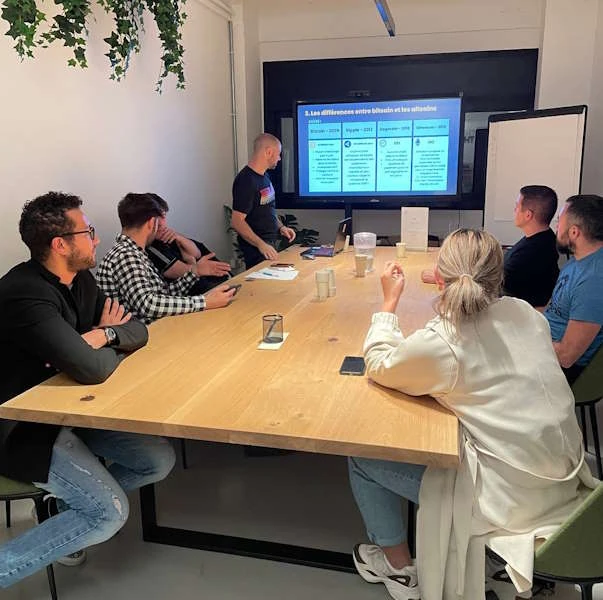
Of course, the more significant the goals you set for the development of your community, the more time you and your members will need to devote to them.
It is therefore important to start by setting achievable goals for the organization of this meet-up.
The first meet-up: when and why?
It is entirely possible, only a few weeks after creating a community, to launch a meet-up type event.
However, in this situation, your community certainly will not have developed much. This means that it is conceivable that few people may show up. Or none at all.
Therefore, it seems relevant to propose organizing a meet-up from the moment there are a few people involved in the communication channels of your community; say for example a small group of about ten members. This can then be fairly quick.
Once you feel this small spark, it is then entirely possible for you to propose the idea of an in-person meet-up. If this idea garners interest from others, you simply fix the date for your first meet-up.
To do this, it is certainly preferable not to set a specific date from the beginning, but rather propose - about ten days in advance - a survey containing different days and time slots. Thus, based on everyone's votes, this will allow you to maximize member participation, create more enthusiasm; but also, to "optimize" your time better.
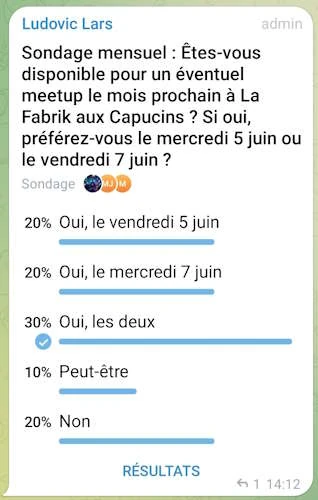
It is then important not to have a fixed idea, in advance, of how this meet-up will take place, how many you will be, the topics of discussion, etc. You risk being disappointed; and participants, potentially feeling "burdened."
In this sense, it seems preferable to let things happen naturally, perhaps over a drink. Conversations should therefore be easy; even if that means talking about Bitcoin if you come face to face with a lost sheep.####
If you wish to anticipate certain quiet times, you can plan several "activities" or backup options. These may include:
- a computer or smartphone with the mempool;
- bring a book;
- bring a Nerdminer, Bitaxe, FPGA, or even an ASIC;
- have available a flier on Bitcoin;
- brainstorm around a more developed Bitcoin visual/logo for your community;
- a card game about Bitcoin;
- the btcmap.org map of communities and businesses;
- an informal, "Hey, by the way, have you ever sent Bitcoin through Lightning?"
However, it is important to note that when the meet-up is just beginning, it may not be relevant to make a formal presentation. When there are only a few of you, it seems preferable to engage in discussions in a more open and friendly manner.
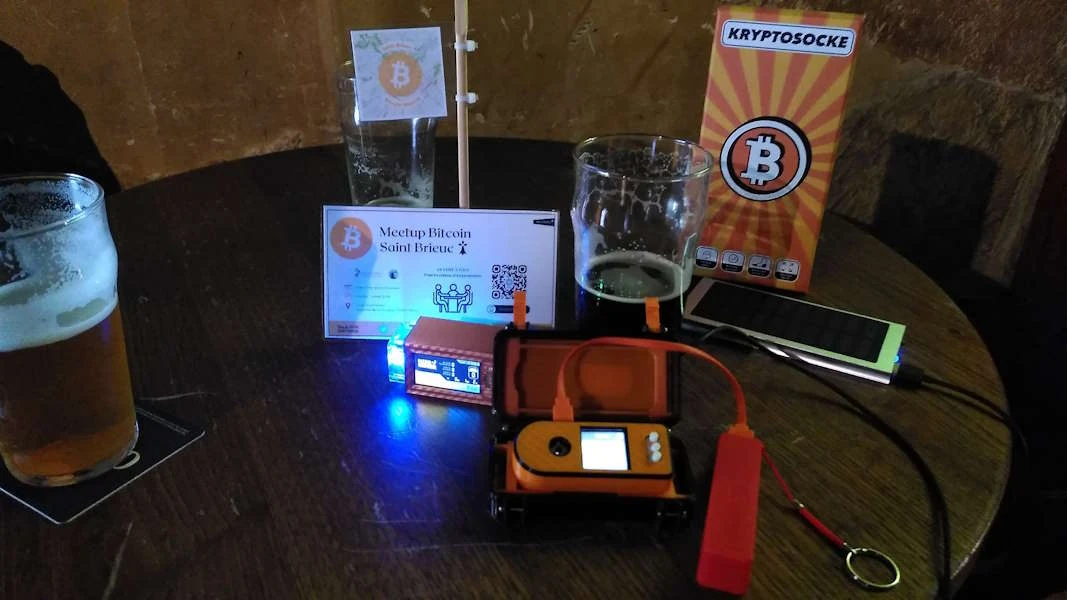
Once your meet-up has taken place, you will probably want to organize another one. As long as your community is still small, it seems preferable to keep suggesting the date through a survey; for example, once a month (or every other month). It is up to you to discuss this with your community.
However, in case a regular group of Bitcoiners and interested parties develops, it seems pertinent to plan this event more regularly; for several reasons:
allows members to plan their participation more easily;
It also helps to establish a "habit ". Thus, someone who no longer follows the communication channels or networks of the meet-up on a daily basis (due to lack of time) and knows the usual day of your meet-up in the month can then drop by, "as usual."
This second point is very important. It is one of the reasons why, in France, most meet-ups take place on the first Wednesday of every month; following the "ambassadors" initiative, launched by DecouvreBitcoin.
In Germany, there is no nationally predefined day; the same applies to Italy.
However, it is important to note that having all national meet-ups on the same day creates a centralization problem. In addition to security concerns, bitcoiners attending the meet-up in their respective cities cannot attend bitcoin events in neighboring communities. Therefore, it is up to you to take a stand. To do so, interacting with the nearest meet-up(s) can lead to a relevant decision.
Finally, when your community grows significantly and your meet-ups begin to fill up, it is entirely possible to propose:
- a specific goal for each of your meet-ups**;
- or even a second event in the month.
In the former case, although everyone's sensitivities and desires need to be taken into account, this can allow all participants to leave the event with new knowledge while refocusing the topics of conversation around Bitcoin (if they were diverging).
In the second case, a second event in the month, for example, allows you to address a specific topic, such as organizing "beginner" sessions and/or workshops (mining, lightning, node installation, etc.).
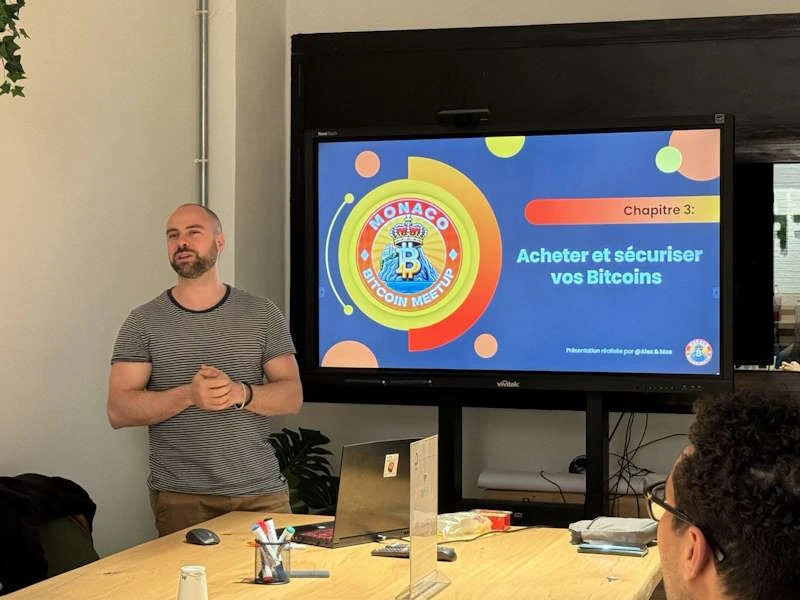
Keep in mind, however, that this requires more organization; and therefore will take more time (although many open-source resources will be available in Part 6/8, titled "Examples of projects and initiatives.
In any case, it will all depend on the short-, medium- and long-term action plan that you (or your community) have established.
Finding a Location
Looking for a location to hold your events is not necessarily simple. However, it seems essential that this venue be located in the city of your community.
At the same time, many criteria must be considered. Among them:
The location of the location: is it easily accessible by public transportation? By car? Is it possible to park there without difficulty?
Is the venue nice and not too noisy? Are you looking for a formal place (coworking space, meeting room) or an informal one (bar or even restaurant)? 3) Does the venue have sufficient capacity to accommodate you? And this, even on the night of a rugby or Champions League game? 4) Does the venue have a video projector and a quiet space for your presentations? 5) finally, in the case of a bar (or even a restaurant), does the menu allow everyone to eat and drink? To these points, three important observations can be added:
- in case you wish to split the evening into two parts (first, a presentation in a formal space to allow everyone to focus more; then change venue to continue the evening in a more relaxed manner in a bar or restaurant), it is important to be aware that this change of venue in the middle of the evening will cause some participants to take the opportunity to leave. Therefore, this type of arrangement is not recommended;
- during your first few meetings, it is likely that few people will show up, so you will probably not make an introduction. In this sense, it does not seem necessary to make yourself known to the owner and present your goals, etc. However, once your meetings become regular and well attended, it seems relevant to introduce yourself, show your seriousness and your desire to come regularly. This can lead to many discussions (automatic monthly reservations, free drinks and/or dishes, discounts, discussion of Bitcoin, acceptance of Bitcoin as a payment method, etc.) Of course, in case you are specifically looking for a venue with a video projector for presentations, it seems essential to request a meeting (in person, or even by phone) with the owner and/or manager in advance to present your project and goals;
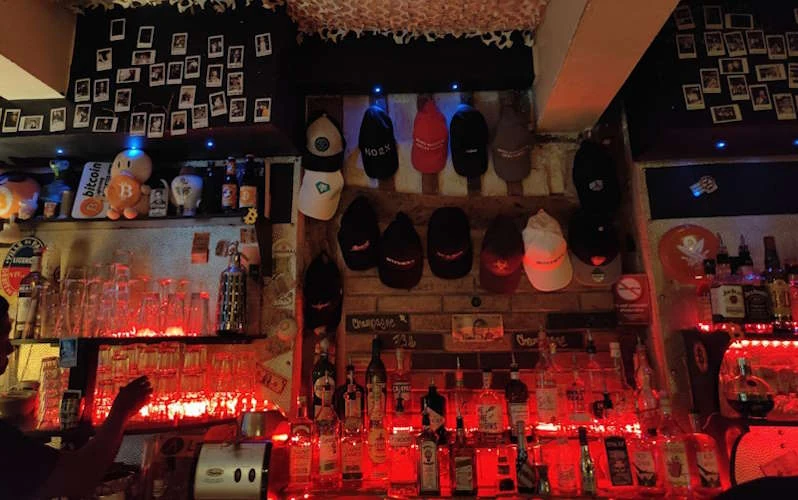
- finally, some communities may decide to hold their events only at venues that accept Bitcoin as a payment method; and this is understandable. With this in mind, it seems relevant to start by searching for businesses in your city that accept Bitcoin (on btcmap.org for example) and contact them to find a venue that meets your criteria. In case, unfortunately, nothing is suitable, you then have the option of "onboarding" new merchants. However, expect to face a lot of rejection, which can be discouraging. That is why it might make sense not to set this as a goal from the beginning, but to get there once your community is well developed and you have sufficient "influence."
Also, do not hesitate to change venues for a few months at the launch of your meet-up. This will allow you to make contacts with some managers, to discover different atmospheres; but also, to gather information about the various venues that could potentially host your events.
Nothing prevents you later, when you start having many participants, from taking a weekend afternoon to visit different businesses and bars to ask if they have a suitable venue to host, once a month, your events and meetings!
Before the meet-up
Have you decided to organize a meet-up and informed your community about the date? Several important steps now follow:
contact the venue where your event will be held, to confirm a reservation for a given number of people;
announce on social media and communication channels your event, clearly stating the date, time, location, and adding the registration link if necessary. For this communication, a specific visual can be created (e.g., a Canva poster, see part 2/8 "Designing a unique identity for your Bitcoin community"). In addition, to ensure maximum visibility for this ad, it can be fixed on Telegram and Twitter, and can also include a "@everyone" on Discord. It also seems more than relevant to publish these announcements 1 week to 10 days before the event date, allowing everyone to plan their participation;
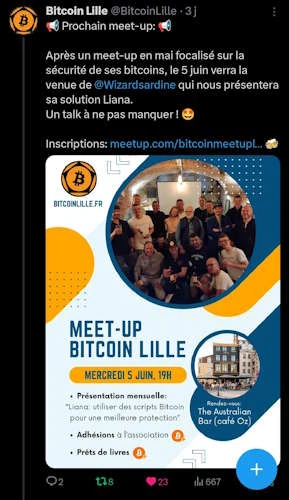
two to three days before the event, these ads can be retweeted and re-shared, increasing visibility;
finally, depending on the number of responses and/or registrations received the day before or the day before, it is entirely possible for you to contact the venue owner again to confirm the number of expected participants.
To these four steps, they can also be added:
- printing flyers and/or posters**;
- create a presentation** on a predefined topic;
- preparing an activity or workshop**;
- etc.
The day of the meet-up
The big day is here! An hour or two before the event begins, you can post a simple message on your community communication channels (no need to overload social media) to announce the time you will be there, but also to inform future attendees that you will be recognizable because you will be wearing (for example) a Bitcoin T-shirt and hat.
As your meet-up grows and you welcome more than 20 people per event, preparing the room/venue will become an important element.
To accomplish this, it will be necessary:
arrive a little early to prepare;
arrange the room or space according to your possibilities and needs. In case you are about half a dozen, there is really not much to do. But as soon as you reach 10 to 20 people per event, you will quickly realize that having everyone seated is not a good idea, as it creates fewer relationships, and you will not be able to talk to everyone during the evening. In this sense, preferring a standing configuration, with, for example, well-spaced high tables (when possible) seems relevant as soon as you reach about 15 people. However, think about having chairs available (tall, for example) anyway. In case a presentation will be given, it is preferable to keep the setup standing throughout the evening, even if it means bringing some (tall) chairs a few minutes before the presentation;
In addition to the room layout, other small "customizations" can be undertaken:
- display, with Patafix, a poster in front of the location of your meet-up, specifying which room you will be in (of course think about asking permission in advance);
- expose, with Patafix, specific posters in the room where your event is being held (Bitcoin white papers, bylaws of your community, ongoing projects, etc.).
- set up on one or more tables adhesives, flyers or even material that can lead to discussion (Nerdminer, hardware wallet, computer turned on with mempool, ASIC, metal plate to protect your private key, etc.)
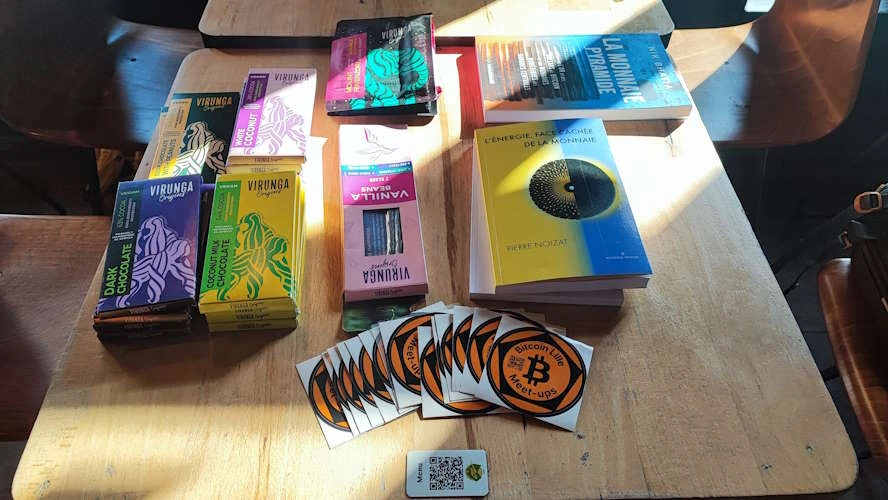
Obviously, if you expect only a few participants and you have not informed the managers of your meeting because you are just launching it, don't start bringing and showing all your materials.
However, once you establish trust with the managers, you will be much freer to organize the space as you see fit.
All that remains is to get a drink and wait patiently for potential participants. However, as mentioned above: don't be disappointed if no one shows up the first time. Therefore, plan to have a book or video to watch, just in case.
After the meeting
When the meeting concludes, it is time for the venue managers to tidy up. So before you leave (and you will generally be among the last to leave, at least initially), consider offering to help the waiters and/or managers. This could be as simple as picking up glasses on a table; or, if you are near the bar, bringing them back before you leave.
Once you return home, you will most likely have bitcoin in your eyes for a few days. This will be an opportune time to evaluate feedback, for example:
- sending a message on your communication channels to thank participants, and/or sharing links or websites you discussed;
- suggesting those who attended the meeting to propose improvements for the next one;
- and also, to prepare for the next event!
A long period of several weeks will then present itself; perfect for developing other designs and/or plans for your meeting.
The importance of Engaging and Retaining Participants
Rome was not built in a day; and the same goes for your community. This means that it is by organizing meetings and events regularly that you will succeed in creating a dynamic around Bitcoin.
To do this, one point is essential: you must retain participants in your events.
This can start with a small group of avid bitcoiners whose goal is to meet regularly to talk about bitcoin. Over the course of weeks, and depending on the time and sensibility of each of them, you can distribute some organizational tasks of your community; or even propose to these bitcoiners to undertake a given project. This project could be specific to your community, your meetings, or even your city; as it could draw inspiration from one of the many initiatives proposed in part 6/8 of this course. This would then involve the core of your community, and thus help it flourish.
New faces will join you over the course of the meetings. These could be people who have purchased BTC and/or alt/shitcoin during previous rounds; no-coiners who wish to deepen their understanding of Bitcoin and its ecosystem; but also novices, gathering their first information about this new incensurable, decentralized, transparent, fair, unconditional, and trustless electronic payment system. To ensure that everyone feels included in the events, two main areas of consideration can be worked on.
On the one hand, from a social perspective, it is crucial for the development of a community that everyone who participates in an event feels included. This means: making an effort to approach these new participants, being interested in why they are there, welcoming them warmly, etc. Feeling included and welcomed, these people will want to return; and even, in the future, depending on their profile, get involved in organizing these events.
Of course, this requires time and motivation. In the case of welcoming a shitcoiner (or worse: an XRP-maximalist), it can be quite difficult to put aside one's time preference and agree to "waste time" in one-sided discussions. However, it is by taking the time to talk to these people that we can help them understand their misunderstandings and errors in reasoning. Once they accept these, they will then be ready to understand Bitcoin.
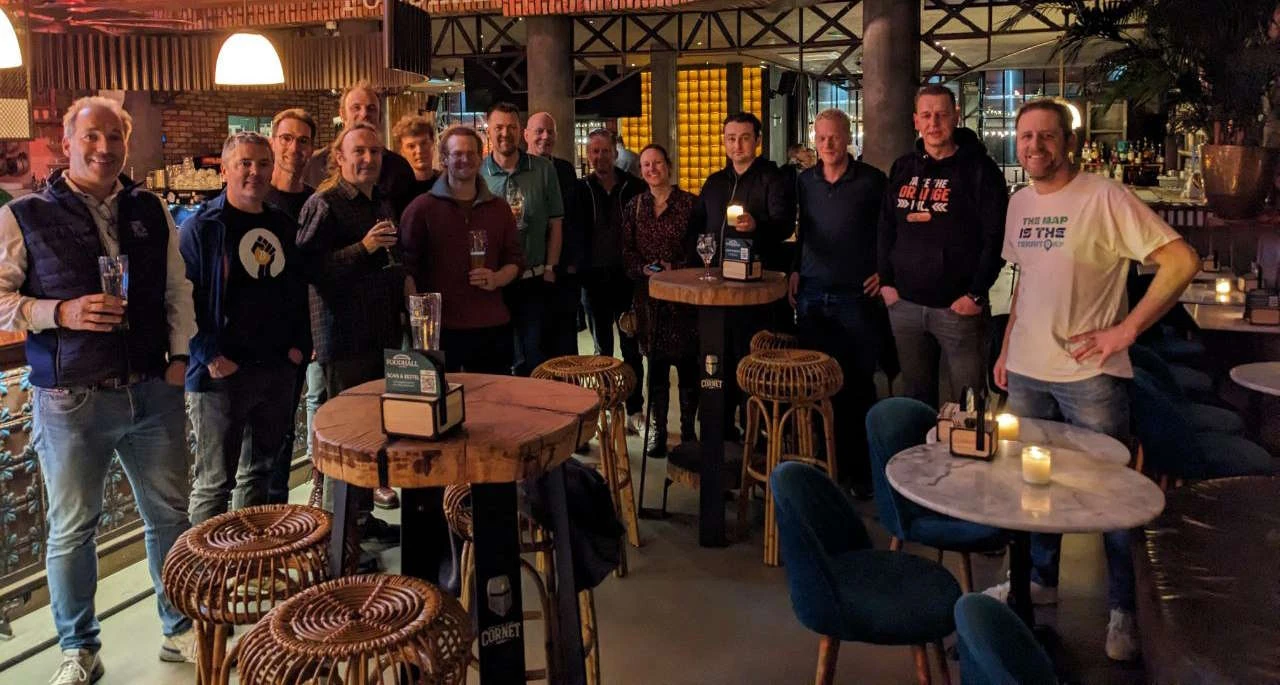
On the other hand, from a technical point of view, several questions may arise:
- the venue where the meeting took place was pleasant?
- was it easily accessible?
- why did some participants ultimately not come?
- what discussions were raised? Were they too technical, not allowing novices to be included?
- was the alcohol flowing too freely?
Of course, each participant has his or her own personality, sensitivity, goals and interests. Therefore, everyone will experience the meeting differently.
But when the venue is well chosen, the people present (especially the organizers) are open-minded, and their goal is noble, there is no reason for the meeting not to be a success.
**Creating a meeting therefore takes time; but more importantly, organization.
It is a human project, which is why it can only work and develop in the long term if it is thought out, open and inclusive**.
Of course, it is up to everyone to set their own limit on what is meant by "open and inclusive." But let's not forget: a shitcoiner is a bitcoiner in the making (who has not yet been spoiled "rekt").
Examples of projects and initiatives
Why go beyond just drinking beers?
As the blocks advance, your community will grow. New faces will join, and others will fade away.
To advance the Bitcoin ecosystem and build even stronger ties within your community, numerous projects and initiatives can be undertaken.
Below, we offer a non-exhaustive set of ideas that can be implemented within a community or during a meeting.
You are free to choose the ones you like, but also to add more by making a "Pull Request" on GitHub.
But before we begin, it seems interesting to elaborate on a point already listed in earlier parts of this course.
When you launch a meeting on Bitcoin, you meet new people. So social interactions are important, and beer (alcohol in general) makes these types of events festive. But CAUTION:
- on the one hand, alcohol inhibits some cognitive abilities (thinking, comprehension, etc.). It therefore becomes more difficult for participants to follow serious discussions - or a presentation - after having a sweet alcoholic drink;
- on the other hand, alcohol can be comforting: every month, you have your "Bitcoin moment," with your new friends. You share a common passion, and that's very positive! But is drinking beers really the main goal of your meeting? Wouldn't you rather exchange information about your new discoveries/research, learn from others' experiences; or even democratize Bitcoin to newcomers, to initiate them?
Everyone has their own desires, their own beliefs, their own personality. So, no judgment is made here about how one or the other meeting works. After all, it is around a beer that we remake the world, but it is not how we transform it deeply.
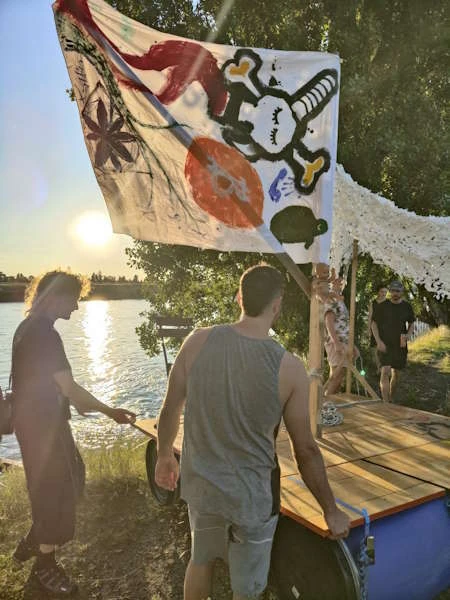
Organizes thematic meetings, following a defined annual progression
Once your meetings become regular and a core group of about ten people has been established, you will be able to conduct a presentation at each of your meetings. These can then be thematic, with a theme announced in advance; or unrelated.
In the context of organizing presentations and/or workshops, it can be very relevant to build a well-thought-out pathway in advance. The goal of this pathway would then be to cover all the important concepts related to Bitcoin; enabling all those attending the meetings to understand Bitcoin in its entirety.
In France, during the summer of 2023, meeting organizers worked on a yearly track, which many of them follow. In addition to having a strong educational dimension, this allows for the exchange of open-source documents and PowerPoint during the meetings in order to build a database of resources on the same topic.
This initiative is particularly popular in the meetings and aims to develop in the coming years.
The path followed in the 2023/2024 French meetings is then available below. It includes the theme of each meeting, as well as an open-source video and presentation that can give you ideas about the concepts that can be addressed.
If you would like access to other editable resources, consider checking out the Bitcoin Educational Toolkit!
It should also be noted that Chapters 2 and 7 can be divided into two presentations, with the aim of not overloading participants with information; ,but they can also be conducted at once. This second option, allows more freedom, allowing in the two meetings to conduct workshops or specific events (joint meeting of meetings or quizzes, for example).
| Month | Theme | Video | Editable Resource |
| ------------------ | ----------------------------------------------------------------- | ------------------------------------------------- | ----------------------------------------------------------------------------- |
| September | Chapter 1: What is Bitcoin? | YT | canva |
| October & November | Chapter 2: Understanding Bitcoin Transactions | YT | canva |
| December | Chapter 3: Understanding the Lightning Network | YT | canva |
| January | Chapter 4: What is Mining? | YT | canva |
| February | Chapter 5: Configuring a Bitcoin Node and Lightning | YT | canva |
| March | Chapter 6: Using the Lightning Network in Everyday Life | YT | canva |
| April & May | Chapter 7: Protecting Your Bitcoins | YT | canva |
| June | Coming Soon | Coming Soon | Coming Soon |
| July | Coming Soon | Coming Soon | Coming Soon |
| August | Coming Soon | Coming Soon | Coming Soon |
Of course, there will be times when some people cannot be present at a meeting. When possible, recording the presentation to post it on a streaming platform and/or on your website can be relevant. This may in fact allow those who were absent to catch up on previous presentations; or even, to watch them again in replay to better educate themselves.
Feel free to take these resources, edit and share them as you wish. Just remember to cite your sources if you reuse an editable presentation.
In parallel, other thematic meetings can be organized. These include:
- a knowledge quiz (with, for example, a physical portfolio as a prize);
- an "onboarding " challenge by sending free satoshi to no-coiners;
- organizing the arrival of an expert in a specific field, or a company** offering a relevant Bitcoin-related product;
- an evening of "tours of bars and businesses " that accept Bitcoin as a payment method;
- etc.
The only limits to be set are those of your imagination!
Creation of Collateral Events and Workshops
Throughout the year, other events may be organized. These may include:
- an evening at the pizzeria for Pizza Day**, May 22;
- an evening or weekend to "celebrate" the upcoming halving**;
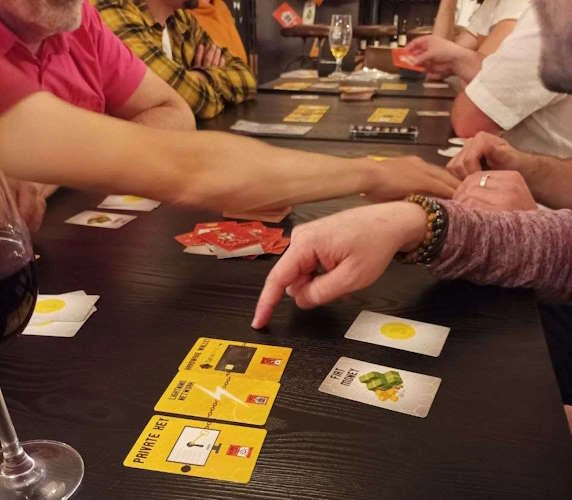
- a "family game" event around Bitcoin** and how it works. You can bring games such as "Le Coin de Table" or "SHAmory";
- a workshop on mining**, with discovery of various equipment (processor, graphics card, FPGA, ASIC, nerdminer, bitaxe);
- an afternoon or evening especially for beginners, with thematic workshops**;
- or even, a joint meet-up with one (or more) neighboring meet-ups.
However, it is important not to organize too many events in a month since, the more events there are, the more time they take both organizers and participants; and this may lead some to reconsider before participating.
Creating Stickers
As symbols of your community's identity, it might be interesting to design and then order stickers.
Before placing the order, it may be relevant to consider the following points:
- if you want these stickers to be able to be attached outdoors, you need water-resistant stickers ("waterproof" or waterproof);
- make sure that your logo is smaller than the area announced when ordering**. In fact, this will help to avoid precision errors of the laser cuts, which may cut off part of your logo. This is usually explained at the time of ordering;
- consider using a vector file rather than an image file. This will improve print quality;
- think carefully about the desired size**. For example, a circular sticker with a diameter of 8 cm is about the size of an adult's palm. Are you looking for this size, which is quite significant for visibility, or are you looking for something more discreet (4 cm in diameter, for example)?
- finally-and this is a bit technical-if you want a rich black print (a "four-color black"), the properties of this should be: 30% cyan, 30% magenta, 30% yellow, and 100% black. In cases where only 100% black is used, the result will be a somewhat grayish black. Fortunately, printers generally pay attention to this detail. So, you should not worry about it too much.
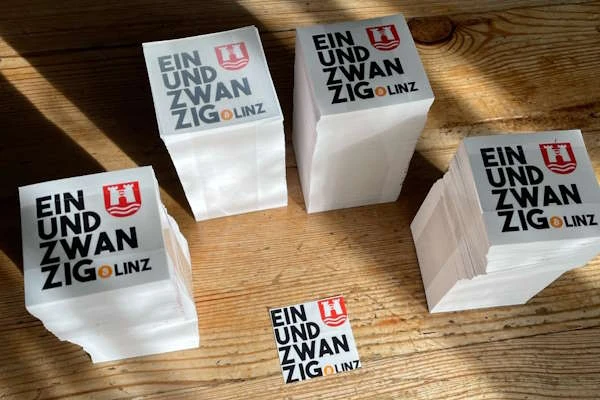
Depending on your request and the vendor you choose, expect to pay between 100 and 250 euros for 1000 stickers. You can also contact @Mill3sim3 on Twitter, a French bitcoiner specializing in marketing who can help you get prices almost 30% cheaper than the usual online sites. Don't hesitate to contact him about this.
However, it is worth noting that 1,000 stickers is a significant amount. Therefore, it is clearly preferable, to begin with, to opt for the purchase of a hundred stickers; to be sure to sell this stock.
Also, a small note: if you decide to stick one of these stickers on the street, depending on the country you are in, this may be prohibited by law. In the case of France, for example, it is forbidden to stick stickers on the street, except on billboards in every city. This means that if one of your stickers is attached carelessly (or rather: anywhere, such as in the middle of a stop sign), it will be removed quickly; and if it contains information that can be traced back to your identity or that of your meeting, it is not out of the question that you may receive a fine. So be careful and inform your members.
In parallel, if you are fond of concerts, bars or stadiums, consider checking if there are already stickers attached before placing yours. If not, consider asking an employee if this is accepted.
In fact, it would be a shame if a merchant hears about your community/meeting/association/Bitcoin for the first time because you sabotaged the decoration of his bathrooms!
Creation of a Library
Another project that can be easily implemented is establishing a library within your meetings.
To do this, you can ask all interested people to share their readings by bringing a book related to Bitcoin and, during the meeting, if someone else is interested in borrowing it, a loan can for example be made to its owner, in exchange for a deposit of 21,000 satoshi in Lightning.
This allows, the owner, to cover the costs in case of forgetfulness or theft; and, the borrower, to return to a future meeting to retrieve his 21,000 satoshi!
If you run an association and wish to invest some of your treasure in educational and pedagogical resources, you can order several books and offer them in your Bitcoin library at each meeting.
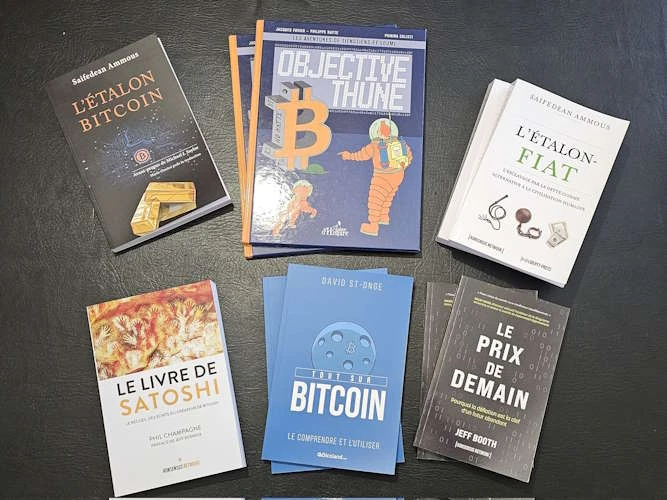
In this regard, and with the aim of developing the ecosystem, publishing house Konsensus.Network is offering international Bitcoin meetings and communities a discount ranging from 15 percent to 35 percent on all of its books; starting with three purchased.
If you do not have the funds, it is still possible to qualify for this discount.
In fact, one of your community organizers can, for example, centralize the order from several members and place it with Konsensus at a lower cost, with the goal of redistributing the copies received at the next meeting. This redistribution could then, for example, be done in Lightning.
To take advantage of this discount, simply contact the Konsensus publishing house on Twitter.
In addition, a charter, which briefly explains the rules of book lending, can be drawn up and displayed at the meetings.
Here is an open-source example, which you can take and modify as you wish:
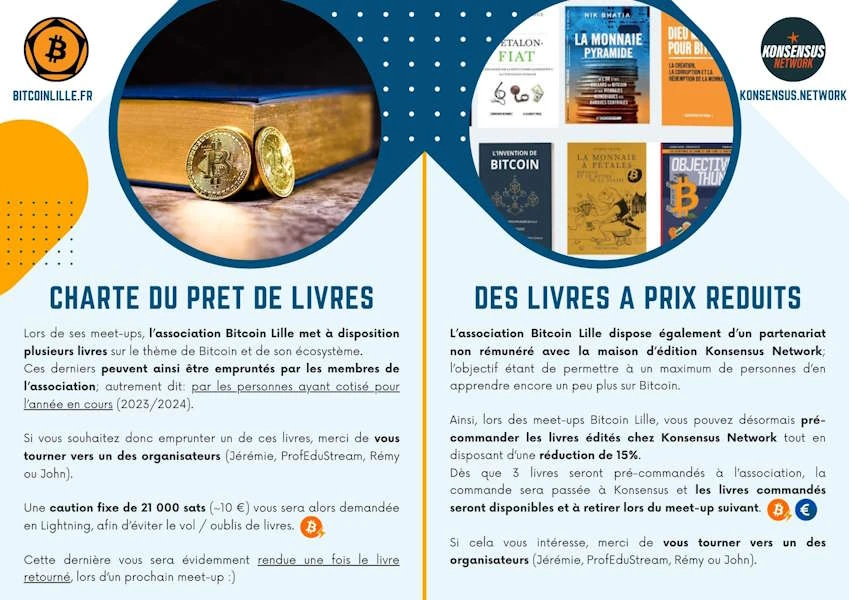
In parallel, still with the idea of promoting reading on Bitcoin, another significant action can be to visit city municipal libraries and see if they have various books on Bitcoin.
If yes, it might be interesting to ask if roundtables will be organized on this topic in the coming months, including providing the contact of the city meet-up. If not, proposing the purchase of several books you have selected in advance may be an option. The website of publisher Konsensus may be a source of inspiration for this.
Create custom flyers and distribute them
Creating flyers is a time-consuming step. However, it allows having a paper medium during Bitcoin discussions, which is quite appreciable.
These flyers can then be intended for:
- merchants**, in case you want to propose them to accept Bitcoin as a payment method;
- people attending your events**, with a flyer specifically explaining how to use and pay in Bitcoin / Lightning; - and newcomers, met on the street, at work, or over a family meal, with a flyer summarizing the main benefits of Bitcoin.
It is also entirely possible to prepare a flyer specifically for your community or meet-up, showcasing your actions, goals, networks and communication channels; but also, the dates and locations of your already planned events.
Several handouts are already available in open-source, and more will be created in the coming months. You can find them especially in planB.network's Bitcoin Educational Toolkit.
Among them, you will find a comprehensive and documented handout listing 21 reasons to use Bitcoin. Its design is also available in open-source.
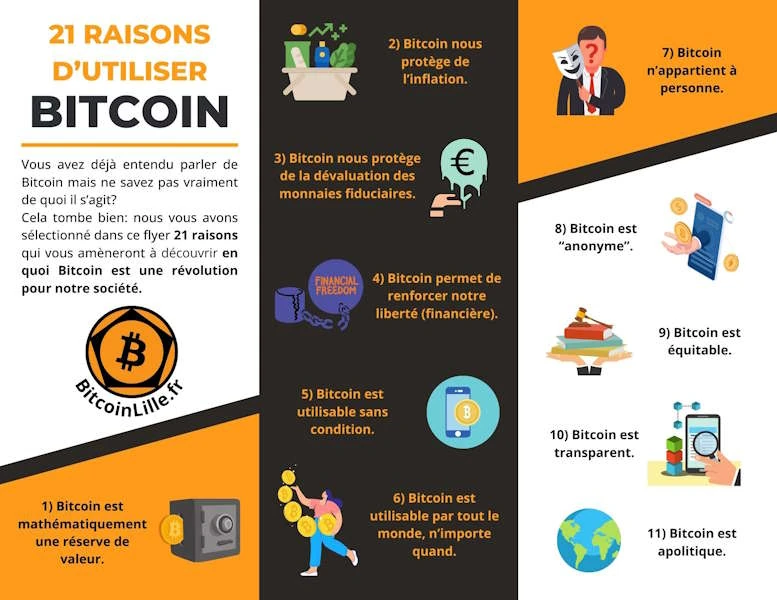
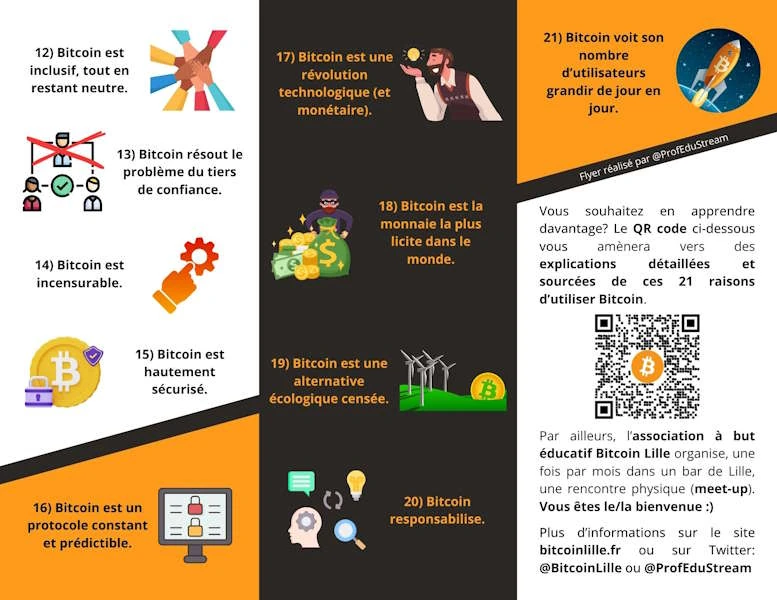
Edit it, adapt it and then share it as you like. However, remember to cite your sources.
As mentioned earlier, these flyers can be placed almost anywhere: on a shared desk at your workplace, on a table during a family meal, at a community library, etc.
In France and some other countries, there are also "book boxes ".
Usually made of wood, these boxes freely accommodate books to be given as gifts. Therefore, one possibility might be to leave a flyer there; or even better: a book!

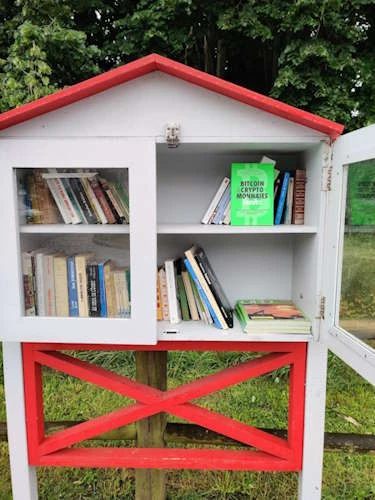
With this in mind, in 2023, the initiative "A Bitcoin White Paper in France's Book Boxes " was launched.
To successfully pursue this project with all stakeholders, it was first necessary to obtain the geolocation of all existing book boxes in the country. To do this, several databases exist:
- boite.a.livres.zonelivre.fr;
- boites-a-livres.fr;
- delivrez.fr;-as well as some articles in the local press.
Of course, placing Bitcoin's white paper in these book exchanges has symbolic significance. However, for a beginner, it is too complex to understand. Therefore, the idea was to write a small pamphlet, including:
- a simplified and documented introduction to Bitcoin, its use and the problems it solves**;
- and the Bitcoin white paper, translated into French.
Here is the pamphlet that has been shared among French bitcoiners the pamphlet that has been shared among French bitcoiners and has finished its journey in several dozen book exchanges across the country. Its design is also available in open-source.
Organizing a Video Projection
Every bitcoiner has certainly already seen the very interesting mini-series "The Mystery of Satoshi, at the Origins of Bitcoin" by Rémi Forte.
Released in 2021, it has been viewed several million times on YouTube, representing an inspiring first step in understanding where Bitcoin came from.
As such, it is entirely possible to propose a video screening of this mini-series to your community; even creating a special event for example.
However, there is one small drawback: in France, we contacted ARTE to see if this was legally possible. Unfortunately, because of projection fees, the cost per projection was almost 250€; with a possible discount of 120€ per projection in the case of 5 consecutive meetings in the year.
As a result, for the vast majority of communities, this fee is prohibitive. However, the documentary is available for free on ART...
Other screenings can be arranged in parallel.
In France, for example, the director of the documentary "Stranded," Alana Mediavilla, has allowed a preview screening of her documentary at meetings; some of the footage is from sequences in the film "Dirty Coin" to be released in 2024.
The French Bitcoiner community then took the initiative to completely translate the documentary "Stranded ", integrate French subtitles, and share it at all meetings in the country. During the week of March 4, 2024, a joint screening was organized in about ten meetings across the country.
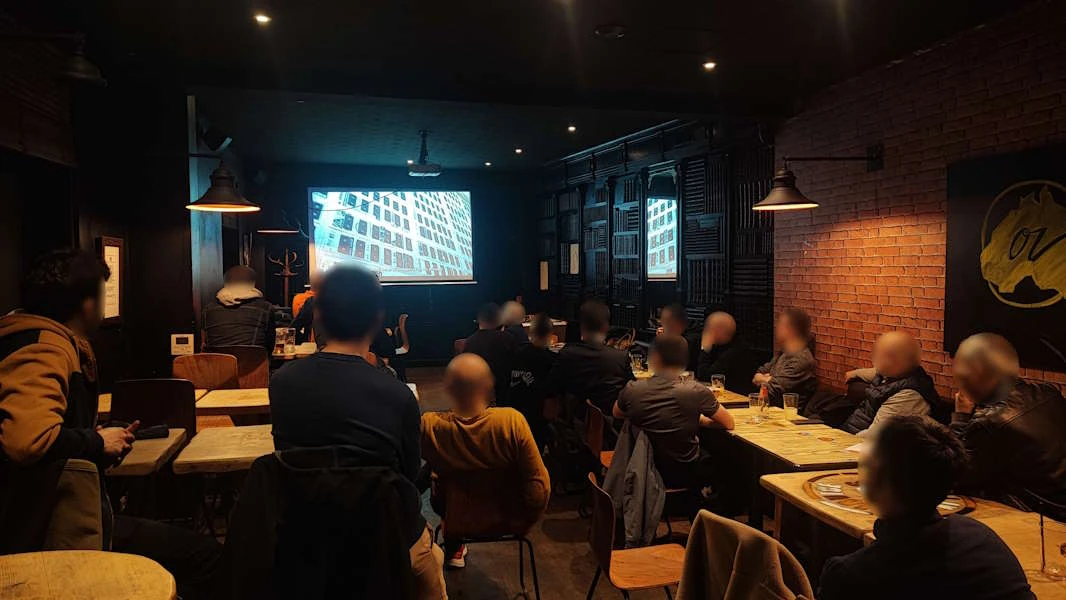
This broadcast led to numerous discussions about Bitcoin mining, its electricity consumption, and its impact on ecology more generally.
Put up Posters in Your City
In several European countries (Germany, Spain, France, etc.), some Bitcoin supporters have taken the initiative to put up posters related to Bitcoin. Some of these posters feature works by Banksy, while others incorporate the Bitcoin logo in different ways.
This is the case, for example, with StreetCyberArt, a German Bitcoiner, who has been creating collages and street art for several years.
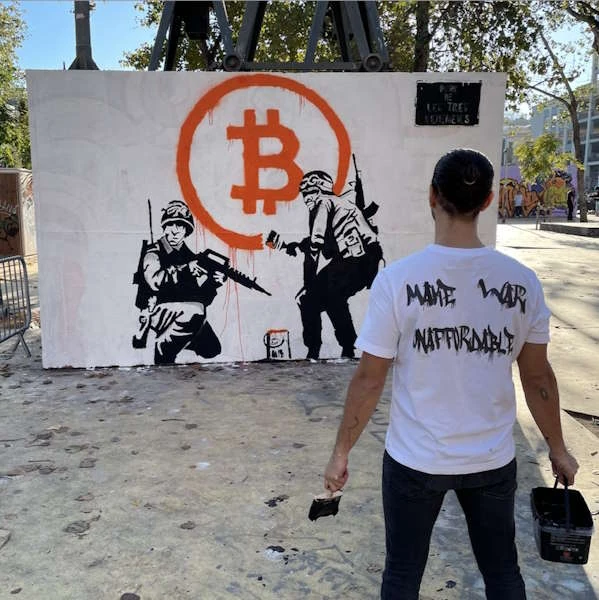
Of course, if you want to
make street posters, you will need to be aware of the laws in your country. In France, for example, it is permitted to put up posters only on municipal billboards. Elsewhere, this is prohibited and can result in a fine.
Obviously: out of sight, out of mind. So, in this case, perhaps it is best to be careful not to include on posters elements that could be traced back to you (rally name, @ Twitter, etc.)
If you plan to print these types of posters with a personal printer, be aware that this generally causes the paper to be heavily smudged and also to deteriorate rapidly over time. With this in mind, the best thing to do is certainly to get in touch with a professional printer to produce these posters on specific self-adhesive paper specially designed for outdoor use. Quality will thus be assured.
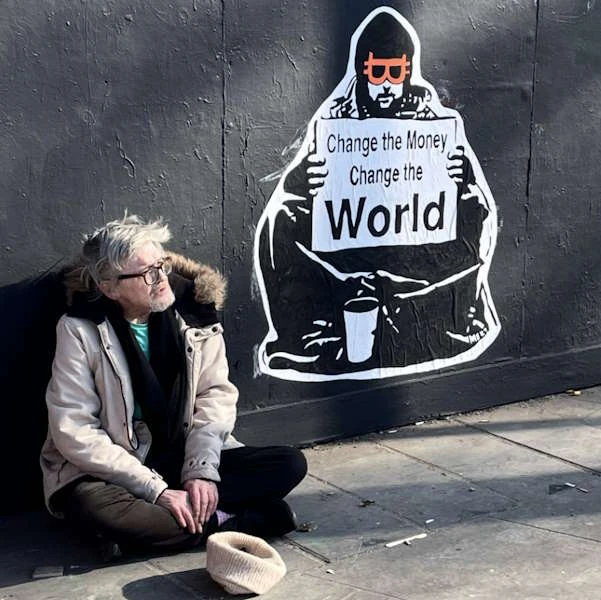
However, it cannot be denied that this initiative has a significant cost: more than 0.40€ per poster (i.e., 40€ per hundred posters); and that, when you have good contacts. Online, prices can in fact vary from double to quintuple.
As mentioned earlier, French Bitcoiner @Mill3sim3 has the appropriate professional equipment. Therefore, you can contact him on Twitter for information.
Having a Personalized NFC Card
Another unique project is the creation of customized NFC cards for payments via Lightning, adhering to the BoltCard standard. For this purpose, Swiss Bitcoin Pay is a quality partner.
Currently, on their website https://swiss-bitcoin-pay.ch/cards, Swiss Bitcoin Pay offers four basic designs.
However, if you wish to order more than 50 NFC cards, you can contact the company on its official website (or on Twitter) and propose a custom design that you have created for the front of the card. The back, however, is standardized.
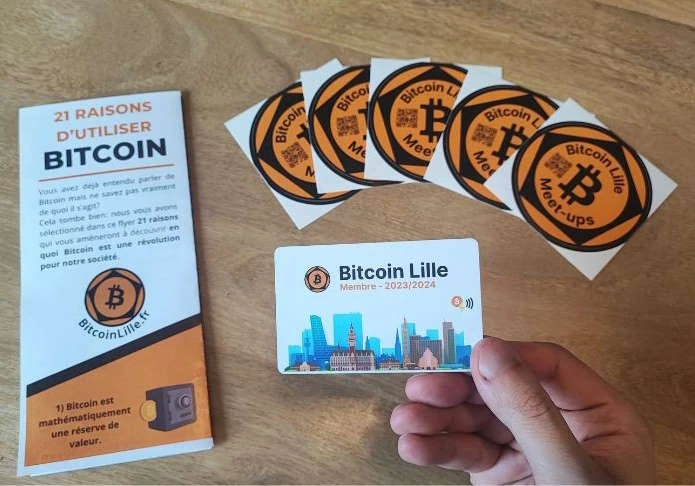
The French Bitcoin Lille Association, for example, ordered one hundred NFC cards with a customized design in 2023, at a price of about €2.50 to €5 per card (the price changes regularly and is progressive).
Thus, every new association member receives a personalized NFC card in their welcome packet.
This idea can of course be taken up and improved as desired.
Creating a Web Site
With the goal of having a showcase for your community it might be relevant to have a website. However, it requires a lot of design time (several tens of hours).
To simplify this creation task, the tutorial below shows you in half an hour the steps to create a free website on the WordPress platform. This site will allow you to have a customizable homepage, create categories, publish articles, integrate media (YouTube videos, images, PDFs), etc.
Later, you will be able to purchase your own domain and even host it on your own server if you wish.
Other CMSs or platforms also allow the creation of websites. Although some are simpler due to their user-friendly interface, the resulting websites are also much less customizable.
WordPress seems to be the most relevant choice for getting started. In addition, it allows integration of plug-ins, some of which are paid but of high quality, allowing further development of the website; and that, without the need to know how to write code.
The Uncode plugin, which is paid, is one of them.
Create a Video Channel (YouTube or Odyssee)
Among your community members, some may be interested in creating multimedia content. This could, for example, take the form of producing video tutorials (using a software wallet, tutorials for buying non-KYC BTC, etc.)
In parallel, the day may come when presentations are made at your meetings. Or even, when your community conducts conferences at post-secondary schools and universities.
In this sense, when the need arises, it might be relevant to have a video channel that allows you to post online all the videos, presentations and lectures you have made as part of your actions and projects.
Among the best-known video platforms, we find in particular:
- YouTube, which has the shortcoming of not being censorship-resistant;
- Odyssee, which is relatively little used but is decentralized through its peer-to-peer operation;
- peertube, which allows you to create your own video platform. This is probably a step forward in terms of configuration.
Depending on what you decide to implement, you will obviously need to create graphics specifically for this platform, with the goal of making your video channel visually appealing. The good thing is that with Canva, which we talked about in part 2/8 of this course, there is a "YouTube thumbnail" category with pre-designed and easily editable graphics.
In case you want to record on your computer, software like "Streamlabs" works very well. It allows you to adjust many settings, is free, and also allows scene transitions.
As for video editing (if any), you will need to have suitable software.
If you don't have one yet, the software "Wondershare Filmora" is particularly effective and very easy to use; it allows you to make serious edits. Unfortunately, it is chargeable (€45 per year). Finally, for introducing and closing your video, a specific search on Canva will allow you to find what you are looking for, edit the results as you wish, download them; and then all you have to do is integrate them into your editing software.
Note: In the event that, one day, Bitcoin is banned or censored, it may be relevant always keep a local copy on a hard drive of the videos you post.
Creating an audio podcast
Creating even an audio podcast can be an interesting venture. As with creating a video channel, however, don't expect to get thousands of views quickly.
Some of the best-known podcast platforms include:
- Fountain, which is particularly interesting because it allows direct donations in Lightning;
- Soundcloud;
- Deezer;
- Spotify;
- Google podcast.
The problem, however, is that each of these platforms has a very specific audience. So, to reach as many people as possible, you will have to be present on almost all of them.
Fortunately, the "Spotify for podcasters" platform allows you to import your podcast file once, and then generate an RSS feed that can be copied and pasted to any of the previously mentioned platforms.
So once you're done working on "Spotify for podcasters," all that's left is formatting on your other platforms; which is relatively quick.
In case you would like to record on your computer, free software such as "Audacity" works very well. It allows you to adjust many settings, perform crescendos, and even improve the clarity of the sound while editing. Recording your voice and then editing the audio of your podcast should then be quite easy.
Here is a short tutorial that presents, in 10 minutes, the main features you need to know about making a podcast with Audacity.
Note: As mentioned earlier, in the event that, one day, Bitcoin is banned or censored, it may be relevant always keep a local copy on a hard drive of the podcasts you publish.
Create a badge for your events
During your meetings and events, it is possible to devise a small incentive for participation. So the idea would be to create a type of badge that can only be obtained at the event in question. This exists under the name "POAP" ("Proof Of Attendance Protocol") on other blockchains. However, there is currently no free way to set it up on Bitcoin.
In principle, this initiative could also serve to reward the most involved members of your community, for example by holding an annual raffle, during which a badge obtained would correspond to a raffle ticket. A member attending all 12 meetings of the year would then have 12 tickets for this annual raffle.
In addition, in a completely different context, it is also possible to ask participants at each event to write their name or pseudonym on a badge. To this, the reasons for their attendance can also be added. This strategy, although somewhat formal, may allow some members to find commonalities and topics of conversation more easily, as well as make it easier for newcomers to identify organizers and potential association members.
Several models used by the Bitcoin Lille Association are also available in open-source on Canva.

Reflections on Transition in the Event of Death
Another point on a completely different note is the position regarding the death of a member of your Bitcoin community.
In fact, the day may unfortunately come when the family of one of your former members contacts you to announce that this person has passed away. They will then explain to you that this individual has left instructions, and one of them is to get in touch with your community/meeting/association.
This person will probably explain that he needs help in recovering the funds, as he is the beneficiary of this former member's inheritance.
In response to this request, it may be very relevant to have already thought of some sort of procedure to follow; and this, for several reasons.
On the one hand:
- to ensure that the deceased had thought ahead to inform his family not to disclose or bring to a meeting the deceased's private keys and physical wallet(s);
- so that the family clearly understands that their presence is about learning Bitcoin in order to eventually become sovereign over the deceased's funds;
- so that the family is aware of the law that applies in the country in case of donation, inheritance or conversion to fiat currency;
In addition, thinking in advance about a procedure to follow also ensures that no one, whether a member of the meeting or simply a guest, can somehow take advantage of this situation (and/or steal funds).
Towards this goal, it might be interesting to propose a "working group" on the procedure to be adopted in case of death and requests for help coming from the family. The Bitcoin Lille association is actually working on this and will share its final working paper in an open-source way here in the coming months.
Conducting lectures in schools and universities
The list of projects previously described is obviously not exhaustive. In general, these are internal community or meeting projects that can easily be started once your community has developed. It is then time to address the case of onboarding.
First of all, you are undoubtedly aware that one of the best ways to talk about Bitcoin to as many people as possible at once is obviously to hold a conference (or workshop). This can be done within post-secondary schools and universities; thus leading young (and perhaps not so young) people to discover or learn more about Bitcoin.
In addition to the importance of knowing how to speak in public, hosting a conference in front of several dozen or even hundreds of people requires knowing how to manage stress, articulation and time. It also requires preparing a quality presentation or workshop that is documented and in line with the skill level of the audience you will be addressing.
In addition, having an open mind, ready to simplify concepts as needed, is essential in this type of exercise; especially during the question/answer phase and in case of panel discussion. This does not mean "abandoning your principles"; but simply accepting that others may have a different point of view, even if it means responding later or letting it go so that the dialogue can progress. In any case, if your speech and responses are based on relevant and documented arguments, the audience will not be misled.
So, if you feel capable: step up! Our world is in such need of education about what Bitcoin is...
However, it is obvious that to accomplish this task, you will need a lot of motivation, a great commitment; but also, the right contacts.
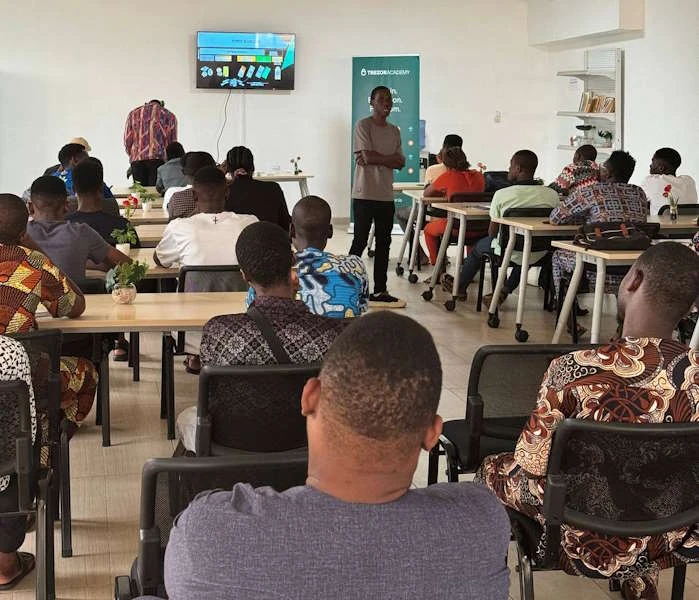
In fact, organizing a conference or workshop at a school and/or university is not at all easy.
First, it is necessary to get a contact. This can be obtained through an acquaintance, through the BDE ("Bureaux Des Étudiants" or Student Offices); or even student associations, which generally organize lecture series and meetings every year. Your former engineering school and/or university professors can also act as intermediaries.
In the case of a postgraduate school, you can also contact the head of the training program directly, with the aim of explaining your proposal. This can then lead to an initial meeting and-at best, a few weeks later-a presentation on what Bitcoin is and how it works in front of students.
Unfortunately, in our current world, Bitcoin is still too often deliberately demonized by the media and politicians; leading many beginners to think it should be banned from classrooms and lecture halls. The likelihood is therefore quite high that you will face a lot of rejection; especially in academia where Bitcoin proof of work and energy consumption sometimes seem taboo.
However, nothing prevents you from trying, especially with the BDE and student associations. With any luck, even if the rejection is firm the first time, it is not impossible that you will be contacted again during the next bull-run at your community email address to give a lecture in front of nearly 280 students!
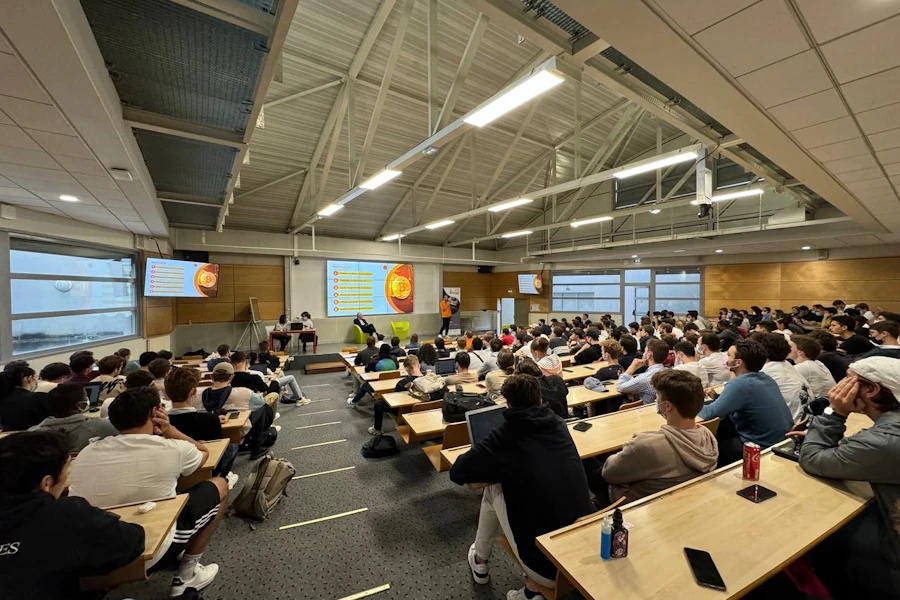
Approaching Enterprises
Achieving the goal of making a merchant accept Bitcoin as a payment method is somehow the "holy grail" for many Bitcoin enthusiasts. It is like unlocking a milestone in their Pokédex! However, because every merchant is different, this task is not easy; and numerous issues arise:
- a merchant still needs fiat currency to pay suppliers (for now)**;
- need clear and explicit financial reports** that can be sent to their accountants;
- their payment methods must work without technical or logistical problems**, and employees must be able to receive payments without being able to run away with the till.
To these aspects, add:
- potential merchant biases** toward Bitcoin;
- the difficulty of finding a software solution** that works perfectly;
- but also, the importance of making them understand the benefits of accepting Bitcoin as a payment method.
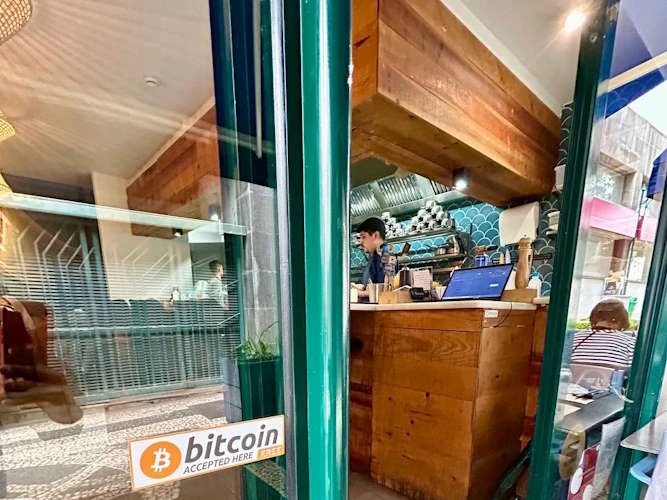
Developing the Bitcoin ecosystem in your city can then involve acquiring merchants. To do this, the easiest way is to proceed in steps:
As soon as you enter a store, always ask if you can pay in Bitcoin. This will generally result in rejection and a questioning look, but this simple question will gradually lead merchants to see that Bitcoin can be used by "normal people" and is gaining interest as a payment method among the population. You can also rotate two or three people in the same store, a few days apart, asking to pay in Bitcoin. At some point, this will get the merchant's attention;
once you get the right interest they might ask what Bitcoin is, you can explain it to them succinctly and in understandable terms. For example, that Bitcoin is a currency, not controlled by banks, without a trusted intermediary, that it is incensurable, not subject to inflation, and that fees are lower than in traditional banking. You can then give them a handout, for example, "21 Reasons to Use Bitcoin" and/or "10 Reasons to Accept Bitcoin in Your Store," and then give them your contact or that of your meet-up. That way, when they are interested in a demonstration, they can contact you.
Once this person has decided to accept Bitcoin, arrange a meeting with them to show the software solution you propose seems appropriate. Swiss Bitcoin Pay looks like an excellent solution in this regard, because:
- allows merchants who wish to do so to convert their daily earnings in bitcoin to fiat currency, enabling them to pay suppliers;
- also allows, if desired, to keep a certain percentage of the proceeds in BTC;
- allows the export of accounting for all bitcoin payments in order to send it to accountants, thus facilitating their work;
- has a user-friendly dashboard for the manager;
- but also an ergonomic and user-friendly interface for employees, who will be able to process payments without being able to run away with the cash register;
- finally, its cost of use is less expensive than 2 to 3 percent in the traditional banking network.
- when this business accepts Bitcoin, it will then be possible for you:
- visit regularly** to shop;
- take the opportunity to ask if everything is going well, offering your contact again if necessary;
- propose again to come to your meet-ups and events**;
- to add this activity on the btcmap.org map, and inform Swiss Bitcoin Pay on Twitter to give visibility to this activity; - but also to potentially organize events in this activity, such as meet-ups or workshops.
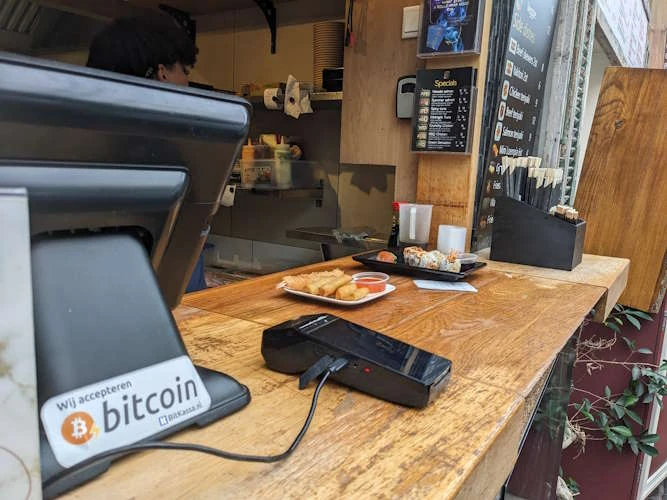
- Once several businesses in your city have been involved and understand what Bitcoin brings them, you can then propose the creation of a special Telegram group for merchants; the goal is to allow them to help each other and to go further in engaging other businesses in the city. In parallel, this group can also act as technical support, in case a problem arises with a customer.
Obviously, this prospecting activity is a long-term job. It requires a lot of time, high motivation, but also some strategy.
Does your community feel ready to build in your city the foundation of a Bitcoin circular economy, similar to Arnhem in the Netherlands? If yes, go for it!
Contact the Press and Local Radio
Very often forgotten, we bitcoiners generally think that the best means of communication are social networks and the Internet. But we are wrong - in part.
Several communities (such as Breizh Bitcoin, in France) have therefore gotten into the habit of contacting the local press in order to:
- Talk about the events they organize** (meet-ups, presentations, workshops, halving parties, etc.);
- Invite them to explore local businesses that accept Bitcoin, with the goal of writing an article** on the topic;
- but also, simply ask them to share the date and location of their upcoming events.
In fact, many local newspapers still have, on the last or penultimate page, a list of events organized in the region.
The feedback from Breizh Bitcoin is clear: it works well, and new people have participated in their meet-ups after discovering their association in the paper.
While this may be specific to your location, here is a list of the top French regional press titles:
In parallel, it may also be interesting to contact local radio stations, to propose, for example, the creation of a podcast or an interview.
However, be aware that words in the media can easily be interpreted to their disadvantage. So, it is not an easy task, and it may be wise to prepare for it.
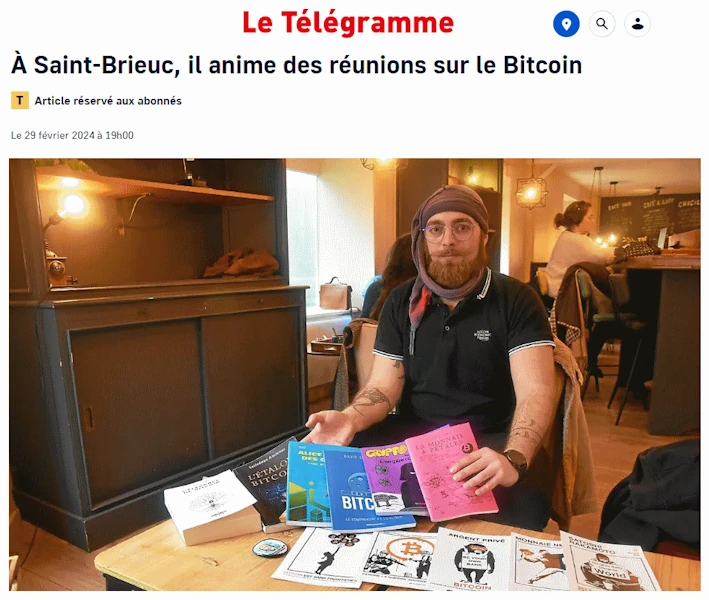
Of course, many other projects can be done. In general, it will all depend on your time, your motivation; but also on the difficulty of the project in question.
In implementing these, three tips can guide you:
define in advance the stages of the project, its goal(s), and what is to be done;
proceed step by step, without getting discouraged; 3) and most importantly, ask for help and a hand from members and other communities around you.
Keep in mind that every community and meeting has gone through the same stages that you are going through. So, do not hesitate to ask them for advice.
Anticipating the Future
Planning for an Increase in Participants
As the world has entered its fourth era, at the 840,000 block, more and more individuals see Bitcoin as a technological, financial and social revolution.
Just like the Internet revolution, this will necessarily take time, and that is a good thing. It will allow everyone to educate themselves on the fundamentals of Bitcoin and learn how to use it. But it will also give developers and companies time to develop relevant protocols and applications, allowing the full potential of Bitcoin to be explored.
Although it is impossible to predict the future, a very significant increase in the number of Bitcoin users is to be anticipated, in order to be prepared for all situations. Including the most catastrophic scenarios, such as a potential implosion of the traditional financial system; or even: a ban on Bitcoin.
In this eighth and final part of this course, we will take the time to detail some points to consider in developing your community and your meetings.
The first among these (the easiest to anticipate) is obviously the increase in the number of people joining your community. This will have an impact in two ways:
- your communication channels (Telegram, Signal, Matrix, etc...) will fill up, potentially making it difficult to follow conversations. Two points are therefore to consider.
On the one hand, if you are 500 exchanging on various topics in the same discussion channel, most of your members will gradually stop following the conversations; among other things because of the abundance of messages to read and the associated notifications. In this sense, it might be relevant to rethink your communication channels; such as Telegram super-groups, or even a Discord server, both of which indeed allow you to group conversations by topic.
On the other hand, more people in the exchange channels also means more bots, more scams, and also more moderation to be done. You will therefore need to be prepared, for example, by drafting a set of rules that you can rely on when moderating a message. From experience, this avoids most conflicts; especially when the rules are available for reading on your communication channels. Along these lines, the Bitcoin Lille association wrote a few years ago an open-source set of rules for its Telegram group and its Discord server, based on simple and universal principles. Its design is also available.
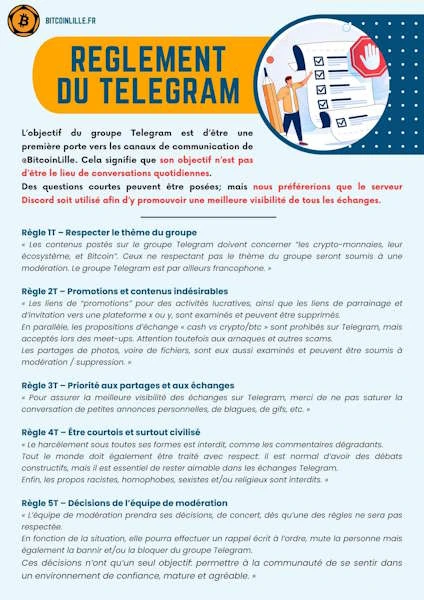
- your meetings and events will fill up significantly, with an abundance of new faces eager to communicate with each other.
In the face of this significant influx, several approaches can be discussed and considered:
- First, it might be relevant to find a larger venue to hold meetings and events, especially if you could only accommodate about 20 people previously;
- Second, if you notice that the human presence becomes too overwhelming, you can also--for subsequent meetings-- require participants to register (this can be done via the Meetup app, or through a standard form), or arrange multiple meetings over the course of the month (for example: a beginner's meeting, an intermediate meeting, and an expert meeting);
- In addition, it is certain that many beginners in the ecosystem will join you, generally with the goal of making money. To keep conversations focused on Bitcoin during these rapidly growing meetings, we recommend:
a) to conduct a thematic presentation on Bitcoin during these meetings, as this will subsequently lead to a good portion of the participants discussing this topic, and not a so-called new revolutionary project;
b) not to limit yourself only to bitcoiners, but to approach newcomers, even if that means taking the initiative to stay in the back of the room to welcome them. Discussions can then revolve around why these people have come, what they are looking for, the goals (or fundamentals) of your community, etc.
Finally, although it is unpleasant to say it, scammers may show up at meetings. So their goal will be to talk as much as possible about their Ponzi scheme, their MLM, or their "revolutionary blockchain project." It is also entirely plausible that people with malicious intentions may come specifically to launder money or to buy BTC with counterfeit bills.
In complex situations such as these, the simplest approach is to take the initiative to "politely" explain to these people that the meeting is not where they will be successful by presenting x or y arguments (such as, informing them about the presence of plainclothes police).
If, unfortunately, these people refuse to leave or comply with the rules of decency (which has already happened), a verbal announcement can be made during the meeting informing that one or more individuals are attempting to engage in such malicious acts.
Unfortunately, these situations are rare and usually quite peculiar. But it is best to be prepared.
Also, if it can reassure you as an organizer, as long as you are not in violation yourself or facilitating illegal exchanges, you need not worry. In fact, in France, you are not legally responsible for the actions of others.####
Thus, in an ideal world, it would be best to have a place that can accommodate several dozen people (depending on the growth of your community); but also, build strong relationships between bitcoiners and future bitcoiners during the bear market, so that you are ready to spread the Bitcoin culture during the next bull run.
Decentralizing the Organization of Your Community
You are the organizer of a meeting and, from one day to the next, you decide to interrupt this task to go to breed llamas in Peru; leaving everything behind?
Consider passing your community:
giving administrative (or even ownership) rights of communication channels to trusted people, even if it means changing them later;
sharing with at least one trusted person in your community the account names, passwords, and emails of the accounts and social networks you have created to give her visibility.
Without these rights and identifiers, it will be impossible for anyone to easily take over and thus continue the initiative you had spent so much time developing.
Starting from scratch by creating "forked" networks and channels really takes a lot of time and energy..
So anticipate your potential departure for Peru. And if you don't have any trusted members in France at your meeting, you can always contact @ProfEduStream or @gabtribe on Telegram to make this transition smooth. This brings us to a crucial turning point in community development: its decentralization. Indeed, if you are the only person involved, having all the control, what will happen if you disappear? The answer is simple: your community will disappear.
So the best way to avoid this is to decentralize tasks and share rights, roles and access. Thus, if one of the members of your community organizing team or meeting is arrested in a future dystopia because he possesses non-KYC Bitcoin (or simply: because he has no more time to devote to it having just had a baby or changed jobs), the others can continue their missions without difficulty.
With a view to further decentralization, the use of open-source software such as framasoft's suite can also be a first "line of defense" against a fictitious state that would censor Bitcoin. Using encrypted communication tools-even anonymous ones-is the second.
What if Bitcoin became public enemy number 1?
On April 5, 1933, Franklin Roosevelt, then the 32nd president of the United States of America, signed Executive Order 6102, which prohibited any individual from possessing gold coins, gold bars and gold certificates throughout the territory.

Of course, the Great Depression (the stock market crash of 1929) is no longer relevant today. But who is to say that, tomorrow, another state will not do the same thing and prohibit any individual from owning bitcoin?
Fortunately, this Orwellian dystopia will not prevent anyone from truly owning their bitcoins, as it is impossible to prevent anyone from learning a sequence of words.
But what will happen if the leaders of our world finally realize that Bitcoin has the ability to change the world order, including at the state level? Bitcoin will then become "public enemy number 1"?
Of course, we should not fall into a form of conspiratorial thinking. But nothing prevents us, from now on, from anticipating, decentralizing and educating.

Bringing Bitcoiners Together
A summarized action plan for creating your Bitcoin community
Satoshi Nakamoto has created a revolutionary tool that has the ability to change the world as we know it. However, it is certain that it is up to us, bitcoiners, to choose the trajectory we wish to take to build the future.
At the same time, the essence of Bitcoin makes it a vast labyrinth, intersecting so many historical, economic, literary, mathematical, computer and cryptographic aspects that it is impossible to cover them all. This constitutes in part its beauty. As human beings, we have only a finite amount of time during our lives. It is by remaining humble and learning from others that each of us will be able to achieve our goals in understanding Bitcoin.
Global bitcoin communities thus play a key role in building tomorrow's world; communities where bitcoiners can exchange, build and share. together.
As you may have gathered from this course, creating a Bitcoin community and meeting requires organization and motivation. Obviously, depending on your desires and the time you can devote to it, you will carry out the projects more or less thoroughly.
However, the goal remains the same: to ignite the spark for Bitcoin to grow in your city.
To summarize the different chapters and sub-chapters of this course, here is a summary of the "action plan" for creating your Bitcoin community:
Decide in advance why you want to create a Bitcoin community, for what purposes, where, etc.;
Approach the already established communities around you by making contact and/or asking for advice;
Create a unique identity for your community and its location (logo, poster, banner, flyer, etc.)
Create communication channels and social networks such as Telegram, Twitter, NOSTR, Discord. Also consider decentralized and/or uncensored channels;
Approach nearby meetings and communities (especially on social media) and get listed on various maps and platforms to gain visibility;
Once your community's communication channels are sufficiently developed:
Propose a gathering through a survey;
Think about the goals you want to achieve with this physical event;
Look for a well-located and cozy place that meets your goals and reserve a table;
A week before the event, communicate about it on your networks and communication channels. Repeat this two or three days before the crucial date;
Place your event on suitable platforms and websites, if feasible;
on the day of the meeting, let things happen and move toward others, even if it means gently directing the conversation if necessary;
After the event:
Try to retain and engage as many members and participants as possible to return;
Propose simple project ideas and initiatives, and start implementing those that are particularly close to your heart. If someone else wants to set up something different, don't hesitate to help out based on the task and desired goal;
Finally:
Anticipate the future by considering a larger venue for meetings, rules for communication channels, a website, etc;
Start democratizing Bitcoin acceptance in businesses in your city, such as asking if they accept Bitcoin;
Decentralize tasks among trusted individuals, as well as rights to your channels and networks;
Promote your community so that more and more people join and engage interested individuals;
Go even further with projects you like and care about.
In slightly less detail, in a 21-minute video, it looks like this:
In any case, remember that you are not alone and that the existing communities are there to help you.
Course BTC302
In this BTC302 course, we have detailed the steps to create a community, a meeting; but also, the implementation of numerous projects.
When your community feels ready to move to the next level, you can create an association.
In France, for example, out of about fifty communities and meetings, there are almost ten associations.
The interest in creating one is twofold:
- on the one hand, the status of an association allows having an official status, opening an association bank account, and also gaining a form of recognition from the press, media, and grants; - on the other hand, it allows a more precise organization of community operations and implementation of its projects, defining specific roles.
With the goal of further prospering your community, a course called COMMU201 will be posted on planb.network in the coming months.
Through it, **we will also detail another important point: the organization of large-scale events with about a hundred participants. We will address questions such as: Why? What organization? Where, what budget? How? What operation?
To achieve this, we will start with the experience of several French communities that have already organized their own events, such as the BEF (Bitcoin Economic Forum, in May, in Brittany) and B-only (in November, in Annecy).
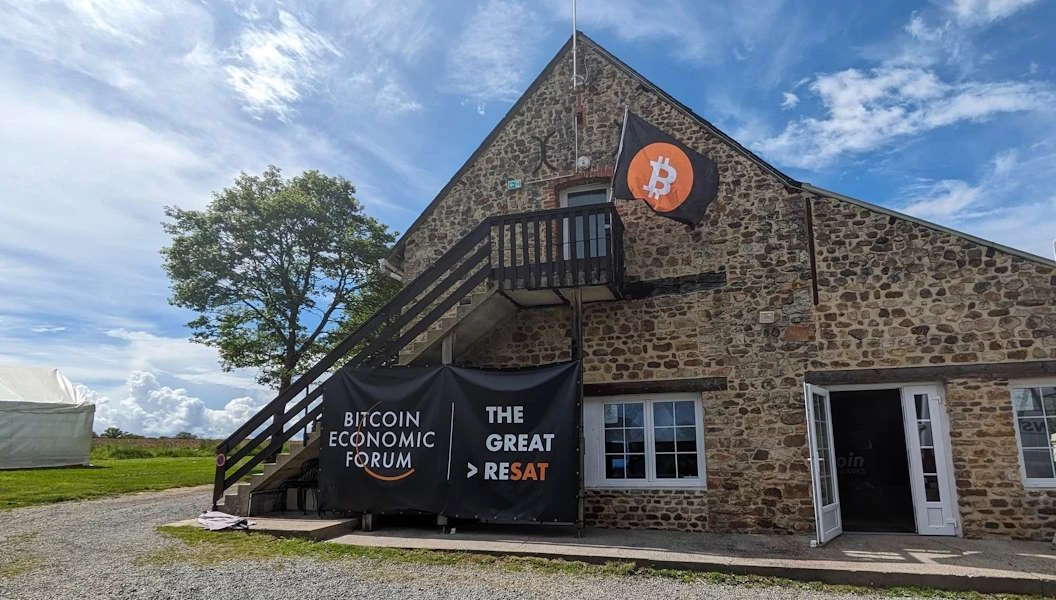
Of course, in other countries, the legislation and operation of associations are different. However, several points will be very helpful in creating an association or organizing an important event; and we hope that other bitcoiners will come and integrate this training specifically for their country.
Final Section
Reviews & Ratings
true
Conclusion
true