name: Biz School Previous Editions goal: learn the basics of Bitcoin, with particular focus on its economical rationale, historical context, social, financial and business implications. objectives:
- Master Bitcoin's economic principles and market impact.
- Explore Bitcoin-based business models and case histories.
- Cover the basics of Bitcoin tecnology from both theoretical and practical standpoints.
Welcome to the 2024 edition of the “Plan ₿ Biz School”, an annual Bitcoin centered educational program curated by Giacomo Zucco and Plan ₿ Network. With almost 102 hours of class spread across 34 lectures, this curriculum provides a comprehensive exploration of Bitcoin fundamentals and practical applications, specifically tailored for future startup entrepreneurs, business students and professionals willing to work in the growing Bitcoin ecosystem in non-technical roles: from finance to marketing, from accounting to operations, from compliance to strategy. The desired target spans from students looking into a first internship, to established professionals eager to apply their skills and knowledge in the new Bitcoin economy.
Our course features insights from world famous experts who contribute as guest lecturers, offering valuable perspectives on Bitcoin's principles and its potential impact on the global economy, beyond the hype and the buzzwords. From the theoretical understanding of the basis of the technology, to the practical exploration of tools, business cases and best practices, participants will gain a thorough understanding of this disruptive phenomenon, learning about its sociological roots, political implications, economic foundations, and business impact.
The 18 curricular lectures are in English, and were recorded from the Plan ₿ Hubs of Lugano (CH) and San Salvador (SV), while the 16 guest lectures were delivered thanks to the collaboration of the Plan ₿ Nodes, which include Turin (IT), Bangkok (TH), and Belgrade (RS). You will find all the video recordings of the 2024 edition, together with a brief text summary of what is explained by the lecturers.
We strongly invite you to also check the other half of the Plan ₿ Network educational offer, the “Plan ₿ Tech School” targeting engineers, cryptographers, computer scientists and tech focused students!
Teachers: Giacomo Zucco, Alekos Filini, Alexandre Bussutil, Rogzy, Riccardo Masutti, Marco Giorgetti, Gael Sánchez Smith, Alejandro Munoz, Ajelex, Mario Jose Flamento Riva, Adi Shankara
Guest Lecturers: Pierre Rochard, Obi Nwosu, Oleg Mikhalsk, Cathie Wood, Knut Svanholm, Allen Farrington, Jack Mallers, Elizabeth Stark, Yan Pritzker, Paolo Ardoino, Jan-Willem Burgers, Eric Yakes, Rockstardev, Stiven Kerestegian.
Note: this course is no longer available for purchase, and the 2025 BizSchool edition will be published soon. In the meantime, you can send an email to contact@planb.network to show your interest and be informed when it will be published.
School Introduction
School Introduction
Welcome to this introductory lecture on the Plan ₿ Biz School. In this session, Giacomo walks us through their journey from a traditional fiat job to becoming a leader in the Bitcoin space, and the exciting educational initiatives we will explore throughout this course.
Overview of the course
Giacomo begins by explaining how this school aims to provide a structured learning experience around Bitcoin. Starting with a background in fiat payments, the professor transitioned into the world of Bitcoin in 2013, founding several Bitcoin related ventures. Some failed, but those experiences shaped the educational approach you will benefit from in this course.
In this course, you will learn about various aspects of Bitcoin, including:
- Why Bitcoin matters
- The technical components of Bitcoin
- The cultural and business dimensions surrounding Bitcoin
Why Bitcoin?
Running a Bitcoin based business comes with its own challenges and opportunities. Sharing personal anecdotes about how abandoning blockchain buzzwords led to success in certain ventures and how important it is to deeply understand Bitcoin to avoid common pitfalls.
Education initiatives in Bitcoin
The Plan ₿ Network initiative, supported by Fulgur Ventures and Tether, is rooted in Lugano and focused on developing Bitcoin education globally. The Plan ₿ School offers comprehensive programs covering technical aspects of Bitcoin, its history, and the business side of running Bitcoin related ventures.
Conclusion
This lecture sets the stage for a deeper dive into Bitcoin's transformative potential. Stay tuned for upcoming lessons where we’ll cover a range of topics from technical skills to the broader Bitcoin ecosystem. To download this presentation slides, together with the ones belonging to the following lectures, please click here.
Why Bitcoin?
Discovery Of Money
Understanding money and Bitcoin: principles and perspectives
In this chapter, we will embark on a comprehensive exploration of the core concepts of money, beginning with its fundamental functions as recognized in classical economic theory: a store of value, medium of exchange, and unit of account. We will also delve into how these concepts align with Bitcoin and why it stands as a transformative force in modern economics. Drawing from Austrian Economics and the Cypherpunk ethos, we will assess the unique role Bitcoin plays in addressing the limitations of traditional money.
What is money?
Money, in its simplest form, is a tool used to facilitate trade and store wealth over time. It serves three primary functions:
- Store of Value: money must be able to retain value over time, allowing individuals to save and preserve wealth for future use.
- Medium of Exchange: money facilitates the exchange of goods and services by eliminating the inefficiencies of barter, such as the need for a "double coincidence of wants."
- Unit of Account: money provides a consistent measure of value, enabling individuals to compare the worth of goods and services.
Classical roots: Aristotle and the birth of monetary theory
Aristotle was one of the first to define these essential characteristics of money in ancient Greece. He recognized that, for something to function effectively as money, it must be durable, divisible, portable, and intrinsically valuable. This foundation set the stage for modern economic thought on money and its role in society.

Store of value: from gold to Bitcoin
Historically, gold has been the premier store of value due to its scarcity, durability, and intrinsic worth. Gold's limited supply ensures that it holds its value over time, even in the face of inflation or economic downturns.
- Gold as the Traditional Store of Value: gold has been used for centuries as a way to preserve wealth across generations. Its physical properties — scarcity, durability, and malleability — made it an ideal choice for this function.
- Bitcoin as Digital Gold: Bitcoin offers a modern equivalent to gold, with the added advantages of being digital and decentralized. Like gold, Bitcoin is scarce, with a capped supply of 21 million coins, making it an attractive asset for those seeking to hedge against inflation and monetary devaluation.
Why Bitcoin excels as a store of value
Bitcoin’s fixed supply means it is immune to the inflationary pressures that plague fiat currencies. Central banks, such as the Federal Reserve, can print an unlimited amount of money, thereby devaluing the currency over time. In contrast, Bitcoin’s decentralized nature ensures that no single entity can alter its supply. This scarcity, combined with its security and divisibility, positions Bitcoin as a superior store of value in the digital age.
- Comparison to Fiat Currencies: while fiat currencies like the US dollar or the Euro can lose purchasing power through inflation, Bitcoin’s fixed issuance schedule ensures long term scarcity, making it an ideal digital asset for preserving wealth.
Medium of exchange: overcoming the double coincidence of wants
In a barter system, trade is limited by the necessity for both parties to want what the other has — this is known as the "double coincidence of wants". Money solves this problem by acting as an intermediary, allowing individuals to trade freely without the need for a direct exchange of goods.
- Bitcoin as a Medium of Exchange: while Bitcoin is often criticized for its volatility, its use as a medium of exchange is growing, particularly in contexts where traditional financial systems are unreliable or overly restrictive. Bitcoin enables peer-to-peer transactions across borders without the need for a trusted intermediary, such as a bank or payment processor.
The role of technology in facilitating exchange
With the rise of Bitcoin and other cryptocurrencies, the way we think about money as a medium of exchange has evolved. Traditional financial systems rely on intermediaries—banks, payment processors, governments—to facilitate transactions. However, these intermediaries often add friction in the form of fees, delays, and censorship. Bitcoin’s decentralized protocol removes the need for intermediaries, making transactions faster, cheaper, and censorship-resistant.
- Examples of Bitcoin as a Medium of Exchange: in countries with hyperinflation or authoritarian governments, Bitcoin is increasingly being used as a medium of exchange, allowing individuals to store and transfer value without fear of government interference or currency devaluation.
Austrian economics and Bitcoin: a natural alignment
Bitcoin’s alignment with Austrian economic principles is one of its most compelling features. Austrian Economics, which emphasizes the importance of individual choice, free markets, and sound money, provides a theoretical framework that explains Bitcoin’s appeal as an alternative to government controlled fiat currencies.
Key figures in Austrian economics
- Carl Menger: the founder of Austrian Economics, Menger introduced the theory of marginal utility, which explains that the value of goods is not intrinsic but is determined by the subjective preferences of individuals. This concept is crucial to understanding why Bitcoin, like gold, is valuable despite being intangible.
- Ludwig von Mises: mises expanded on Menger’s work with his Mises Regression Theorem, which traces the origin of money back to commodities with intrinsic value. Bitcoin, as a digital commodity, fits neatly into this framework.
- Friedrich von Hayek: hayek’s advocacy for the denationalization of money laid the intellectual groundwork for Bitcoin. He believed that money should be separated from government control to prevent inflation and preserve individual liberty.

Marginal utility and Bitcoin
The concept of marginal utility helps explain why Bitcoin is valuable despite its digital nature. Marginal utility suggests that the value of an additional unit of a good decreases as the supply of that good itself increases. Since Bitcoin has a finite supply, its marginal utility remains high, especially as more people adopt it.
Cypherpunk ideals: privacy, decentralization, and control resistance
Bitcoin is not just a product of economic theories — it is also a direct response to the ideals of the Cypherpunk movement. This movement, which emerged in the early 1990s, sought to protect individual privacy and freedom in an increasingly digital world. The Cypherpunks believed that cryptography could be a powerful tool to resist surveillance and censorship by governments and corporations.
- Founders of the Cypherpunk Movement: key figures such as Eric Hughes, Timothy May, and John Gilmore pioneered the use of cryptography to create secure, private systems for communication and commerce. Bitcoin embodies these ideals by allowing individuals to transact without revealing their identities and without relying on centralized authorities.
- Bitcoin and Decentralization: Bitcoin’s decentralized nature ensures that no single entity can control the network. This makes it resistant to censorship and manipulation, aligning with the Cypherpunk vision of a free and open internet.
Privacy as a core principle
The importance of privacy in the Bitcoin network cannot be overstated. In traditional financial systems, transactions are monitored and controlled by central authorities, which can block or reverse payments. Bitcoin, by contrast, allows for pseudonymous transactions, meaning that while all transactions are recorded on the public blockchain, users’ identities are not directly tied to their Bitcoin addresses.
- Bitcoin’s Role in Financial Sovereignty: by allowing individuals to store and transfer value without the need for a bank or government, Bitcoin provides financial sovereignty to those who may not have access to traditional financial services.

Unit of account: a new measure of value
A unit of account is a standard by which the value of goods and services can be measured. Historically, fiat currencies have served this function, providing a stable reference point for pricing goods and services. However, Bitcoin’s growing adoption and the increasing use of Bitcoin-denominated assets suggest that it may eventually serve as a global unit of account.
- The Potential for Bitcoin as a Unit of Account: although Bitcoin’s volatility currently prevents it from being widely used as a unit of account, some economists argue that as adoption increases and volatility decreases, Bitcoin could one day replace fiat currencies as the primary measure of value.
Conclusion
In this chapter, we have explored the evolution of money, from its classical functions to its modern incarnation in the form of Bitcoin. By serving as a store of value, medium of exchange, and a potential unit of account, Bitcoin represents a fundamental shift in how we think about and use money. Rooted in Austrian Economics and inspired by the Cypherpunk ethos, Bitcoin offers a decentralized, secure, and censorship-resistant alternative to traditional financial systems. As we continue to explore the world of Bitcoin, it becomes clear that its impact on economics, privacy, and individual freedom is just beginning to unfold.
Corruption Of Money
Introduction to the corruption of money
The journey of money has evolved from physical exchanges, like gold and silver, to the digital world of fiat and cryptocurrencies. However, this evolution has faced several challenges. In this chapter, we will explore the historical patterns of the corruption of money, how legal tenders have exacerbated these problems, and how Bitcoin offers a potential solution to these long-standing issues. We will break this discussion into three sections: the evolution of money, the challenges of verification and trust, and the role of Bitcoin in combating monetary corruption.

The evolution of money: from commodity to fiat
From barter to commodity money
Early civilizations struggled with the inefficiencies of barter, leading to the adoption of commodity money like gold and silver. These metals were chosen for their intrinsic value, durability, and divisibility. Over time, the need for more efficient means of trade gave rise to coinage, where trusted authorities minted coins to standardize the value of these commodities.
- Coinage and Verification: coinage introduced the concept of delegated verification. Rather than individuals needing to verify the purity and weight of gold themselves, trusted entities like temples and governments would stamp coins to certify their authenticity.

Paper money and the emergence of fiat
As economies grew, carrying large quantities of gold or silver became impractical. This led to the development of paper money and banknotes, which initially represented a claim on stored commodities. Over time, however, governments began issuing paper money without any commodity backing, giving rise to fiat currencies. Fiat money derives its value solely from government decree rather than any intrinsic value.
- Fiat and Legal Tender: the transition to fiat money was accompanied by legal tender laws, which forced citizens to accept government issued money for transactions. This created a system where governments could print money at will, leading to inflation and the erosion of the currency’s value.
The role of trust and verification in monetary systems
Delegated verification: a historical perspective
Throughout history, the authenticity of money has always required verification. In ancient times, this was done by weighing and assessing the purity of metals. As the monetary system evolved, trust shifted from the individual to institutions. For example, goldsmiths and religious institutions began issuing certificates that represented claims on gold, which could be redeemed later.
- The Problem of Trust: with fiat money, trust shifted entirely to governments and central banks, raising concerns about their ability to manage the money supply responsibly. In fact, the risks of fractional reserve banking and inflation have become more pronounced as the power to create money is concentrated in fewer hands.
The erosion of trust
As governments expanded their control over monetary systems, they began to engage in practices like seigniorage — the profit made by issuing currency at a higher value than the cost of producing it. Over time, these practices have led to the debasement of currency, where the actual value of money decreases, yet the nominal value remains unchanged.
- Fractional Reserve Banking: banks, in a bid to increase liquidity, began practicing fractional reserve banking, meaning they lent out more money than they actually held in reserves. This system has allowed banks to create money, but it also introduced systemic risks that can lead to insolvency during financial crises.

The emergence of Bitcoin: a response to monetary corruption
Bitcoin’s decentralized framework
Bitcoin was conceived as a decentralized alternative to traditional fiat currencies. By using a distributed ledger known as the blockchain, Bitcoin eliminates the need for trusted intermediaries like banks or governments to verify transactions. Instead, a network of nodes validates and records each transaction, ensuring transparency and security.
- Trustless Verification: unlike traditional monetary systems, Bitcoin does not require trust in a central authority. The blockchain allows individuals to verify transactions themselves, removing the need for delegated verification.
Bitcoin as a store of value and hedge against inflation
One of Bitcoin’s most significant advantages is its fixed supply of 21 million coins. This scarcity makes it a deflationary asset, contrasting sharply with fiat currencies that can be printed in unlimited quantities. As governments continue to print money, leading to inflation, Bitcoin’s value is likely to appreciate over time, providing a reliable store of value.
- De-virtualization of Money: while fiat currencies are increasingly detached from physical assets, Bitcoin represents a return to sound money principles. It operates as a form of "digital gold," offering a way to store wealth without the risk of devaluation through inflation.
Conclusion: Bitcoin and the future of money
The corruption of money through inflation, seigniorage, and fractional reserve banking has eroded trust in traditional monetary systems. Bitcoin, by contrast, offers a decentralized, transparent, and secure alternative that addresses many of the issues plaguing fiat currencies. As we continue to explore the world of Bitcoin and decentralized finance, it becomes clear that Bitcoin is not just another form of money, but it represents a fundamental shift in how we think about and use money in the modern world.
How Bitcoin? (Theoretical)
Before Satoshi
The evolution of cryptography and its role in Bitcoin
In this chapter, we will trace the foundations that led to the creation of Bitcoin. Before Satoshi Nakamoto’s whitepaper, a series of technological inventions and concepts laid the groundwork for its creation, especially those related to cryptography, digital signatures, and decentralized systems. Thus, we will explore the history and key cryptographic principles that helped make Bitcoin possible.
Cryptographic foundations
Bitcoin relies on cryptography for security, trustlessness, and decentralization. Two key types of cryptography have been essential:
- Symmetric cryptography: this system uses the same key for encryption and decryption, requiring a secure channel for exchanging keys. Though effective, symmetric cryptography has limitations, especially when secure communication channels are not possible.
- Asymmetric cryptography (public key cryptography): introduced in the 1970s, this system allows users to have a pair of keys—a public key for encrypting data and a private key for decrypting it. This breakthrough removed the need for secure channels to share encryption keys, making it possible to communicate securely over public channels.
Bitcoin makes extensive use of Elliptic Curve Digital Signature Algorithm (ECDSA), a form of asymmetric cryptography where users generate a public and private key pair. The public key is shared openly, but the private key must remain secret. These keys are critical for verifying and signing Bitcoin transactions.

Hash functions: the backbone of Bitcoin's security
A hash function takes an input (or message) and returns a fixed length string of characters, which is typically a hash value. This way, even the smallest change in the input drastically changes the hash output, making it nearly impossible to reverse engineer the input from the output. Hash functions are integral to Bitcoin’s proof-of-work system and ensure the integrity of the blockchain.
Bitcoin uses SHA-256, a highly secure hash function developed by the NSA which has two critical properties:
- Preimage resistance: given a hash, it is computationally infeasible to determine the input.
- Second preimage resistance: it is nearly impossible to find two different inputs that produce the same hash output.

Proof-of-work: solving the double spending problem
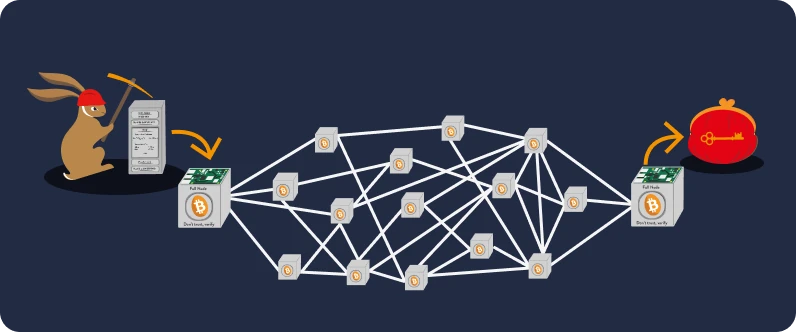
Before Bitcoin, digital money had long struggled with the double spending problem, where the same digital token could be spent more than once. Bitcoin’s innovation was the introduction of proof-of-work (PoW), a system that requires participants to solve complex computational puzzles to validate transactions and add new blocks to the blockchain.
Proof-of-work ensures the security of the Bitcoin network by requiring miners to expend energy (via computational resources) to solve a hash puzzle. This solution deters malicious actors from manipulating the blockchain because altering any part of the chain would require recalculating the proof-of-work for all the subsequent blocks — a computationally impossible feat.
The cypherpunk movement: privacy, decentralization, and Bitcoin’s ideals
The cypherpunk movement, which emerged in the 1990s, mastered the use of cryptography to enhance privacy, resist censorship, and enable decentralized systems. Founders like Timothy May, Eric Hughes, and Nick Szabo were instrumental in shaping the ideals that would later influence Bitcoin’s creation.
One of the earliest attempts to create digital cash was Hashcash, developed by Adam Back. Hashcash was initially designed to prevent email spam by requiring proof-of-work to send messages. Although it wasn’t widely adopted for its original purpose, the idea of proof-of-work was later adapted by Bitcoin to secure transactions.
Reusable proof-of-work and the move towards decentralized digital money
The concept of reusable proof-of-work (RPoW), introduced by Hal Finney, was another step toward digital money. Finney’s system allowed proof-of-work tokens to be transferred from one person to another, mimicking the properties of cash. However, the system relied on a central server to verify transactions, which posed limitations in terms of decentralization.
Bitcoin solved this matter by eliminating the need for a trusted central authority. It combined Finney’s idea of reusable proof-of-work with a decentralized ledger (the blockchain), where all participants in the network independently verify transactions.

Smart contracts: expanding Bitcoin’s use cases
Another key precursor to Bitcoin was Nick Szabo’s concept of smart contracts: self-executing contracts with the terms of the agreement directly written into code. Smart contracts enhance the functionality of decentralized systems by enabling complex transactions, such as multi-signature accounts or escrow services, without needing intermediaries.
Szabo also proposed Bit Gold, a decentralized currency system based on proof-of-work. While Bit Gold was never implemented, it provided much of the conceptual framework for Bitcoin.
Conclusion: laying the foundation for Bitcoin
Before Satoshi Nakamoto, technologies like cryptographic signatures, proof-of-work, and smart contracts were all explored by cypherpunks and cryptographers. These concepts laid the groundwork for the invention of Bitcoin in 2009, providing the technological and philosophical foundation that has since transformed how we view money and decentralized systems.
After Satoshi
The impact of Bitcoin post Satoshi
After Satoshi Nakamoto’s groundbreaking release of Bitcoin in 2008, the cryptocurrency world evolved rapidly, with significant technological advancements and broader implications for decentralized digital currencies. In this chapter, we will explore the foundations laid by Bitcoin, the technological innovations it introduced, and the key challenges and solutions that have emerged since its inception. The "After Satoshi" era delves deep into the mechanics that ensure Bitcoin’s trustless security and how it handles challenges like scalability, privacy, and consensus.

The theoretical framework of Bitcoin
Bitcoin revolutionized the concept of decentralized finance by introducing a system that allows peer-to-peer transactions without intermediaries like banks or governments. Satoshi Nakamoto’s whitepaper introduced the framework for a system that solved the double spending problem while creating digital scarcity through proof-of-work. This section will revisit and expand on the core principles that underpin Bitcoin’s mechanics.
Time chain vs. blockchain
Contrary to modern terminology, Satoshi Nakamoto never referred to the system as a "blockchain" but rather as a "proof-of-work chain" or "chain of blocks." Even in his early code, Satoshi used the term time chain to refer to Bitcoin’s way of organizing transactions chronologically. This time based ordering is critical for ensuring the immutability of Bitcoin’s ledger and preventing double spending.
- Proof-of-Work Chain: proof-of-work ensures that transactions are verified by requiring nodes to solve complex computational problems. The solution ties the time chain, securing Bitcoin’s transaction history and making it resistant to tampering.

The global consensus mechanism
One of Bitcoin’s key innovations is its global consensus mechanism, which prevents Sybil attacks and ensures that all participants in the network agree on the order and validity of transactions. Unlike earlier systems that relied on centralized servers to verify transactions (e.g., reusable proof-of-work), Bitcoin uses a decentralized global network to validate each transaction through majority consensus.
Proof-of-work and sybil resistance
Bitcoin proof-of-work mechanism prevents Sybil attacks, where malicious actors create multiple fake identities (or nodes) to control the network. Since proof-of-work requires real computational effort, it ensures that only those who expend resources (electricity, computational power) can influence the voting process. As a result, it becomes economically impractical for an attacker to take over the network.
- 51% Attack: in a 51% attack, an aggressor would need to control more than half of the network’s computational power to manipulate the blockchain. The cost of acquiring and maintaining this amount of computing power makes such attacks nearly impossible under normal circumstances.
Global voting for double spending protection
In earlier attempts at digital currencies, double spending — where the same digital asset is spent more than once — was a persistent problem. Bitcoin solves this through a decentralized global voting system. All network participants (nodes) must agree on the validity of transactions, making it impossible for any single party to spend the same Bitcoin twice without detection.

Scalability and the challenge of growth
As Bitcoin’s network expands, so do its challenges too, particularly regarding scalability. In fact, each node in the Bitcoin network must store the entire transaction history, which grows, as more users join and transactions accumulate.
The scalability problem
Bitcoin’s decentralized structure requires that every participant in the network stores a copy of the Unspent Transaction Output (UTXO) set, a record of all unspent Bitcoins. As the network grows, the amount of data each node must store increases, leading to concerns about centralization (where only large, resource-rich participants can afford to run nodes).
- Layered Solutions: to address these issues, Bitcoin has embraced layered solutions like Lightning Network, which allows for fast, off chain transactions that don’t burden the main blockchain with additional data. Off chain solutions help reduce congestion on the primary blockchain while maintaining its decentralized principles.
Privacy concerns in a global consensus system
While Bitcoin offers pseudonymity, where public keys are not directly tied to real world identities, the permanence of the blockchain poses privacy risks. Every transaction is recorded forever, which allows for the potential de-anonymization of users through public key analysis. Privacy solutions, such as coin mixing or privacy coins like Monero and Zcash, have attempted to mitigate these risks, though they come with their own challenges.
Second layer solutions and the future of Bitcoin
As Bitcoin continues to grow, second layer solutions like Lightning Network and sidechains have emerged to enhance scalability and privacy while preserving the integrity of the core network. These layers enable faster transactions, lower fees, and more flexible use cases, all while maintaining Bitcoin’s decentralized ethos.

- Lightning Network: a second layer protocol that allows users to conduct transactions off chain, significantly reducing the load on the main Bitcoin blockchain. Transactions are settled off chain and only recorded on the main chain when necessary, enhancing scalability.
- Sidechains: separate blockchains that run alongside Bitcoin, allowing for experimentation with new features and functions without compromising the main blockchain's security.
Conclusion: Bitcoin’s evolution after Satoshi
The period after Satoshi Nakamoto’s disappearance saw rapid developments in the Bitcoin ecosystem, driven by technological innovations that addressed its limitations. Proof-of-work remains a cornerstone of Bitcoin’s security, ensuring the network’s resistance to Sybil attacks and double spending, but scalability, privacy, and decentralization remain ongoing challenges. Through layered solutions like the Lightning Network, Bitcoin is evolving to meet these demands while staying true to Satoshi’s original vision of a decentralized, trustless monetary system.
How Bitcoin? (Practical)
Basic
Let’s begin this session by exploring the foundational aspects of Bitcoin.
Essential Bitcoin knowledge and key management
In the rapidly evolving world of Bitcoin, understanding key concepts such as private keys and addresses is fundamental. These components are the cornerstone of Bitcoin ownership and transaction management, ensuring secure and verifiable exchanges of value.
- Private Keys: private keys are secret cryptographic materials that are crucial for Bitcoin ownership. They are large, hard to guess numbers, enabling the creation of the cryptographic signatures that are necessary for transaction authentication. Generating private keys requires high quality entropy to ensure security, so it's important to avoid biased random generators, which can create keys that are vulnerable to attacks. Historical incidents underscore the importance of proper entropy management like those examples.
The blockchain.info wallet weak rng issue (2013-2014)
- Blockchain.info, a popular Bitcoin wallet at the time, had a flaw in its random number generator (RNG) when generating private keys in browser-based wallets. The bug caused the wallet to sometimes generate weak keys with low entropy, making them predictable.
- Hackers exploited this weakness, brute forcing the private keys and stealing funds from affected wallets.
- This incident highlighted the importance of secure entropy sources when generating private keys, ensuring they cannot be easily guessed or reproduced.
Android securerandom bug (2013)
A flaw in the Android SecureRandom function used in Bitcoin wallets resulted in weak cryptographic signatures (nonces) when signing transactions.
This bug led to the compromise of private keys in wallets like Bitcoin Wallet, Mycelium, and others, allowing attackers to recover private keys from signatures and steal Bitcoin.
The issue was fixed, but it demonstrated how poor entropy in random number generation could compromise Bitcoin security.
Key Generation: use reputable, Open Source software for generating Bitcoin keys, ensuring high quality entropy. For those who are particularly concerned about entropy, methods like throwing dice can offer additional security, albeit with complexity.
Key Backup: always back up your keys to prevent loss due to device failure. Physical methods like paper or steel plaques are recommended, as digital backups can be vulnerable to hacking and are difficult to erase.
Security Precautions: avoid storing keys on digital media such as smartphone apps or computers, which are prone to unauthorized access. Use well-known, reputable software for key management, ensuring that backups are resistant to physical damage and security breaches.
These foundational practices are critical to securing your Bitcoin assets and ensuring safe transaction management, protecting against loss, theft, or accidental damage.
Advanced Bitcoin wallets and transaction optimization
As we advance to more complex topics, understanding Bitcoin wallets and optimizing transaction strategies becomes essential, especially for those aiming to improve efficiency and scalability in their Bitcoin usage.
BIP32 Basics: this standard allows to starts from a master seed to create a hierarchical tree structure of keys, allowing for unlimited depth in key generation. BIP32 is particularly useful for businesses that need segmented wallets for different clients without generating new keys each time.
Transaction Optimization: optimizing Bitcoin transactions involves strategies like batching to reduce fees and prioritizing transactions based on the fee per byte. Tools such as Partially Signed Bitcoin Transactions (PSBT) facilitate secure transaction transfers between different wallet applications, enhancing interoperability.
UTXO Management: unspent Transaction Outputs (UTXOs) are critical to transaction management. Avoid creating dust UTXOs, as they may cost more in fees than their value. Use wallets that minimize UTXO fragmentation and consider full UTXO usage when transferring funds to an exchange to avoid creating change.
Mastering these advanced aspects of Bitcoin wallet management and transaction optimization will not only enhance security but also improve the efficiency of your Bitcoin operations, allowing for more sophisticated use of digital assets.
Security practices and privacy considerations in Bitcoin usage
When using Bitcoin, both security and privacy are paramount, due to its decentralized and pseudonymous nature. Protecting your funds and personal data from potential risks requires a deep understanding of the following practices.
Security practices
To mitigate the risk of losing Bitcoin due to private key exposure, advanced security strategies like Shamir Secret Sharing and multi-signature setups can be employed. These methods distribute the control of private keys among multiple trusted parties, preventing a single point of failure. Hardware wallets also offer robust security through offline key storage, although users must carefully consider the potential risks related to the trustworthiness of the hardware vendor.
Privacy considerations
Using third party blockchain explorers or services can compromise privacy, as these services may collect identifiable user data. To mitigate this, running a personal Bitcoin node or using privacy enhancing tools such as Tor can anonymize your IP address, reducing the chances of your identity being linked to your Bitcoin transactions.
Wallet types
Bitcoin users must choose between two main types of wallets: software wallets (hot wallets), which offer greater convenience but are more vulnerable to hacking, and hardware wallets, which are more secure as they store private keys offline. Balancing security and convenience is crucial, depending on your specific threat model and how frequently you need to access your Bitcoin.
Advanced features
For those dealing with high value transactions or more complex business needs, advanced features like Miniscript (a simplified scripting language) and time locks can add layers of security and control over how and when Bitcoin transactions are executed. These tools are invaluable for establishing complex spending policies without sacrificing security.
By adhering to these security and privacy best practices, you can better safeguard your Bitcoin holdings and ensure that your transactions remain both secure and private, reducing the risk of unauthorized access or data breaches.
Conclusion
This concludes the lecture on Bitcoin’s essential knowledge, key management, wallets, and security practices. In the next one, we will move into more technical aspects, such as running a Bitcoin node and connecting wallets to the network. Feel free to share your thoughts or ask any questions, as we aim to build your understanding progressively through each step of this series. Thank you for your participation, and we look forward to continuing this journey together.
Intermediate
Lecture on Bitcoin node setup and multisig configuration
Welcome to today's comprehensive lecture on setting up a Bitcoin node and configuring multisig wallets. Led by Alekos Filini, this session is designed to provide a hands on experience, guiding participants through the practical steps of creating a Bitcoin Core node and integrating it with a multisig wallet using Specter. This interactive session aims to blend theoretical concepts with live demonstrations, offering participants the opportunity to engage directly with the material.
We invite you to follow carefully the video of our lecturer to successfully complete the installation.
content overview
This lecture is structured to provide a complete walkthrough of setting up a Bitcoin Core node and utilizing it with a multisig wallet configuration, and it is divided into several key components:
- Bitcoin Core Node Setup: this section covers the installation and configuration of a Bitcoin Core node from scratch, emphasizing manual setup to ensure a thorough understanding.
- Integration with Specter Wallet: after establishing the node, the focus shifts to installing and configuring Specter, a desktop wallet that supports multisig options. This process includes best practices for security measures like signature verification and hash validation, crucial for maintaining network integrity.
practical setup of a Bitcoin core node
To ensure participants gain real world experience, the practical segment simulates a Bitcoin node setup in a Linux environment, using a virtual machine that mimics setups like Raspberry Pi or dedicated Linux hardware. Here's a breakdown of the process:
linux command essentials
Understanding basic Linux commands is foundational for managing a Bitcoin node. This section introduces participants to:
- File and Directory Management: using commands like
cd(change directory),ls(list files),mkdir(make directory),cp(copy files), andmv(move files) to navigate and organize the Linux environment. - Administrative Tasks: commands such as
sudo(superuser do) for executing administrative tasks, essential for managing permissions and system configurations. - Advanced Operations: in depth commands for user creation,
ownership adjustments, and file handling, including
useradd(add user),chown(change ownership),tar(archive files),wget(download files),GPG(GNU Privacy Guard for cryptographic verification), andSHA-256 SUM(checksum verification).
node configuration and setup
Participants will manually configure their Bitcoin Core node, walking through these critical steps:
- User and Directory Setup: create a dedicated user for running the Bitcoin node, isolating it from other system processes for added security.
- Data Directory Preparation: set up the Bitcoin Core’s data directory, organizing it for optimal performance and future expansion.
- Downloading and Verification: securely download Bitcoin Core from the official website and verify its authenticity using cryptographic tools like GPG and SHA-256, ensuring the integrity of the installation package.
- Configuration Adjustments: modify the Bitcoin Core configuration file to set up RPC (Remote Procedure Call) authentication, adjust network settings, and define node behavior. These configurations ensure the node operates securely and aligns with best practices.
- System Service Setup: configure Bitcoin Core to run as a system service, enabling it to start automatically on boot and ensuring continuous uptime.
integrating wallets and multisig configuration with specter
Once the Bitcoin Core node is operational, participants will proceed to connect it with a secure wallet setup using Specter, focusing on multisig configurations:
wallet setup and security measures
- Specter Installation: download and install Specter Desktop, ensuring it connects seamlessly with the Bitcoin Core node. This software acts as an interface for managing keys, addresses, and transactions.
- Hardware Wallet Integration: participants will learn to link hardware wallets (e.g., Jade) with Specter, creating a secure environment for managing private keys. This integration adds an essential layer of security, ensuring sensitive data remains protected.
- Public Key Management: properly manage and export public keys to facilitate multisig operations, understanding how they contribute to overall wallet security.
creating and managing multisig wallets
The multisig setup is a critical part of the session, emphasizing the importance of multiple signatures for transaction authorization. Here below is what participants will do:
- Generate Multisig Addresses: learn how to create multisig addresses, setting up wallets that require multiple private keys for transaction approval.
- Security Best Practices: back up configuration data, store keys securely, and implement procedures for data recovery in the case of loss. This segment highlights the importance of redundancy and secure backup in Bitcoin operations.
- Transaction Creation and Verification: explore how to create, sign, and verify multisig transactions using Specter, ensuring accuracy and compliance with Bitcoin’s decentralized principles.
advanced practical activities
To reinforce the session's concepts, participants will engage in advanced group exercises that simulate real world scenarios. These activities will test their understanding of node management, multisig wallet configurations, and transaction security.
Collaborative exercises
- Group Work with “Elephant” Tool: in teams, participants will use the web based "Elephant" tool to create and manage complex multisig setups. This exercise aims to enhance their grasp of Bitcoin scripting capabilities and how advanced spending policies can be enforced.
- Multisig Transactions and Recovery: each group will simulate a scenario involving the creation of multisig wallets, validation of transactions, and the recovery process if a key is lost. These activities emphasize teamwork and effective communication, mirroring professional Bitcoin operations.
troubleshooting and optimization
Participants will face common challenges encountered during node setup and multisig configuration. This troubleshooting segment focuses on practical solutions, teaching participants to resolve connectivity issues, transaction errors, and data synchronization problems efficiently.
conclusion
By the end of the lecture, participants will have a comprehensive understanding of Bitcoin's infrastructure, from setting up a node to managing multisig wallets. They will leave with practical experience, capable of operating within Bitcoin’s ecosystem securely and confidently. This hands on knowledge not only demystifies Bitcoin technology but also empowers students to participate actively in the world of decentralized finance.
This session is designed to be both instructional and interactive, with ample opportunities for hands on practice, group collaboration, and in depth exploration of Bitcoin's capabilities. Participants are encouraged to continue experimenting with the tools and techniques covered in the session, both independently and in collaborative environments, to solidify their skills and contribute to the broader Bitcoin community.
Bitcoin Myths Debunked
Bitcoin "Maximalism"
Lugano, Switzerland dac3b166-31ef-41f3-bfef-6e9d3855c12c
Introduction to Bitcoin maximalism
Bitcoin Maximalism is more than a simple preference for Bitcoin over other cryptocurrencies — it is an ideology grounded in the belief that Bitcoin is the only cryptocurrency that truly matters. Maximalists see Bitcoin as superior due to its decentralized structure, its fixed supply of 21 million coins, and its unique ability to act as a hedge against inflation. This chapter delves into the historical, cultural, and economic factors that have shaped Bitcoin Maximalism, and explores why its proponents believe that Bitcoin is the best, and perhaps the only, viable long term cryptocurrency.
The origins and growth of Bitcoin maximalism
The term Bitcoin Maximalism originated outside the Bitcoin community as a way to describe what outsiders perceived as an overly zealous focus on Bitcoin. However, over time, the term was embraced by the Bitcoin community itself. Central to this ideology is the belief that Bitcoin's decentralization, immutability, and scarcity make it fundamentally different from — and superior to — all other cryptocurrencies.
Bitcoin's mathematical scarcity (with a cap of 21 million coins) makes it a unique digital asset, setting it apart from fiat currencies, which can be printed at will, and from altcoins, which can be created infinitely. This scarcity makes Bitcoin the only truly sound money in the cryptocurrency space}.

Cultural and social significance
Bitcoin Maximalism is rooted in more than just technology. It is tied to a broader cultural skepticism of centralized authority and a belief in the importance of individual sovereignty. Many Bitcoin maximalists are staunch advocates of financial privacy, decentralization, and self-sovereignty. They see Bitcoin as the ultimate tool for empowering individuals by giving them control over their own wealth, free from the influence of governments and banks.
Criticism of altcoins
A key aspect of Bitcoin Maximalism is its rejection of altcoins, which are often referred to derisively as shitcoins. This derogatory term stems from the belief that altcoins are either unnecessary clones of Bitcoin or outright scams designed to enrich their creators at the expense of users. Maximalists argue that any innovation purportedly brought by altcoins can be better implemented on Bitcoin’s existing infrastructure without the need for a separate token.

Historical parallels: the protocol wars
The Protocol Wars of the 1970s to 1990s — debates over the best communication protocol for the Internet — offer a striking parallel to the current competition between Bitcoin and altcoins. Just as the TCP/IP protocol eventually emerged as the dominant standard for the Internet, Bitcoin maximalists believe that Bitcoin will be the dominant protocol for decentralized money.
During the Protocol Wars, competing models like the OSI (Open Systems Interconnection) were bureaucratic and inefficient, while TCP/IP was simpler, more adaptable, and decentralized. In the same way, maximalists argue that Bitcoin's simplicity and decentralization will make it the ultimate standard, while altcoins will fade into obscurity as inefficient, over engineered alternatives.
Bitcoin as the dominant protocol
Bitcoin is seen as not just another cryptocurrency but as the base layer for a new global financial system. Maximalists believe that Bitcoin's first mover advantage, network effects, and hard cap of 21 million coins give it a near insurmountable lead over other cryptocurrencies. Altcoins, in contrast, are seen as redundant at best and fraudulent at worst, with most serving no real purpose other than speculative profit for their creators.
Network effects and the future of money
The power of network effects is crucial to understand Bitcoin's dominance. In fact, as more people use Bitcoin, its utility increases, making it more valuable and reinforcing its position as the dominant cryptocurrency. This trend mirrors the adoption of TCP/IP during the early days of the Internet. Once a network achieves critical mass, it becomes nearly impossible for competitors to displace it without offering a dramatically better alternative. Bitcoin maximalists argue that no altcoin has offered improvements significant enough to challenge Bitcoin’s dominance:contentReference[oaicite:6]{index=6}:contentReference[oaicite:7]{index=7}.
Philosophical underpinnings
Maximalists also emphasize the philosophical purity of Bitcoin’s creation. Bitcoin was launched without any pre-mined tokens or initial coin offerings (ICOs), meaning that its creator, Satoshi Nakamoto, had no financial incentive other than building a decentralized monetary system. In contrast, many altcoins usually are launched with pre-mines or ICOs, enriching their founders and early investors, which corrupts the purpose of a decentralized currency, as maximalists argue.:contentReference[oaicite:8]{index=8}:contentReference[oaicite:9]{index=9}.

Conclusion: why Bitcoin alone matters
Bitcoin Maximalism is based on the belief that Bitcoin, with its decentralized, immutable, and scarce nature, is the only cryptocurrency capable of truly revolutionizing the global financial system. Other cryptocurrencies, according to maximalists, distract from the Bitcoin mission by creating confusion and diluting the principles of sound, decentralized money. For maximalists, Bitcoin is not just the best cryptocurrency — it is the only one that matters:contentReference[oaicite:10]{index=10}.
Bitcoin Criticisms
Introduction to the criticism of Bitcoin
Bitcoin has faced a wide range of criticism over the years, ranging from its environmental impact to its use in criminal activities. In this chapter, we delve into the most common critiques leveled against Bitcoin, addressing their validity and exploring the counterarguments often made by Bitcoin proponents. These types of criticism are important to understand, as they reveal the external challenges and misconceptions Bitcoin faces on its journey to widespread adoption.
Environmental criticism: pollution and energy usage
One of the most common criticism of Bitcoin is its energy consumption. Bitcoin mining, the process by which new coins are created and transactions are validated, uses substantial computational power, which in turn consumes large amounts of electricity. Critics argue that this contributes to global pollution, especially when the energy used comes from non-renewable sources.
Energy consumption in perspective
To fully assess the environmental impact of Bitcoin, it is crucial to understand that energy consumption is not inherently bad. Bitcoin actually uses less than 1% of the world's energy extraction, and much of the energy consumed is renewable or otherwise wasted energy. In fact, Bitcoin miners often utilize energy sources that would otherwise go unused, such as stranded or flared natural gas. This feature makes Bitcoin's energy consumption more efficient than critics suggest:contentReference[oaicite:0]{index=0}:contentReference[oaicite:1]{index=1}.

Bitcoin's consumption must also be compared to the energy use of traditional financial systems. The banking sector, with its extensive infrastructure, ATMs, branches, and data centers, uses far more energy. Furthermore, the U.S. military, which underpins the global financial system, is one of the largest consumers of fossil fuels on the planet. In comparison, Bitcoin offers a far more efficient alternative for securing and transferring wealth:contentReference[oaicite:2]{index=2}:contentReference[oaicite:3]{index=3}.
Crime and illicit activity
Another major criticism of Bitcoin is its association with criminal activities. Since Bitcoin transactions offer a degree of pseudonymity, critics claim that it is used for money laundering, drug trade, and even terrorism financing.
The reality of Bitcoin and crime
While it is true that Bitcoin has been used in illegal transactions, its traceability actually makes it less ideal for criminal enterprises. In fact, every Bitcoin transaction is recorded on the blockchain, a public ledger that allows for the tracking of funds, and law enforcement agencies have successfully traced and seized illicit Bitcoin in numerous cases, debunking the myth that Bitcoin is untraceable:contentReference[oaicite:4]{index=4}.
In contrast, traditional fiat currencies like the U.S. dollar remain the most widely used for large scale crime. Cash transactions, in particular, are anonymous and nearly impossible to trace. Bitcoin, by comparison, can reduce crime through smart contracts and multi-signature transactions, which require multiple parties to approve a transaction, thus offering more security:contentReference[oaicite:5]{index=5}.

Technical shortcomings and scalability
Bitcoin also faces technical challenges, particularly around scalability and transaction throughput. The Bitcoin network can only process a limited number of transactions per second, which some critics claim is insufficient for a global currency. Moreover, transaction fees can increase during times of high network usage, further limiting Bitcoin’s scalability as a medium of exchange.
Layered solutions to scalability
To address these issues, Bitcoin developers have proposed and implemented second layer solutions such as the Lightning Network. Lightning Network allows transactions to be conducted off chain, reducing the load on the main Bitcoin blockchain while enabling faster and cheaper transactions. By utilizing these second layers, Bitcoin can maintain its security while vastly improving scalability:contentReference[oaicite:6]{index=6}:contentReference[oaicite:7]{index=7}.

Cultural criticism: toxicity and exclusivity
Bitcoin’s culture has also been a target of criticism. Some describe the Bitcoin community as toxic due to its often harsh and direct communication style. This stems from Bitcoin’s roots in the cypherpunk movement, which prioritized privacy, security, and ideological purity over widespread adoption. The term "toxic maximalism" is often used to describe Bitcoiners who reject all other cryptocurrencies and aggressively defend Bitcoin's principles.
Embracing criticism for progress
While the toxicity criticism is valid in some respects, the blunt nature of Bitcoin debates stems from the desire to protect Bitcoin’s fundamental principles. In the Open Source community, rigorous scrutiny and direct communication are seen as essential for ensuring the integrity of the project. Many in the Bitcoin community believe that this cultural characteristic is what keeps Bitcoin free from dilution by corporate or governmental interests:contentReference[oaicite:8]{index=8}:contentReference[oaicite:9]{index=9}.
Conclusion: understanding Bitcoin's criticism
Bitcoin faces a broad range of criticism, but many of them are based on misunderstandings or misinterpretations of the technology. Whether it's energy consumption, criminal activity, or scalability, Bitcoin’s critics often overlook the solutions being developed to address these concerns. By acknowledging and addressing these criticisms, the Bitcoin community can continue to improve and evolve the technology, ensuring its place in the future of global finance:contentReference[oaicite:10]{index=10}:contentReference[oaicite:11]{index=11}.
Business Projects
Bitcoin Business Models
The course began with a focus on the foundational concepts of Bitcoin through the modules "Why Bitcoin," "How Bitcoin," and "Bitcoin Myth Debunked." These modules provided a strong theoretical and practical understanding of Bitcoin, exploring the key mechanisms that make it function and debunking common misconceptions about the technology.
Transition to business applications
Now, as we move into the next phase of the course, our focus shifts from understanding Bitcoin’s mechanics to applying it in real world business contexts. This transition marks a critical point in the course where students begin to explore how Bitcoin can be integrated into business models. The goal is to equip students with the skills to use Bitcoin as a tool for solving business challenges and fostering innovation.
Introduction to advanced topics
To complement the business focused modules, students will have the opportunity to participate in the PlanB Tech School, which will delve deeper into technical topics such as coding, cryptography, and Bitcoin development. As a consequence, by combining both business and technical knowledge, students will have a well rounded understanding that prepares them for a range of career opportunities within the Bitcoin ecosystem.
Group formation and project assignments with industry participation
Formation of student groups
A key component of this phase is the formation of student groups. Each group will consist of three members, a size that encourages collaboration and ensures active participation from all members. This structure also allows for dynamic decision making, as smaller groups tend to function more efficiently in problem solving and project execution.
Project assignments from leading Bitcoin companies
The projects assigned to each group are sourced from leading companies in the Bitcoin ecosystem, including Full Group Ventures, Tether, Bitfinex, Satsbeq, Lipa, and Breeze. Each company has provided real world business challenges, giving students the opportunity to apply their knowledge to current industry needs. These assignments vary in complexity and scope, allowing students to choose projects that align with their strengths and interests.
Timeline and submission requirements
The projects come with a tight timeline, as students will have approximately two months to complete their assignments. Each group will submit their project to the mentors for review, with a maximum of seven submissions accepted per assignment. This competitive element ensures that students put forth their best efforts, knowing that their work will be evaluated by industry professionals who are actively involved in the Bitcoin space.
Bitcoin and the evolution of decentralized systems
Evolution of the blockchain use cases
Blockchain has undergone a significant evolution from being a mere buzzword to becoming a core technology in decentralized systems. In the early stages, the term "blockchain" was often misused as an “excuse” to gain legitimacy for projects that didn’t require it. However, as the industry matures, the blockchain is now being applied in more meaningful ways, particularly in decentralized finance, identity management, and secure transactions.
The role of consensus mechanisms
An important part of understanding Bitcoin’s and blockchain’s role in decentralized systems is the distinction between consensus mechanisms, specifically proof-of-work (PoW) and proof-of-stake (PoS). While many assume that PoS is inherently cheaper than PoW, both mechanisms come with their own energy costs, which are essential for maintaining network security. Understanding the role of energy consumption in these systems is crucial for evaluating their long term viability.
Open source and Bitcoin’s influence
Blockchain’s rise can be attributed in large part to Bitcoin’s Open Source roots. Licensed under MIT, Bitcoin’s Open Source nature has allowed it to influence numerous industries, particularly banking and finance. However, many businesses have rushed to adopt the blockchain technology without fully understanding its limitations. As a result, some have applied the blockchain where simpler, centralized systems would suffice, missing the true value that decentralization can bring.
Smart contracts and digital identity systems
One of the most promising areas of blockchain application lies in the use of smart contracts and digital identity systems. Smart contracts allow for automated, transparent transactions without the need for intermediaries, while digital identity systems offer individuals greater control over their personal information. These decentralized systems empower users by reducing reliance on centralized authorities, although challenges remain in ensuring true decentralization in practice.
Conclusion: business models
As we move forward, it’s important for students to critically assess the use of blockchain and Bitcoin in various industries. By understanding both the potential and the limitations of these technologies, students will be better equipped to contribute meaningfully to the next generation of decentralized applications. This course aims to provide the tools and knowledge necessary to harness these innovations for business growth and societal impact.
Business Projects Assignment
Welcome, to this comprehensive lecture for Business Projects Module. Today, we will delve into three primary themes: assignment Guidelines and Group Formation, Case Studies and Company Involvement, and Sustainable Energy and Bitcoin Mining. These sections are designed to provide essential insights to guide you through your assignments and projects.
These themes were part of the nominations for Biz School 2024, and while we encourage you to watch the video for additional learning and insights, please note that the assignments and group formations discussed have already been finalized. They should not be considered as a template or basis for future editions of Biz School, as each year’s structure and requirements are tailored to reflect evolving educational goals and industry trends. We hope this content serves as a valuable resource to enhance your understanding, but always refer to the latest guidelines provided for your specific cohort.
Company specific assignments
Fulgur Ventures: groups will perform market research on one of Fulgur's portfolio companies, focusing on target markets, revenue streams, and long term exit strategies. Lipa: groups will investigate how banks have adapted to Bitcoin over the last five years, assessing their services and attitudes towards Bitcoin integration Breeze: known for its non custodial mobile wallets and Lightning Network integration, Breeze’s assignment focuses on conducting market research to identify how P2P technologies could benefit from their software development kit (SDK). Bitfinex: bitfinex is seeking help in marketing and community building strategies for their RGB protocol, which allows Bitcoin based tokenization.
Bitcoin Business Cases
Mining And Energy
The Bitcoin ecosystem operates at the intersection of mining, energy consumption, and economic models, creating a dynamic and evolving landscape. As Bitcoin has grown in prominence, so too has the scrutiny on the environmental and economic implications of its mining process. The following discussion delves into the key aspects of Bitcoin mining, from the energy demands and technological advancements, to the business models that sustain it, offering a comprehensive look at the factors that shape its role in the global economy.
Mining and energy in the Bitcoin ecosystem
The Bitcoin ecosystem represents a complex interplay between mining activity and energy consumption. As Bitcoin popularity has grown, the balance between mining operations and energy sources has become a central topic of discussion and innovation. This lecture explores the mining process, its energy implications, and its critical role within the Bitcoin ecosystem, drawing on insights from experts involved in energy utilities and ventures.
The Mining Process is the backbone of Bitcoin, as it enables the addition of transactions to the blockchain. The process involves solving complex computational problems using SHA-256 hash functions, typically performed by ASICs (Application Specific Integrated Circuits). Like other energy intensive industries, such as data centers or steel production factories, Bitcoin mining requires significant energy resources.

Energy Considerations: Bitcoin mining’s energy demand has sparked global debate, particularly concerning its environmental impact. Critics point to the high electricity consumption, especially when powered by non renewable sources such as coal. However, approximately 60% of Bitcoin mining is now powered by sustainable energy sources, including hydroelectric and geothermal energy, as evidenced by Iceland's distinct energy mix (watch the video at around 1:00:00 to know more).

- Graph: Comparison of sustainable energy usage in Bitcoin mining vs. countries, showing Bitcoin Mining Council members leading with 63.1%
Understanding the energy dynamics of Bitcoin mining is vital for recognizing its future role in the global economy. While its energy use is substantial, the industry is progressively incorporating more renewable energy sources, which offer many environmental advantages.
The economics and business models of Bitcoin mining
The economics of Bitcoin mining encompass diverse business models and market strategies, reflecting the multifaceted nature of the technology. This section explores these economic dimensions, providing insights into how mining operations are structured and sustained financially.
Economic Models: Bitcoin mining involves significant capital expenditure (CAPEX) and operating expenses (OPEX). Mining profitability is driven by factors such as electricity costs, equipment efficiency, and market conditions. The cyclical nature of the industry—marked by periods of bull and bear markets—requires strategic investment and operational readiness to maintain profitability over time.
Business Models: several business models have emerged within the Bitcoin mining sector. Self-miners own and manage their hardware and obtain the rewards directly, while hosting services provide infrastructure management for a fee. Mining pools play a central role, pooling computational power to increase the likelihood of earning rewards and providing more stable income streams for participants.
As the industry evolves, these business models adapt to market trends and technological advancements, shaping the landscape of Bitcoin mining and its economic impact.
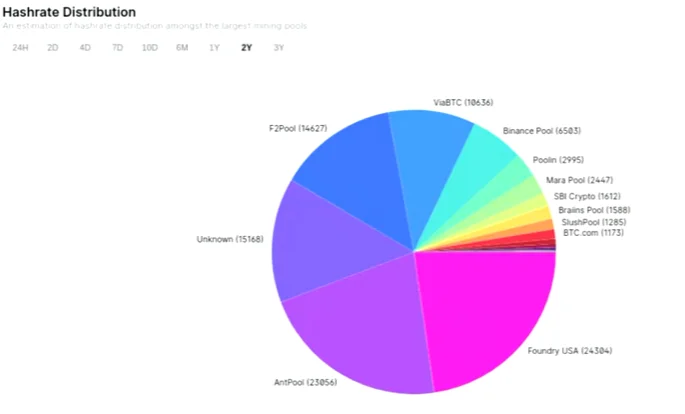
- Graph: Pie chart showing the hash rate distribution among major Bitcoin mining pools over a 2 year period, with Foundry USA and AntPool leading.
Environmental and technological impacts of mining
Mining has both environmental and technological impacts that influence the ecosystem and broader environmental policies. This section examines these effects and highlights potential solutions and innovations within the mining industry.
- Environmental Impacts: concerns surrounding Bitcoin mining are often tied to its energy consumption and associated carbon footprint, particularly in regions that rely heavily on coal powered electricity. However, growing efforts to integrate renewable energy sources, such as flared gas and hydroelectric power are positioning Bitcoin mining as a forward thinking energy consumer, offering innovative solutions to traditional energy use.

- Technological Impacts: technological advances in mining equipment have significantly increased efficiency over time. The shift from early CPU-based mining to the use of highly specialized ASICs has industrialized the process, making it both capital and energy intensive. Additionally, the development of supporting infrastructure, such as data centers and energy grids, has had a significant impact on the technological landscape surrounding mining operations.
Cryptocurrency mining continues to present both challenges and opportunities in the environmental and technological arenas. By adopting sustainable practices and leveraging technological innovations, the industry can reduce its environmental footprint while pushing the boundaries of mining efficiency and scalability.
Conclusion
The Bitcoin ecosystem is deeply intertwined with mining, energy, and economics: each one is playing a critical role in its overall growth and sustainability. Understanding these aspects is essential for those engaging with or contributing to this transformative technology.
Lightning And Open Source
The Lightning network: enhancing Bitcoin's scalability
One of the primary challenges of Bitcoin is its scalability. With a transaction capacity of only about seven transactions per second, compared to traditional payment systems like Visa or MasterCard, Bitcoin's utility as a medium of exchange has been limited. The Lightning Network, a layer two solution, addresses this limitation by enabling fast, low-cost payments between nodes. By creating off chain transaction channels, Lightning Network facilitates numerous transactions with minimal fees before final settlement on the Bitcoin blockchain. This solution not only enhances transaction speed but also significantly reduces costs, making microtransactions feasible.
Entrepreneurial opportunities
The interplay between AI and Lightning Network presents new entrepreneurial opportunities. With AI's capabilities in data analysis and automation, innovative services can be developed to optimize Lightning Network efficiency and user experience. These emergent business models can revolutionize the way transactions and related services are executed, offering unique value propositions in the financial technology landscape.
The Open Source movement and its impact on technology
Historical context and evolution
The Open Source movement, deeply rooted in the principles of transparency and community collaboration, has significantly shaped modern technology. It began as a counter movement to proprietary software, championed by figures like Richard Stallman, who founded the Free Software Foundation (FSF) in the 1980s. The FSF advocated for software freedom, encapsulated in the concept of "free software," which emphasized the freedom to study, modify, and distribute code.

Impact of free and Open Source Software (FOSS)
The impact of free and Open Source software (FOSS) on technology is profound and multifaceted. Major projects like Linux, Apache, and Bitcoin itself exemplify the transformative power of Open Source development. These projects illustrate how open collaboration can lead to robust, secure, and innovative solutions. The Open Source model fosters an environment where developers can freely contribute, leading to a diverse range of perspectives and solutions.

Licensing and business models
Open Source software employs various licenses, such as the GPL, MIT, and newer models like BSL, which balance openness with commercial strategy. Business models in the Open Source realm are diverse, ranging from the OpenCore model to SaaS and marketplace platforms. Companies like Red Hat have demonstrated profitability through service based models, proving that Open Source can be both sustainable and lucrative.

Technological and market impact
Open Source software has become integral to the tech industry, prevailing in DevOps, IT operations, and data analytics. It promotes healthy market competition and transparency, enabling developers to build on existing solutions and to innovate freely. The Open Source ethos supports technological advancements by facilitating integration and interoperability through open APIs and collaborative development.

Bitcoin's scalability and the role of the Lightning Network
Scalability challenges and solutions
Bitcoin's scalability has been a persistent challenge due to its limited block size and transactional throughput. Two primary approaches have emerged: increasing the block size, as seen with Bitcoin Cash, or optimizing transactions through solutions like SegWit and the Lightning Network. The latter has been more widely adopted, focusing on layer two solutions to enhance scalability without altering the core Bitcoin protocol.
The Lightning Network's role
The Lightning Network stands out as a pivotal solution to address Bitcoin's scalability issues. By facilitating off chain transactions, it significantly boosts the network's capacity, enabling high speed, low cost payments that are settled on the main blockchain only when necessary. This feature not only alleviates network congestion, but also expands Bitcoin's usability for everyday transactions.
Challenges and future developments
While Lightning Network offers substantial improvements, it comes with its own challenges. Issues like the requirement for nodes to be online for receiving payments and the complexity of channel management need addressing. Future developments, such as integrating client side validation and exploring additional layers like RGB and Taproot Assets, all aim to further enhance Bitcoin's scalability, privacy, and functionality.
Conclusion
Bitcoin, as both a protocol and an asset, continues to evolve within the framework of Open Source collaboration and innovation. Lightning Network exemplifies how layered solutions can address inherent limitations, paving the way for Bitcoin's broader adoption and integration into global financial systems. As the Open Source movement continues to influence technological development, Bitcoin's role in shaping the future of digital transactions remains significant, offering a glimpse into a decentralized and transparent monetary future.
Bitcoin Business Context
Bitcoin Market Cycles
Introduction to Bitcoin's investment dynamics
This lecture is about Bitcoin's investment dynamics and it is led by Gael Sánchez, a seasoned expert with a unique career from engineering to finance. Gael's fascination with Bitcoin volatile market behavior has been bolstered by his hedge fund experience and his academic role at IE University, where he explores Bitcoin and blockchain intricacies. As the co-founder of AlphaBitcoin and the author of "Bitcoin Lo Cambia Todo," Gael provides an unparalleled perspective on Bitcoin as an investment asset.
Bitcoin's characteristics as an investment asset
Bitcoin is often viewed through technical or philosophical lenses, but its attributes as an investment asset warrant separate consideration. Its fixed supply of 21 million coins creates unique dynamics, distinguishing it from other assets like equities or real estate. As a store of value, Bitcoin's scarcity mirrors the one of precious metals, yet its digital nature allows for unprecedented accessibility and divisibility. The network effects generated by its decentralized architecture further enhance its appeal as an investment, allowing Bitcoin to serve as a hedge against fiat currency devaluation.
Integration into investment portfolios
Integrating Bitcoin into investment portfolios involves evaluating its risk return profile. Despite its volatility, Bitcoin offers diversification benefits due to its low correlation with traditional assets such as bonds and equities. Institutional interest, evidenced by SPOT ETF approvals and increasing allocations by pension funds, underscores its growing credibility. The key is balanced allocation, typically between 0.5% to 3%, which can enhance portfolio performance by optimizing the Sharpe ratio, ultimately contributing to a sophisticated investment strategy.
Bitcoin's market influences and price analysis
Exploring Bitcoin's market dynamics involves understanding the micro and macroeconomic factors that influence its price. Bitcoin's halving cycle, occurring every four years, significantly impacts its supply-demand equilibrium, often leading to price appreciation. This cyclical pattern aligns with historical returns, where post-halving periods witness notable gains, despite skepticism from traditional financial institutions.

Price analysis and predictive models
Price forecasting in Bitcoin markets necessitates sophisticated modeling techniques. While models like the stock-to-flow are popular, their predictive power is limited by market inefficiencies and collective behavior. The recursive nature of these models means that as they become widely adopted, they may alter market dynamics, challenging their accuracy. Thus, alternative models focusing on Bitcoin adoption metrics, such as user count and transaction volume, are crucial for nuanced analysis.

- Chart illustrating Bitcoin's price history compared to the stock-to-flow model.
External influences and institutional dynamics
Global liquidity, influenced by central bank policies, plays a pivotal role in Bitcoin's price trends. The interaction between liquidity conditions and halving cycles suggests that Bitcoin's market behavior is not solely dictated by its supply dynamics. Institutional scrutiny and legal frameworks, as highlighted by the IMF and ECB concerns, add another layer of complexity. These regulatory perspectives shape market sentiment and investor behavior, creating a dynamic investment landscape.
Bitcoin's role in global financial systems
Bitcoin's expanding role in global financial systems presents both opportunities and challenges. Its potential to serve as a global reserve asset, akin to gold, underscores its transformative impact on monetary policy. Despite its current market presence being relatively small compared to large asset managers, Bitcoin's potential for growth remains substantial.

Global adoption and legal considerations
As Bitcoin adoption increases, especially among younger generations and among institutions, its influence on financial systems grows. The legal and regulatory frameworks governing Bitcoin vary worldwide, with debates on issues like transaction censorship and security budget sustainability shaping its future trajectory. The dynamics between national policies and decentralized networks will determine Bitcoin's long term viability as a financial asset.
Security risks and future challenges
Bitcoin's security model presents future challenges, as it relies on transaction fees as block rewards diminish. Ensuring robust network security through sufficient transaction fees is crucial, particularly as the last halving approaches. Additionally, risks such as hash rate concentration and potential quantum computing threats require ongoing vigilance. Navigating these challenges will define Bitcoin's evolution within global financial systems.
Conclusion
In summary, understanding Bitcoin's investment dynamics, market influences, and role in global finance involves a multifaceted analysis of its unique characteristics, price drivers, and systemic implications. This lecture aims to equip you with a comprehensive understanding of Bitcoin's place in modern finance, empowering you with the knowledge to navigate its complexities.
Bitcoin Legal Frameworks
Introduction to Bitcoin legal frameworks
The legal regulation of Bitcoin is a dynamic and evolving area, as governments, regulators, and courts struggle with its unique properties. As a decentralized, pseudonymous digital currency, Bitcoin defies traditional categories of financial assets like currency, commodity, or security. This has led to a fragmented regulatory landscape, where Bitcoin is treated differently across jurisdictions and regulatory frameworks.
Global legal classification of Bitcoin
One of the central legal challenges surrounding Bitcoin is its classification. Different countries and regulatory bodies have provided varying definitions:
United States: in the U.S., different regulatory agencies apply diverse frameworks. The IRS classifies Bitcoin as property for tax purposes, meaning Bitcoin transactions are subject to capital gain taxes. The Commodity Futures Trading Commission (CFTC) treats Bitcoin as a commodity, allowing Bitcoin futures and options to be traded on regulated exchanges. Meanwhile, the Securities and Exchange Commission (SEC) has maintained that Bitcoin is not a security but it still has scrutinized Bitcoin related products and services.
European Union: the European Court of Justice (ECJ) ruled in 2015 that Bitcoin transactions are exempt from VAT because Bitcoin should be treated as a means of payment rather than a good or service. The EU has also addressed Bitcoin through anti money laundering (AML) directives, requiring Bitcoin exchanges and wallet providers to implement Know Your Customer (KYC) protocols.
El Salvador: el Salvador became the first country to adopt Bitcoin as legal tender in 2021. This groundbreaking move integrates Bitcoin into the country's monetary system, allowing it to be used for everyday transactions alongside the U.S. dollar. The decision has sparked global debates, especially regarding its potential impact on El Salvador's economy, financial stability, and sovereignty.

Legal precedents and court rulings
Several court rulings worldwide have established legal precedents in the classification and treatment of Bitcoin:
Property Status: various courts, for example in New Zealand and Spain, have classified Bitcoin as a form of property. This recognition of Bitcoin as an asset has implications for ownership rights, seizure during criminal investigations, and inheritance law.
Cryptocurrency Forks: legal cases have also addressed the issues surrounding Bitcoin forks, such as the split between Bitcoin and Bitcoin Cash. Courts have ruled on whether holders of Bitcoin automatically own the newly forked assets, treating these as part of the original property.
Fraud and Money Laundering: cases such as Silk Road and other fraud related trials have linked Bitcoin with criminal activities. Courts have tackled issues of whether Bitcoin qualifies as "money" for purposes of prosecution under money laundering laws, often ruling based on local statutes and case specific interpretations.

Regulatory approaches
Different countries have implemented diverse approaches to regulating Bitcoin, often shaped by broader cryptocurrency policies:
Anti-Money Laundering (AML) Regulations: the Fifth Anti Money Laundering Directive (AMLD5) in the European Union expanded the scope of AML regulations to include cryptocurrency exchanges and wallet providers. These entities are now obligated to perform KYC checks and report suspicious transactions to authorities. The aim is to prevent Bitcoin's use in illicit activities such as money laundering and terrorist financing.
Crypto Asset Service Providers (CASPs): the Markets in Crypto-Assets (MiCA) regulation in the EU, expected to take full effect by 2024, introduces rules for Crypto Asset Service Providers. These include obligations for transparency, consumer protection, and governance, especially concerning stablecoins and initial coin offerings (ICOs).
Taxation: many jurisdictions, including the U.S. and the EU, tax Bitcoin as a form of property, subjecting transactions to capital gains tax. In contrast, countries like Germany offer more favorable treatment, exempting Bitcoin held for over a year from capital gains tax.

Challenges in legal frameworks
One of the most significant legal challenges is the pseudonymous nature of Bitcoin, which complicates the enforcement of regulations like taxation and AML laws. Without a central authority or intermediaries, traditional legal mechanisms that rely on intermediaries for enforcement face serious challenges.
Additionally, cross border transactions create jurisdictional issues, as Bitcoin moves freely across borders without the need for banks or financial intermediaries. Countries have different stances on how to regulate cross border Bitcoin transactions, leading to difficulties in harmonizing regulations.
Future outlook
As Bitcoin adoption increases, governments and regulators will likely continue refining their legal approaches to better integrate Bitcoin into existing frameworks. Regulatory bodies such as the Financial Action Task Force (FATF) have advocated for stronger international cooperation on cryptocurrency regulation, particularly around AML and combating the financing of terrorism (CFT).
The emergence of comprehensive regulations, such as the MiCA framework in Europe, demonstrates that regulators are beginning to treat Bitcoin and cryptocurrencies as integral parts of the financial system. However, striking the right balance between innovation, consumer protection, and preventing misuse remains a complex challenge.
Conclusion
The legal status of Bitcoin remains fluid, with evolving interpretations and regulatory frameworks. Courts and regulators worldwide continue to assess Bitcoin's role within legal systems, balancing its potential for innovation with concerns over financial stability, consumer protection, and criminal misuse. As Bitcoin continues to gain acceptance, clearer and more cohesive legal frameworks are expected to emerge, shaping the future of cryptocurrency in the global financial landscape.
Bitcoin Business Ethics
Bitcoin Entrepreneurship
Introduction
The world of Bitcoin entrepreneurship is characterized by unique challenges and opportunities. As the ecosystem continues to mature, entrepreneurs need to understand both the subtleties of Bitcoin and the broader principles of business development. Successful ventures demand a strong commitment, a comprehensive market understanding, and the agility to adapt to rapid changes. The focus should be on creating a sustainable and scalable business that aligns with Bitcoin’s ethos while addressing market needs. This journey is not only about building a product or service, but about joining a movement that aims to reshape the financial landscape.
Understanding the entrepreneurial landscape
Entrepreneurship requires a delicate balance of creativity, perseverance, strategic planning, and a bit of luck. In the Bitcoin space, these traits are even more critical due to the unique challenges of the nascent market. Entrepreneurs must be deeply self aware, understanding their strengths, weaknesses, and the skills they need to develop or delegate. Effective resource and time management are crucial, as is the need to stay informed about the fast evolving Bitcoin environment.
Bitcoin entrepreneurship demands resilience, a willingness to face setbacks, and the courage to operate in a relatively uncharted territory. The market's volatility and the revolutionary nature of Bitcoin mean that startups are often navigating unexplored waters, requiring both a strong foundation and the flexibility to pivot when necessary.
Leadership vs. management
A successful Bitcoin startup depends on finding the right balance between leadership and management. Leaders provide vision, inspire teams, and drive the company towards ambitious goals. Managers, on the other hand, ensure that day to day operations run smoothly, tasks are completed efficiently, and the team remains productive. Bitcoin startups often require a blend of both qualities, as leadership is necessary to keep pushing boundaries, while effective management is critical to maintain order amid the chaos of a fast paced environment.
Understanding one's role within this spectrum can define the company's culture and directly influence its trajectory. An entrepreneur in the Bitcoin space must be able to inspire belief in their mission while also making pragmatic decisions to keep the venture moving forward.

Personal capability and skill acquisition
Entrepreneurs must avoid the extremes of overconfidence and self doubt. While it’s crucial to acquire a wide range of skills — from technical, to financial, to marketing — it's equally important to delegate tasks that are outside one's core strengths. This balance prevents burnout and allows founders to focus on strategic decisions. In the Bitcoin sector, entrepreneurs must also learn how to navigate specialized areas like cryptographic security, decentralized networks, and the implications of Open Source software.
The Bitcoin space values those who can adapt and learn quickly, especially given the rapid evolution of technology and market demands. Entrepreneurs must be prepared to master the fundamentals of Bitcoin technology, as well as more general skills related to business, marketing, and communication.
Commitment and market understanding
A deep commitment is essential for success. Entrepreneurs must fully immerse themselves in the Bitcoin ecosystem, understanding the nuances of the market, which blends Open Source philosophy, decentralized ideals, and disruptive technology. The Bitcoin market is often driven by a mix of enthusiasts, tech innovators, and libertarians, making it a unique ecosystem to navigate. For those unsure about starting from scratch, joining a well established team can provide valuable experience and insight into the market's complexities.
Committing to the Bitcoin space also means recognizing that the market's demands can be unpredictable and may require shifts in strategy. Entrepreneurs must remain adaptable while staying true to Bitcoin’s core values of decentralization and transparency.
Tools, strategies, and market dynamics for Bitcoin startups
Navigating the Bitcoin market is like stepping into a still maturing ecosystem with bold claims of disrupting traditional financial systems. Entrepreneurs must contend with various challenges, including regulatory uncertainties, technological hurdles, and a niche audience that is often skeptical of new products. Yet, this ecosystem also provides immense opportunities for those who can align with Bitcoin's ethos and bring innovative solutions to market.
Overconfidence and market challenges
Many new entrepreneurs fall victim to the Dunning-Kruger effect, overestimating their knowledge of the Bitcoin market. The key is to understand the typical journey of Bitcoiners—those new to the space often begin with skepticism, move through stages of discovery, and eventually become dedicated users. Recognizing where the target audience is on this journey can inform effective communication and product development strategies.

- Visual representation of two key concepts: the Dunning–Kruger Effect, showing confidence vs. competence, and the BTC energy curve, illustrating enthusiasm over time.
Axioms for Bitcoin entrepreneurs
A critical aspect of engaging the Bitcoin market is understanding the diversity within the audience. From tech savvy developers to those interested in the financial benefits, entrepreneurs must tailor their approach to different segments. Knowing how to speak to newcomers versus seasoned Bitcoiners can define a startup's success. The Bitcoin market requires a nuanced understanding of its participants and a strategic engagement plan to navigate its unique dynamics.

- Timeline illustrating key milestones in a Bitcoin journey, from first hearing about Bitcoin to starting a Bitcoin related venture
Market engagement and dynamics
Identifying and understanding where your target market is placed on the Bitcoin adoption curve is essential for positioning your product. Decide whether the goal is to cater to early adopters and Bitcoin enthusiasts or to introduce Bitcoin related solutions to mainstream audiences. This decision will impact product design, communication strategy, and marketing channels. Additionally, entrepreneurs must assess the scalability of their solution, the viability for mass production, and potential partnerships within the ecosystem.
Strategic considerations
Strategically aligning your product with existing infrastructure, such as Lightning Network or Bitcoin Core, can reduce time to market and increase chances of success. Evaluating the uniqueness of the idea and its potential reach — whether it targets Bitcoiners or a broader, non Bitcoin audience — can guide development decisions. A successful strategy often involves combining personal passion with market research to identify gaps and opportunities.
Open source and monetization in the Bitcoin ecosystem
The Bitcoin ecosystem is heavily influenced by Open Source principles, making monetization a unique challenge. While Open Source aligns with Bitcoin’s decentralized ethos, building a profitable business requires careful planning and innovation. Successful ventures often find a balance between contributing to Open Source development and implementing sustainable business models.
Bitcoin monetization and open source necessity
In the Bitcoin space, monetization strategies differ from traditional businesses. Bitcoin’s value appreciation plays a significant role in financial planning for startups, particularly Open Source projects. Open Source software reduces costs, enhances security, and fosters community engagement, making it a preferred approach for many Bitcoin startups. The challenge lies in finding a way to monetize without compromising on these core values.
Market dynamics and open source ethos
Bitcoin’s culture leans towards Open Source ideals, favoring transparency and community contribution. This ethos influences business models, often leading to lower costs and higher technology adoption rates. While closed source development can offer control, it may face resistance within the Bitcoin community. Open Source projects can build trust and loyalty, but the challenge is to create a sustainable revenue stream that supports ongoing development.
Financial incentive models
Bitcoin offers unique financial incentives for Open Source projects. Micropayments, streaming payments, and tipping provide alternative revenue streams, though mass adoption remains a work in progress. Examples like mempool.space show that successful Open Source projects can evolve without a traditional business plan, focusing instead on community engagement, contribution, and gradual development of sustainable financial models.
Strategic planning for open source projects
Strategic planning is essential, whether the goal is rapid growth for a future acquisition or steady progress for long term sustainability. Building networks, telling compelling stories, and contributing to the community are crucial for recognition and support. Open Source models like WordPress and Android have demonstrated that it's possible to achieve widespread success while maintaining open development.
Navigating regulatory and technological challenges
Bitcoin startups face complex regulatory environments that vary across regions. Entrepreneurs must be vigilant about local and global regulations, ensuring compliance while preserving Bitcoin's decentralized nature. At the same time, understanding the technical layers within Bitcoin—such as Bitcoin Core, sidechains, and the Lightning Network—enables startups to make informed decisions about where to innovate. The use of existing solutions like LNBits or ZBD can accelerate development, allowing entrepreneurs to focus on proving their concept before investing in proprietary technology.
Networking and community building
The Bitcoin ecosystem thrives on personal connections and community involvement. Participating in conferences, hackathons, and meetups is essential for building relationships with potential users, investors, and collaborators. Creating a loyal community around a product or brand not only aids in gaining early traction but also helps in refining the product based on real user feedback. In Bitcoin, where the audience values authenticity and transparency, building a community can be as crucial as building the product itself.

Future outlook for Bitcoin startups
The Bitcoin ecosystem remains in its early stages, with vast potential for growth and innovation. As the industry matures, it will bring increased competition, regulatory scrutiny, and a push for mainstream adoption. Entrepreneurs who remain adaptable, understand market dynamics, and stay true to the core values of Bitcoin will be well positioned to succeed. Focusing on scalability, community involvement, and technological innovation will be key to navigating the ever evolving Bitcoin landscape.
Conclusion
Bitcoin entrepreneurship is about more than creating a profitable business; it's about participating in a transformative movement. Success in this space demands not only technical and business acumen but also a commitment to Bitcoin’s underlying values of decentralization, transparency, and freedom. Entrepreneurs who can balance these elements while delivering practical solutions stand to make a significant impact on the future of money and technology.
Cybersecurity And FLOSS Practices
9599c4e8-91af-405d-9798-bb46357fc548 d097844f-d3a8-4b8b-9fe9-7de4f70ad6b7
Introduction
Meet Marco Giorgetti, a distinguished expert in the software industry and a vocal advocate for open source solutions. His career and insights have significantly contributed to our understanding of open source software and its transformative impact on technology and business. The concept of open source software has redefined how we communicate and collaborate in the digital space, providing a foundation for innovation and community driven development.
Understanding FLOSS and its historical context
Free Libre Open Source Software (FLOSS) is a paradigm that combines the principles of software freedom with the collaborative benefits of open source development. FLOSS emerged from a historical context where the computing industry, starting in the 1960s, faced a growing demand for adaptable and competitive software. This demand led to the development of software as a market commodity, moving away from its original open nature.
The origins and development of FLOSS
In the late 1960s, the software industry began to recognize the business potential of software products, leading to the introduction of software copyrights in 1974. This shift in perception transformed software into a valuable asset, with companies like AT&T initially offering Unix systems for free before transitioning to a commercial model. This commercialization prompted resistance from the hacker community, resulting in pivotal moments like Richard Stallman's launch of the GNU Project in 1983 and the publication of the GNU Manifesto in 1985. These efforts laid the groundwork for the Free Software Movement and the subsequent formation of the Free Software Foundation.

Key principles and expansion of FLOSS
The Free Software Definition emphasizes four key freedoms that ensure software remains free and adaptable. The introduction of the GNU General Public License (GPL) in 1989 further enforced these principles, requiring that derivative works remain open and accessible. The release of the Linux kernel by Linus Torvalds in 1991 marked a significant acceleration in free software development, leading to the proliferation of FLOSS projects throughout the 1990s. This expansion was fueled by the increasing accessibility of the internet, enabling global collaboration and innovation.

The rise of open source and its market impact
By the late 1990s, the term "open source" gained prominence as a more commercially palatable alternative to "free software." This rebranding, coupled with significant milestones like Netscape's release of the Mozilla source code, led to the establishment of the Open Source Initiative. This shift emphasized the practical benefits of open source software, encouraging diverse licensing and widespread adoption. The evolution of FLOSS has been critical in shaping the software industry, influencing both the development methodologies and market strategies of companies worldwide.

FLOSS in the modern context
Today, FLOSS continues to play a vital role in technological advancement, with many widely used software systems, including Android and Mac OS kernels, originating from open source projects. The diversity of software licenses further supports the ongoing development of FLOSS, fostering innovation and competition. FLOSS exemplifies the power of global collaboration, enabling projects to thrive without centralized control.
Security and governance in the open source ecosystem
Communication and governance challenges in open source
Effective communication is a cornerstone of successful open source projects, but it also presents challenges. The decentralized nature of open source development can lead to fragmentation and miscommunication, as seen in early examples like Linus Torvalds' interactions with contributors. Despite these challenges, the open source model remains resilient, promoting transparency, auditability, and decentralization. These aspects are particularly relevant to communities like Bitcoiners, who prioritize security and governance.
FLOSS security enhancements
FLOSS enhances security by allowing continuous code improvement through community contributions. This collaborative approach not only prevents monopolistic control but also fosters an environment where innovation thrives. The transparent nature of open source projects like Bitcoin epitomizes the proof-of-work concept, where security and quality are constantly scrutinized and improved by the community.
Governance mechanisms in FLOSS
Decentralized governance is a hallmark of successful open source projects. This model ensures that no single entity maintains control, which is crucial for projects like Bitcoin that rely on strong governance to remain secure and resilient. The community driven approach to governance in FLOSS projects allows for real world problem solving, ensuring that solutions are practical and relevant.
Business models and economic impact of open source software
Economic influence of open source
Open source software has fundamentally disrupted traditional business models by introducing innovative economic strategies. The principles of trust, transparency, and decentralization associated with open source have maximized adoption and allowed users to actively participate in the improvement of software. This collaborative spirit enables companies to leverage the contributions of competitors, benefiting the entire ecosystem.
FLOSS and business model evolution
Over the past 40 years, FLOSS has significantly influenced business model development, inspiring a wide range of strategies beyond direct sales. Models like Software as a Service (SaaS) and the rise of companies catering to niche, ideologically driven markets demonstrate the adaptability and impact of the open source approach. Bitcoin, among other technologies, continues to disrupt markets by echoing open source business strategies.
The quest for sustainable business models
As open source continues to evolve, companies face the challenge of finding sustainable business models that align with the open source ethos. The ongoing quest for innovative approaches is marked by intense competition and the need to adapt to changing market dynamics. FLOSS has enabled the development of massive global projects, setting the stage for future advancements in technology and business.
Conclusion
The lecture on FLOSS, security, governance, and business models highlights the transformative power of open source software in shaping the technological landscape. It underscores the importance of understanding its history, principles, and ongoing impact on both security and economic strategies. As FLOSS continues to evolve, it will remain a pivotal force in driving innovation and collaboration in the digital age.
School Conclusion
School Conclusion
Looking Ahead: Plan ₿ Biz School 2025
As we wrap up the 2024 edition of Plan ₿ Biz School, we want to thank all participants for their dedication and commitment to learning about Bitcoin’s economic, financial, and business implications. This program has provided a comprehensive exploration of the fundamental principles of Bitcoin and its real-world applications in business, entrepreneurship, and strategy.
But this is just the beginning! We are thrilled to announce that Plan ₿ Biz School 2025 is already in the works, and it promises to be even bigger and better.
What to Expect in 2025
- Expanded Curriculum: More content covering Bitcoin-based business models, investment strategies, and real-world applications in emerging markets.
- New Expert Lecturers: We will bring in additional industry leaders, entrepreneurs, and professionals to share their insights and experiences.
- Enhanced Business & Employability Focus: Practical knowledge for those looking to start Bitcoin businesses, integrate Bitcoin into existing industries, or pursue careers in the Bitcoin economy.
- Updated Case Studies & Real-World Applications: Fresh examples of successful Bitcoin companies, evolving regulatory frameworks, and innovative use cases for Bitcoin in global commerce.
Stay Connected for Updates
Plan ₿ Biz School is more than just a course—it’s a growing educational initiative aimed at empowering the next generation of Bitcoin professionals. We invite you to stay connected with us and be the first to receive updates on Plan ₿ Biz School 2025:
- Follow us on social media for the latest news, announcements, and insights.
- Get ready for another year of cutting-edge Bitcoin education!
Stay tuned—more details coming soon!
https://planb.network/en/courses/c762773a-9017-4129-bc0e-06adf86050ef
Final Section
Evaluate this course
true
Conclusion
true